


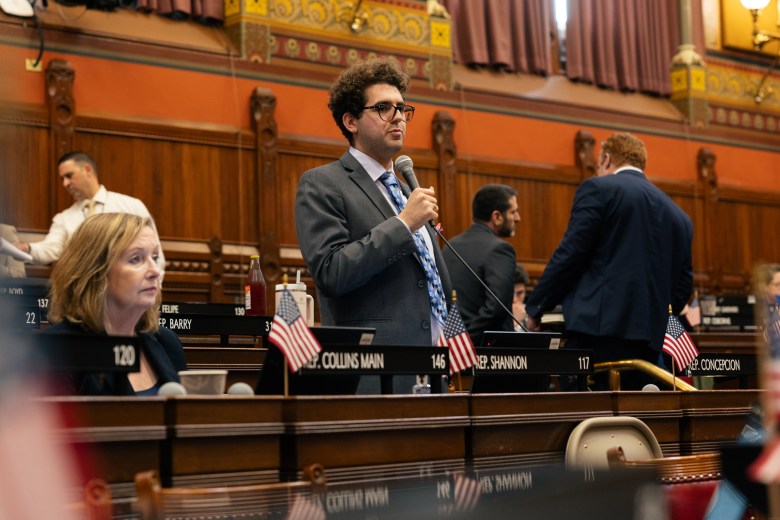
In rising last week to make his first speech to the Connecticut House of Representatives, Rep. MJ Shannon, D-Milford, stepped onto one of America’s culture-war battlefields: a debate over transgender rights that President Donald J. Trump is intent on erasing.
Shannon, a 24-year-old gay man elected last fall, said he was making a gesture to aging gay-rights pioneers by volunteering to take on the task of explaining, defending and seeking passage of House Bill 6913, “An Act Concerning LGBTQ+ Discrimination in Long-Term Care Facilities.”
“These folks, they fought the fight,” Shannon said.
Recommended by the state’s long-term care ombudsman, the bill would affirm and require public notice in nursing homes that state and federal law prohibits discrimination on any number of counts, among them sexual orientation, HIV status and “gender identity and expression.”
Essentially a restatement of existing laws, the bill also included one provision that offered a granular example of how they should be enforced: No facilities could “refuse to assign a room to a transgender resident other than in accordance with the transgender resident’s gender identity.”
To Rep. Joe Canino, R-Torrington, who is 27 and was elected in November in the same legislative class as Shannon, that sounded like someone’s grandma might get a trans roommate without their consent.
“This is terrifying. This is sick. It is absurd,” Canino said during the debate. “And it’s not the type of policy we should be making in this body.”

The bill came to a vote only after the adoption of a bipartisan amendment negotiated by Rep. Steve Stafstrom, D-Bridgeport, the co-chair of the Judiciary Committee. It struck the provision stating a transgender patient’s right not to be refused a room or not to be forcibly transferred.
“Well, that’s a right every resident should have, whether you’re trans or not trans, right?” Stafstrom said in an interview Monday. Making the bill less specific broadened its reach, not limited it, he said.
Also stricken was language specifying that a trans person could dress as those chose.
The amended version passed on a vote of 124 to 19, with no Democrats and less than half the GOP minority opposed.
In calling the bill for a debate, House Speaker Matt Ritter, D-Hartford, signaled a willingness to engage in culture-war politics and a defiance of Trump’s executive order that repudiated “gender ideology” and “gender identity” and ended any federal recognition or accommodation of transgender persons.
“We don’t run from contact on these issues,” Ritter said.
Ritter noted the passage the previous week of a reproductive health bill that allows minors access to contraception without parental consent or notification.
House Minority Leader Vincent J. Candelora, R-North Branford, said the two bills, plus a gun control measure that exposes gun manufacturers and dealer to liability claims, are evidence of a Democratic majority interested in highlighting national politics.
“I think the Democrats are overplaying their hand this year,” said Candelora, who voted for the amended nursing home bill. “If you see the priorities coming out, it is about guns, reproductive health and LGBT issues, and that’s the wedge issues that they win on.”
The LGBTQ+ nursing home bill originated from the legislature’s Aging Committee, not typically an incubator of controversy.
Mairead Painter, the long-term care ombudsman, told the committee her office has cases “related to discrimination, harassment, and isolation faced by LGBTQ+ residents within skilled nursing facilities.”
Complaints included the denial of admissions and the “intentional misgendering” of transgender patients, Painter said.
Amy Porter, the commissioner of aging and disability services, also had recommended passage.
“While the LGBTQ+ community has seen significant gains in civil rights over the past several decades, negative disparities unfortunately still exist at every stage of their lives. All people have the right to age with dignity in a safe living environment free from discrimination,” Porter testified.
A legal prohibition against gay sex was repealed in Connecticut in 1971. Twenty years later, the state outlawed discrimination on the basis of sexual orientation in housing and employment. In 2011, the state banned discrimination in public accommodations based on “gender identity or expression.”
That is precisely the phrase that Trump is working to erase. On his first day in office, the president signed an executive order stating, “It is the policy of the United States to recognize two sexes, male and female. These sexes are not changeable and are grounded in fundamental and incontrovertible reality.”
Among other things, Trump ordered that that “gender” be struck from federal documents in favor of “sex” and reversed the Biden administration’s policy of allowing transgender individuals to mark an X for gender on their passports, rather than male or female.
“Efforts to eradicate the biological reality of sex fundamentally attack women by depriving them of their dignity, safety, and well-being,” Trump wrote. “The erasure of sex in language and policy has a corrosive impact not just on women but on the validity of the entire American system.”
Last week, in the debate of HB 6317, similar sentiments were expressed in challenges to Shannon by Canino and a half dozen other Republicans.
“Can you explain to me what gender identity is?” asked Rep. Gale Mastrofrancesco, R-Wolcott.
“Gender identity is how somebody would identify themselves and their preferred identity that they choose,” Shannon replied.
“So it’s how they identify themselves. But I’m confused as to what that means. Identify as what?” she asked.
Shannon referred her to Connecticut law, which states gender identity can be defined as other than the sex assigned at birth based on medical and other evidence and the assertion that “gender related identity is a sincerely held part of the person’s core identity” and “not being asserted for an improper purpose.”
Mastrofrancesco asked Shannon for his definition of gender.
“When you are born, you either have a penis, that would consider you to be a boy, and if you are born with a vagina, you are a girl,” she said. “Are you telling me that there’s something different other than a vagina or a penis, whether you are a boy or girl?”
“That is simplifying it a lot, but yes, that is how they determine [gender] at birth,” Shannon said.
What about gender expression, she asked.
“When we talk about expression, are we talking about a facial expression?” she said. “Or is it maybe the way they act, maybe the way they dress?”
For a second time, Shannon referred her to the gender identity and expression law that has been on the books in Connecticut for 14 years.
Canino asked Shannon, “Is woman a gender expression?”
“Yes, woman can be a gender expression,” Shannon replied.
“What is a woman?” Canino asked.
Shannon hedged, saying he lacked the background to provide a precise definition.
“I do not believe that you need any type of degree, any real type of education, to understand what a man and a woman is,” Canino said. “I think every single rational person in this room can tell you exactly what a man and a woman is, and that really just underlies the absurdity of what we are doing here today.”
In an interview Monday, Canino said he views being transgender as a “delusion,” not a status.
“The issue more broadly is it’s delusional at best to say women can become men and men can become women,” Canino said. “I would argue that the vast majority of residents in Connecticut would have a problem with that.”
If he had his preference, the 2011 law prohibiting discrimination on the basis of gender identity and expression would be repealed. It passed then on a party-line vote, with every Republican opposed.
Shannon and Canino are both former legislative staffers and members of Generation Z who captured seats last fall that had long been held by the opposite party. Each said they were comfortable bringing a national debate on transgender rights into the Connecticut House.
Neither was born when the state’s original gay rights law was passed in 1991, and both were children when same-sex civil unions were legalized here in 2005.
Shannon said the defense of gay rights now falls on Gen Z.
“There are, of course, people older that do care about it, but right now, the driving force is younger folks,” he said.
