



On November 8, 2022, Marvin Minter was pinned against a wall by a malfunctioning elevator door at the New Haven Correctional Center. The aging elevator, unserviced since 2020 despite numerous complaints, abruptly slammed shut and crushed Marvin’s arm while he was doing his prison job. A correctional officer rushed him to get medical care, but the damage was done —Marvin’s arm is now severely impaired.
Connecticut’s sovereign immunity laws generally bar individuals from directly suing the state for negligence, unless the state grants permission. That permission typically comes from the state’s Claims Commissioner, an official who acts as a gatekeeper for lawsuits against the state. Because of this, Marvin, who was seriously injured by a faulty elevator while incarcerated, had to file a claim with the Claims Commissioner instead of going directly to court. In other words, he couldn’t simply sue the state agency responsible; he first had to ask the Claims Commissioner for approval to seek compensation.
Seeking some measure of justice, Marvin filed a claim with the Connecticut Claims Commissioner, aiming to hold the state accountable for its negligent maintenance of its elevator.
The Claims Commissioner, taking the position of Attorney General William Tong, refused to even consider the merits of his claim.
Why?
Not because of any factual dispute or lack of evidence, but because of a cruel technicality. Under a 2016 state law, incarcerated individuals cannot file a claim with the Claims Commissioner until they have “exhausted administrative remedies” through the Department of Correction (DOC) internal prison grievance system. Marvin had not completed the prison’s internal grievance process before filing his claim, so the Claims Commissioner tossed it out without ever examining the evidence.
A 2016 state law demands incarcerated people like Marvin try all administrative remedies (such as prison grievance procedures) before turning to the Claims Commissioner. The catch, however, is that the prison grievance system cannot award monetary damages for injuries. For someone seeking financial compensation for serious harm, filing a grievance is a dead end. Forcing Marvin to exhaust such a process is a classic Catch-22: he had to complete an entire grievance process—with deadlines, filings, and appeals—that could never give him the relief he needed, or else be denied the chance to have his claim heard at all.
This is not only factually absurd but also legally dubious. In fact, it directly contradicts a recent Superior Court ruling. In Mago v. Department of Correction (2024), Superior Court Judge Daniel Klau made it clear that while inmates do need to file internal grievances generally, they should not be required to do so when that process cannot provide the relief being sought – in that case, monetary compensation for injuries.
This was common sense. Requiring exhaustion under such circumstances serves no meaningful purpose. It doesn’t advance any of the traditional goals of an exhaustion rule (like giving an agency a chance to fix a problem or reducing court case loads) when the agency has no power to grant the remedy in question. Instead, it simply slams the courthouse door on people with legitimate claims. Marvin’s case is just like Mago —the prison grievance system offered no chance of helping solve the problem, so why is the inmate required to pursue it?
Marvin’s case is not an isolated fluke — it exposes a systemic barrier that many incarcerated people face, especially people of color. Incarcerated individuals already struggle to navigate complex legal procedures. Prisons are not exactly conducive to filing paperwork: access to law libraries or legal counsel is severely limited, and strict deadlines and arcane rules can easily trip up even a trained attorney, let alone someone with limited education and likely no legal education. Language barriers frequently mean that prisoners with limited English proficiency cannot even understand the grievance instructions. Research shows that requirements like Connecticut’s create uniquely difficult hurdles for incarcerated people and these hurdles hit inmates of color the hardest.
Connecticut, for all its progressive reputation, has one of the worst records of racial disparity in incarceration in the nation.
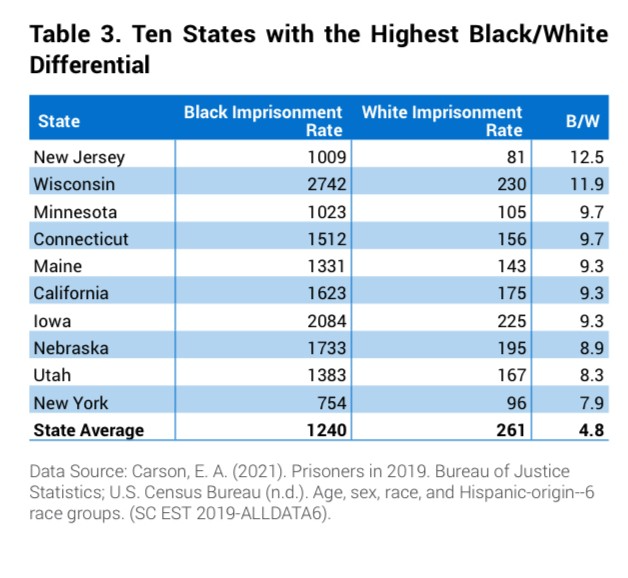
Black residents in Connecticut are incarcerated at a significantly higher rate — nearly ten times higher — than white residents. With a prison population so disproportionately Black and brown, any law that makes it harder for inmates to seek redress will inherently have a disproportionate impact on people of color.
The 2016 exhaustion requirement is a prime example. It slams the courthouse door on incarcerated individuals, a group in which people of color are overrepresented due to systemic inequities. As the Congressional Black Caucus Foundation noted in a recent report, Black incarcerated victims are “less likely to bring a claim or recover damages because of the insurmountable barriers” imposed by stringent grievance requirements. This makes logical sense: when the process is made onerous to the point of futility, many people will simply give up, and injustices will go unaddressed. Connecticut should be working to eliminate such barriers, not entrench them in state law.
The legislature’s immediate step should be to address Marvin’s individual case. Under Connecticut law, the General Assembly can review the Claims Commissioner’s dismissal and decide to authorize Minter to pursue his claim in court or even order appropriate compensation for him directly. Lawmakers should do exactly that. Correcting this injustice will not only help Minter; it will also send a message that Connecticut stands on the side of justice rather than pointless bureaucracy. It would reaffirm our state’s commitment to the principle Judge Klau underscored in Mago v. DOC.
Beyond the resolution of one man’s claim, Connecticut must confront the broader policy failure here. The 2016 administrative exhaustion requirement (now codified in Conn. Gen. Stat. § 4-165b) should be repealed or fundamentally amended. At minimum, the law must be rewritten to waive the exhaustion requirement when the internal prison process cannot provide the relief an inmate is seeking – for example, when only monetary damages will address the harm. There is simply no legitimate purpose served by forcing people through a grievance process that is guaranteed not to help them. All it does is create delay, deny justice, and generate unnecessary litigation expenses that ultimately waste taxpayer money.
Repealing this law would realign Connecticut with basic principles of justice and with our own stated values. It would not mean opening any floodgates of frivolous lawsuits – claims filed by inmates would still have to meet the same standards of merit as any other claim. It would only ensure that meritorious claims are not thrown out on a technicality before they’re even heard. It would ensure that when the state harms someone through negligence, our system provides a path to make that person whole, regardless of whether the person is incarcerated or not.
No one should be denied access to justice because of a procedural rule that serves no constructive purpose. It is time for the General Assembly to fix this mistake from 2016. Repeal the futile grievance -exhaustion requirement, and let people like Marvin Minter have their rightful day in court.
In the end, this is about more than one elevator accident or one inmate’s injury. It is about affirming that justice is for everyone. When our laws inadvertently shut out the most vulnerable from the justice they deserve, those laws must change. Connecticut’s leaders have the power to remove this barrier now. Remove the hurdle. Restore common sense and humanity to the system. In doing so, Connecticut will take a modest but meaningful step toward a more just and equitable future for all its people.
Alex Taubes is an attorney in New Haven.