


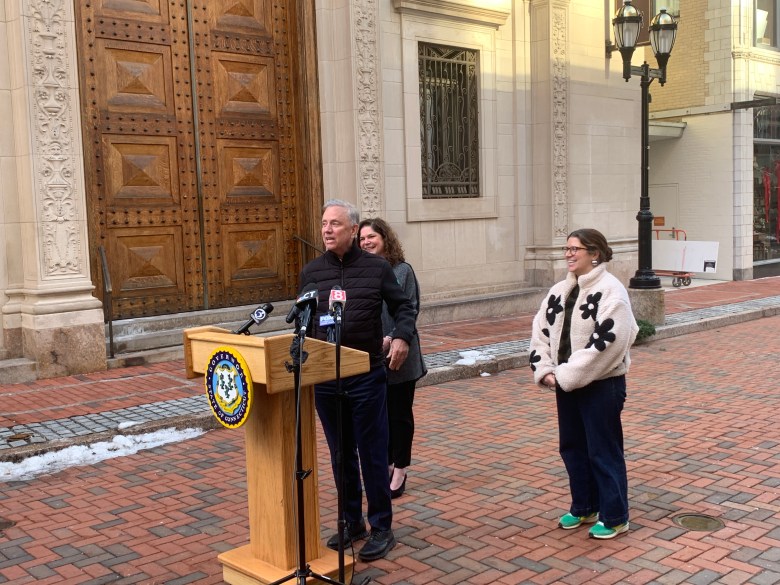
For more than a decade, business owner Rory Gale has run Hartford Prints!, using her downtown Hartford storefront to sell cards, state-themed apparel and home goods. The business, which recently expanded its longtime location on Pratt Street, has become a popular destination in Hartford, serving as a shining example of the city’s efforts to revitalize downtown.
Gale said the business’s success is the result of factors ranging from strong community support to local grant funding. At a press conference Thursday morning, Gale said state policy has helped her, too — particularly Connecticut’s indexed minimum wage, which rose to $16.94 on Jan. 1.
“I have hired so many employees over the years and feel so proud to be in a state that has a minimum wage like Connecticut,” she said.
Since the state legislature passed a schedule of increases in 2019, Connecticut’s minimum wage has increased annually. In recent years, those increases have been tied to the U.S. Bureau of Labor Statistics’ federal Employment Cost Index, which measures the changes in the cost of labor for businesses.
The state’s most recent increase, announced in the fall, has pushed Connecticut to one of highest statewide minimum wages in the country, surpassed only by Washington, which has a wage of $17.13 an hour.
Connecticut state officials said that at a time of increased economic strain across the state and the country, a higher minimum wage helps workers get a foothold they desperately need.
“You hear about affordability, and a lot of that is bringing down costs, and that’s also about paying people a wage that helps them survive,” Gov. Ned Lamont said Thursday. “That’s what we’re trying to do with this wage right now.”
‘This is not just something for teenagers‘
The minimum wage increase was an early priority during Lamont first term. He’s now campaigning for a third term and seeking the support of labor organizations and workers. The governor said his work to raise the minimum wage has helped many — particularly workers of color who are overrepresented in the state’s minimum wage workforce.
According to state officials, more than 60% of minimum wage workers in Connecticut are women or people of color, with women of color representing a large portion of this group.
“This is not just something for teenagers. This is not just an after school job,” said Labor Commissioner Danté Bartolomeo. “This is how they support themselves and how they support their families, and when they’re not making a fair wage, they have to work more and have less quality of life, which leads to all kinds of other complications, stress and health and all of those kinds of things”
Still, the minimum wage increase has long been a source of political division, with state Democrats largely arguing that the increase is a necessary economic justice issue intended to address disparities and help narrow income gaps. Some Republicans, meanwhile, have said the wage increases stifle economic growth, harming small business owners who are unable to manage constantly rising wages.
The minimum wage increase has also been criticized by groups like the Connecticut Business and Industry Association, which said the annual rise negatively affects businesses already dealing with economic uncertainty and rising expenses, potentially encouraging business owners to move to states with friendlier policies.

Lamont however, challenged those arguments. “Going back to 2019, a lot of folks said, ‘If you raise the minimum wage, it’s going to be a parade of horribles,” he said. “‘You’re going to shut down the economy. Unemployment is going to surge. The economy is going to drag to a halt.’”
Pointing to the state’s recent GDP growth, which rose 4.6% in the second quarter of 2025 and an unemployment rate that remains below the national average, Lamont said those fears have not come to pass.
“It’s just the opposite,” he said. “Paying people a decent wage is a show of respect for them.”
There’s still room for new legislation on the issue
Still, even with the state’s improved minimum wage, there is some unfinished business on the subject. The state’s tipped minimum wage rates, which include tipped workers like restaurant and hotel workers and a separate rate for bartenders, have remained at $6.38 and $8.23 respectively, for several years.
While there have been efforts to increase those wages to match the indexed minimum wage, including through the growing national One Fair Wage movement, Connecticut has yet to eliminate the tipped minimum wage, with bills in 2023 and 2024 clearing committee but failing to come to the floor of either chamber for a vote.
The current tipped minimum wage has been supported by groups like the Connecticut Restaurant Association, which argues that the current wage structure, which allows for workers to make the tipped minimum wage and add their tips on top, works well for restaurants in the state and allows workers to make far more than the current indexed minimum wage.
Asked about state leaders’ support for changing the tipped minimum wage on Thursday, Bartolomeo noted that the issue is up to state lawmakers to address. “We’ll have to see what the legislature feels about that this year,” she said.
And while minimum wage increases have helped some of the state’s lowest paid workers, officials said the minimum wage is still not enough for one person to live on. According to the MIT Living Wage calculator, a “living wage,” defined as a wage that allows a person to meet all of their basic needs, is over $25 an hour for a single adult with no children.
Lamont said helping people address those needs, as well as keeping the state’s rising costs of living in check remain priorities for his administration. Still, he said, the new minimum wage is a sign of progress.
“When we came into office in 2019, this state and this country had been waging what they call a ‘Fight for $15’ — a $15 minimum wage — for many years,” he said. “Connecticut won that fight.”