It is arguably Connecticut’s worst and most intractable environmental problem — the air.
This requisite for life has been less-than-standard here for decades. Connecticut has some of the worst air east of the Mississippi — partly a function of the prevailing west-to-east winds that carry all manner of pollution in from elsewhere in the country.
While air quality is better than it was thanks to more than 50 years of increasingly rigorous federal environmental standards, regulations and enforcement, that progress is now under assault by the Trump administration, more systematically and comprehensively than his first-term efforts.
Policies have been changed or not enforced, standards have been rolled back or outright eliminated, and funding has been slashed. Those moves, along with their secondary impacts, threaten deterioration of the state’s already delicate air quality and the health of anyone who breathes it.
In short — everyone.
The list of changes is long and continues to get longer.
“These rollbacks, are really, really dramatic, and they’re very disheartening,” said Katie Dykes, commissioner of Connecticut’s Department of Energy and Environmental Protection, DEEP. “I’m deeply concerned about what this will mean for public health and for reversing decades of improvement in air quality here in Connecticut.”
“I’m concerned about the fact that the lung health of our children, and particularly communities that already are experiencing disparities as it relates to health outcomes, are going to see additional impact,” said Connecticut Department of Public Health Commissioner Manisha Juthani.
The air problem most persistent in Connecticut is ozone. The factors contributing to it are already worsening under Trump administration policies.
Under assault from ozone
Ozone is the main component of smog — created most often in the summer when pollutants, which can come from multiple sources, cook in the heat and sun to form a brown cloud of smelly pollution that can make healthy people sick and sick people sicker. Connecticut’s ozone levels do not meet federal standards and haven’t for decades.
Dykes, along with staff in DEEP’s air office, point to the same culprit.
“The mobile sources sector, just by the numbers, is the greatest contributor to air pollution,” Dykes said.
“Without a doubt, mobile source emissions, motor vehicle emissions,” said Paul Farrell, director of the planning and standards division in DEEP’s air office.
The Trump administration has taken direct aim at some of the highest profile and most effective motor vehicle pollution-cutting regulations that have been instituted since the Clean Air Act, CAA, came into existence nearly 60 years ago.
It is rolling back the more stringent fuel efficiency standards, also known as the corporate average fuel economy or CAFE standards that the Biden administration had put in place. Those standards were also designed to push greater adoption of electric vehicles. Together they mean that now motor vehicles will be able to burn more fuel, which generates more pollution.
They’ve also eliminated the penalties car companies have faced if they don’t meet efficiency standards — so effectively there’s no incentive to follow regulations, weak or strong.
In March, the Environmental Protection Agency, EPA, announced a temporary expanded use of what’s known as E15, gasoline blended with 15% ethanol, effective this summer. E15 is normally not permitted in the summer because it worsens smog.
DEEP said it will be monitoring the air quality to determine whether state regulatory action will be needed.
The administration is also taking a lenient stance on diesel emissions, which come from trucks, farm equipment and other older engines. Diesel alone accounts for more than one quarter of all smog-forming nitrogen oxide emissions nationwide, according to analysis by the Natural Resources Defense Council, NRDC.
The Department of Justice announced in January it would no longer criminally prosecute the use of devices that disable emissions controls on diesel vehicles. The department asserts it doesn’t have authority to do that under the CAA, even though it has successfully done so for years. The result will be more pollution likely leading to more ozone.
In a filing on Friday, the EPA is asking to revise the schedule for phasing in the stricter emissions standards for light- and medium-duty vehicles that begin with model year 2027. Those standards were approved by the Biden administration. According to the advocacy group Public Citizen, EPA is requesting a two-year delay.
That follows action last May in which the administration revoked permission the Biden administration gave California to implement stricter emissions standards for two categories of trucks and cars.
Known as the California waiver, it’s the exception the state has had — since the inception of the CAA — to set stricter tailpipe emissions. States can choose either the California regulations, which more than a dozen do, or the less stringent federal standards. (Connecticut has mostly followed California’s, though a legislative dispute here in 2023 put the state back on the federal regulations.)
Most recently — and to many environmental advocates, most alarmingly — in February the EPA rescinded what is known as the endangerment finding. That is the designation in place since 2009 that requires the regulation of greenhouse gas, GHG, tailpipe emissions.
The six gases covered — especially carbon dioxide and methane — are known contributors to the planet-warming that’s causing climate change and extreme weather conditions that in turn have had catastrophic effects from floods to drought to fires to freezes.
The additional GHG means more pollution — and that means more ozone, Farrell said.
“There’s going to be real implications in terms of ozone precursor emissions,” Farrell said. “Our focus is, I would say, all the above. But where we have limited bandwidth, we need to focus on the ozone issue and all of the regulations and programs that EPA has been actively rolling back that are going to impact ozone levels whether those impacts are felt tomorrow or five years from now.”
Emma Cimino, DEEP’s deputy commissioner for environmental quality, said the department was worried about everything, but she agreed ozone is at the top of the list.
“The tools that are getting taken away are not easily replaced at the state level,” Cimino said. “We do have state level policies on some of these other emission sources. But when it comes to transportation as a source, we have such limited tools at the state level, and so I think that the loss of the federal tools are felt that much more.”
The most recent ozone standard is from 2015 set at 70 parts per billion. Southern Connecticut, however, is still out of compliance — known formally as being in “non-attainment” — with the 2008 standard of 75 parts per billion.
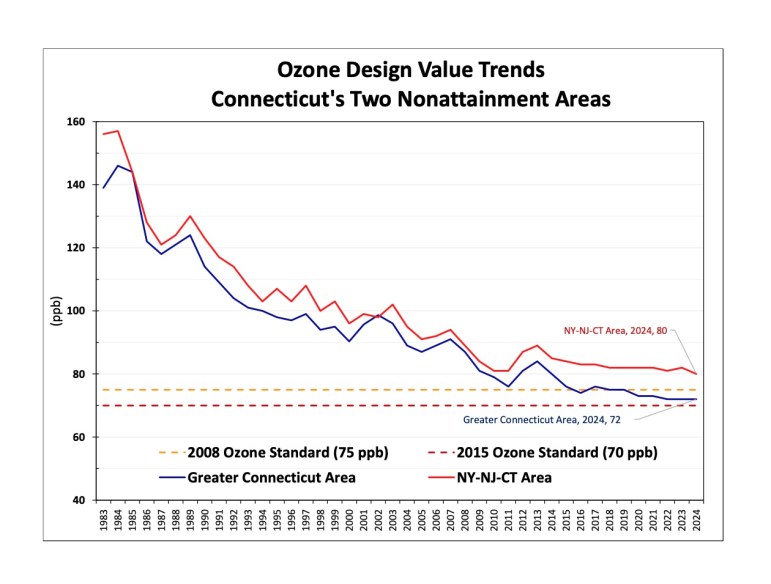
That area encompasses Fairfield, New Haven and Middlesex Counties along with the New York and New Jersey metropolitan areas. (It includes the Long Island district EPA Administrator Lee Zeldin represented for eight years as a member of Congress.)
Connecticut and other East Coast states have sought to have the ozone standard tightened, which would force emissions improvements by upwind states. That has not happened, nor has an effort to expand what’s known as the “ozone transport region.”
That effort falls under the Good Neighbor provision of the CAA, which has requirements for states that are in violation to develop cleanup plans or have the federal government do it for them. The Biden administration had been clamping down on violators by ordering tougher plans.
The EPA under President Donald Trump has backtracked — approving some of the rejected plans. DEEP’s Farrell said the EPA is looking at how it determines whether a state is contributing significantly to ozone levels. A current proposed rulemaking would essentially increase the threshold needed to determine linkage by almost 50%. “So it’s a big give to those states,” he said.
All of which is troubling news for Connecticut. Adding to that frustration, motor vehicle pollution isn’t the only contributor to the problem. And the administration is loosening rules governing many of those other sources, as well.
There’s more — a lot more
The list of Trump administration actions with direct and indirect impacts on air quality is long.
“You’re depressing me here,” said former EPA Administrator Gina McCarthy after listening to a partial accounting.
McCarthy, who also served as EPA air chief before becoming administrator during President Barack Obama’s second term — and before that was Connecticut’s environment commissioner — called the years of air quality improvements one of the biggest accomplishments by the U.S.
“It’s not just on an individual state basis. It was done at the federal level and also done with collaboration from other countries,” she said.
The U.S. has National Ambient Air Quality Standards, NAAQS, which goes by the nickname pronounced “nax.” Ozone is one of six pollutants that comprise NAAQS. The others are sulfur dioxide or SO2, nitrogen dioxide or NO2, carbon monoxide, lead and fine particulate matter or PM2.5, also referred to as soot.
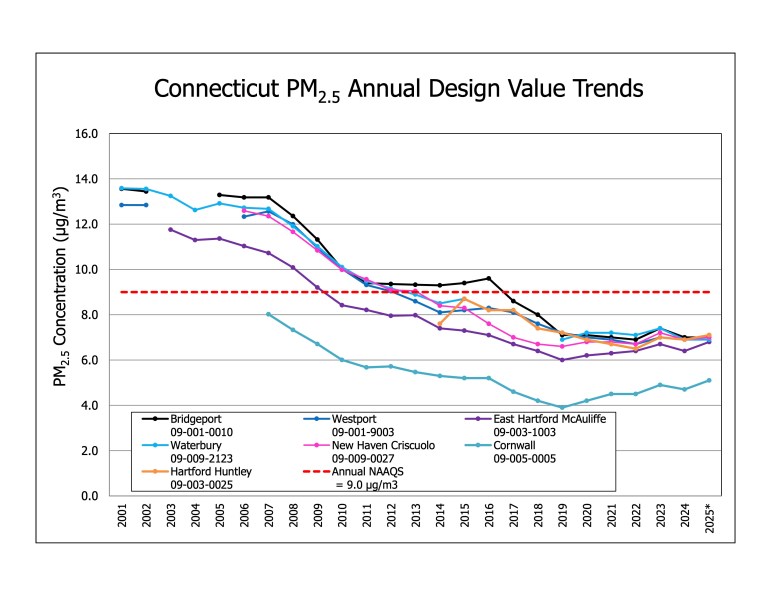
PM2.5 particles are one-thirtieth the diameter of a human hair. They can be breathed in, causing an array of physical problems from respiratory issues to cancer.
The Biden EPA lowered the annual fine particulate NAAQS from 12 micrograms per cubic meter to nine. The standard remains at nine, but Trump’s EPA has made moves to roll that back to 12 or higher.
“Fine particles are in and of themselves dangerous, but in many, many instances, what makes them particularly lethal is the fact that they carry toxic substances,” said Joe Goffman, who ran the EPA’s air office during the Biden administration. “They’re both pollutants and vectors for other pollutants simultaneously.”
Another focus of the Trump administration is restoring the use of coal. Several interrelated actions already taken are likely to worsen Connecticut’s and the region’s air quality, even though none are happening in the region itself and there are no longer any operating coal power plants in New England or New York.
The Trump administration, under what it claimed on Day 1 was an energy emergency, has ordered a number of coal plants to continue operating beyond their planned closures. Most are old and burn the most polluting form of coal. Their emissions add to what comes east as ozone and other pollutants.
The administration also repealed a more stringent Biden-era rule on emissions from coal- and oil-fired power plants. The rule is known by its shorthand — MATS — which stands for mercury and air toxics standards.
It covers emissions of metals including mercury and lead and a laundry list of other toxins such as arsenic, chromium, nickel and a number of gases. Some of the substances are carcinogenic or can cause neurological damage among other health impacts.
EPA’s Zeldin, as a New York congressman in 2019 during the first Trump administration, voted to stop the administration’s effort to diminish MATS. The EPA did not respond directly to the question of why Zeldin’s view had changed.
In a lengthy email, an unnamed person in the EPA press office said, “Administrator Zeldin’s action is entirely consistent with his record whether in his previous roles or leading this agency.”
The statement also said reverting to the older standards, which were put in place in 2012, “ensures the continuation of the highly effective and robust 2012 MATS requirements.” Using language it has used many times in the past, the email referred to the now-revoked 2024 standards as “another notch in the Biden-Harris Administration’s war on coal.”
Another part of the MATS rollback was the Biden administration’s requirement for continuous monitoring of emission levels. The rule now only requires stack sampling.
John Walke, the NRDC’s federal clean air director and senior attorney, said between that and the additional coal plant operations, EPA’s own data showed sulfur dioxide emissions from coal plants rose 18% last year. He called that stunning and said it was only the second time in his more than 30 years as a clean air attorney there was an increase in emissions — the first time being the period following the COVID-19 lockdown.
“So this is really under normal economic conditions, the worst performance by any administration overseeing emissions from power plants,” he said.
The administration has also targeted tighter Biden-era standards for methane, one of the two most potent greenhouse gases. It is most associated with natural gas and oil drilling, and pipeline and industrial leakage. The Trump administration has already delayed the compliance deadline for the new standards until 2027. It is widely assumed the goal is to get rid of them by then.
In the meantime, the administration ended penalty fees for excess methane emissions, while just recently allowing longer periods for burning off excess methane — known as flaring.
Recently, EPA ended CAA regulations for a controversial plastic recycling and burning process called pyrolysis. The agency also weakened emissions standards in medical sterilization facilities that use ethylene oxide — a known carcinogen.
In addition to direct actions that will have an impact on air quality, the administration has taken a host of actions that will affect it indirectly.
They are blocking wind and solar projects — both explicitly and by removing their longstanding and valuable tax credits — while authorizing increased oil, gas and coal extraction and use.
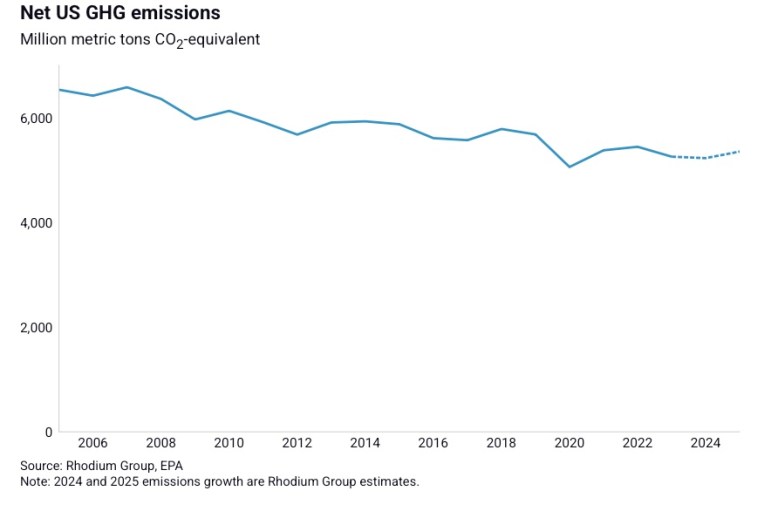
GHG emissions rose in 2025 according to the Rhodium Group, some of which is attributable to the increased use of coal. That connection will be more difficult to make in the future because the EPA has moved to end its GHG reporting program, punctuated by its revocation of the endangerment finding. The release of its 2025 data has been delayed from March until October.
Incentives to purchase electric vehicles have been eliminated and a clean school bus program to lower the use of diesel fuel is being revamped. The original program had focused mainly on electric buses. The administration is advertising its new goal as allowing many alternatives, but the parameters are steering the focus away from electric buses.
The administration is also looking to weaken the National Environmental Policy Act, NEPA, which has required federally funded projects to meet specific environmental standards. Some of those standards could be for air quality.
“It’s actually sort of mind bogglingly pernicious that they’re doing all this at once. It’s as if they had a deep insight into just how air pollution works on human health and what makes it especially dangerous, and they devised a devilish strategy aimed at maximizing this threat,” said Goffman, the former EPA air official. “There’s no place that bears the brunt of it more than the Northeast.”
“Connecticut is helpless against this vast portion of its emissions inventory because EPA is not only failing to exercise national leadership, they are actively tearing down the structure of regulations that could deliver cleaner air to citizens of Connecticut,” said NRDC’s Walke. “It’s like a hostile takeover by the forces from industry that had been filing lawsuits against EPA to destabilize and to weaken the Clean Air Act.”
He said one move the administration made that would have an outsized influence was its decision to stop valuing the health benefits from reducing air pollution. The health benefits now are valued at $0.
“The reason that’s important is because it allows them both to hide from the public the magnitude of harms from their rollbacks and to count industry compliance costs exclusively,” he said.
The EPA in its email said it “is still considering the impacts that PM2.5 and ozone emissions have on human health. We’re pausing putting a dollar amount on these health benefits because pollution levels have already gone down so much that the extra improvements are harder to measure accurately with today’s tools. The health benefits are still real and important, but the models we use to measure them need updates.”
Health effects
Farrell at DEEP called the EPA’s decision to not look at health benefits in its regulatory impact analysis “deeply disturbing.”
“The health benefits — that’s why we’re in this business. We’re in the business to protect health,” he said. “When they change the rules of the game, that’s a harder fight to have, but I think it will be a fight that we will have.”
It could be a broad-based fight encompassing both direct and indirect effects. Compounded, the results could be staggering.
Among the direct impacts, the most pervasive here in New England stem from ozone. It leads to or worsens respiratory problems, most notably asthma, which Connecticut already has high rates of. More ozone could cause those rates to increase.
That in turn can worsen other conditions such as heart and circulatory problems and allergies. It can affect pregnancy outcomes as well as compromise the health of children, older people and those with weakened immune systems. People who live near major highways, who tend to be lower income with more limited access to medical care, would also be at high risk.
But many of the other emissions for which restrictions have been loosened, or are expected to be, are toxic and in many cases cancer-causing.
PM 2.5 — soot — is especially concerning, said Jenni Shearston, an environmental epidemiologist at the University of Colorado in Boulder. PM 2.5 can cause lung cancer in addition to respiratory and cardiovascular diseases. But newer research shows its neurological impacts can be devastating.
“PM 2.5 is associated with deteriorating cognition, increased risk for Alzheimer’s, IQ loss in children,” Shearston said.
The MATS changes are also concerning — mercury in particular. Mercury is a heavy metal neurotoxin that can cause brain damage. Environmental groups say levels from coal plants had dropped 90% since regulation began in 2012. They could resurge. And mercury in the air can make its way into fish that when eaten can cause mercury poisoning in people.
“Mercury exposure is already a concern in the Northeast, and higher levels can harm child development and cause lasting neurological and reproductive health problems,” Connecticut Public Health Commissioner Juthani said in an emailed statement at the time the rollback was first announced.
“I think it’s very, very challenging,” she said in an interview.
“There are going to be so many multiple different factors that are going to potentially aggregate and be more than additive in terms of their negative impacts. You’re going to have multiple different things happening at once, and I think that is challenging to tease apart in terms of exactly how those impacts are going to be felt,” Juthani said.
But what these emissions also do — especially GHGs like methane — is contribute to the warming that worsens climate change, which can lead to problems that can be harmful to health in myriad ways.
“Not only do you have the direct effects of the health harms of the pollution, you also have those pollutants contributing to climate change, contributing to disruptive climate patterns and things like natural disasters like hurricanes, tornadoes, strong storms, high heat, cold surges, which also then additionally can kill people and have further secondary impacts on health,” Shearston said.
Heat and cold can cause many physical ailments, worsen existing ones and even be deadly. The same goes for extreme weather that can result in excessive precipitation and flooding. Those all have secondary impacts such as drowning, water contamination or the proliferation of insects that also carry diseases.
Drought and flooding can ruin agriculture that in turn makes food scarce, which can lead to famine and starvation with their physical ailments.
“I think the totality is more concerning, actually, in that it feels like it’s a systematically orchestrated rollback of environmental protections,” Shearston said. “It’s a big problem because it impacts health, and that has huge cascading impacts.”
There’s a name now for this cumulative and multi-factorial impact phenomenon. It’s called exposomics — how all exposure to harmful things cumulatively affect the body.
“We’re really continuing to enter unknown territory, and that just makes me concerned about unknown threats that will become threats because of changes that are happening for climate,” Juthani said.
“What the administration is doing is providing a perverse insight to an often hidden reality that the effect of air pollution is multifaceted and synergistic,” said Goffman, the former EPA air chief.
He explained that all the different pollution and toxics humans breathe work on the body — lungs, bloodstream, organs — often in highly interactive ways.
“Your health doesn’t differentiate between pollution that comes from the tailpipes of cars and trucks versus pollution that comes from power plant smokestacks,” Goffman said. “Your health really is determined to the extent that air pollution affects it, by the total loadings of air pollutants.”
States aren’t helpless
States can fight back legally, and Connecticut certainly is doing so.
The state is part of nearly a dozen lawsuits, plus letters and comments — all with multiple other states — that aim to stop rollbacks of emissions standards that will affect air quality.
Matthew Levine, deputy associate state attorney general and chief of the environment section said that the office, in consultation with DEEP as needed, is trying to be active in anything that will have an impact on Connecticut’s air quality.
“There is no area that they are not touching involving environmental protection,” Levine said of the Trump administration. “Especially if it has something to do with climate change or renewable sources of energy. They are taking a complete brush to sweep that away, and we are trying, with our multi-state partners, to push back on all of it.”
A suit challenging the revocation of the endangerment finding was filed in March, followed about 10 days later by one to prevent the rollback of MATS levels.
Legal actions, letters or comments have been filed — or will be — against Trump policies on motor vehicle efficiency standards, vehicle emission standards, PM 2.5 and the Good Neighbor policy with respect to ozone.
Ozone has been a recurring subject for Connecticut attorneys general for decades, with cases taking years to wind through the legal system. That process is about to get even slower as the office fights the watered down state pollution remediation plans recently approved by the Trump administration. Under a new court ruling, each plan will now go to court in the region the polluting state is in instead of in the district court in Washington as they had before.
“Right now, we are in a mode of trying to make sure that what is in place, what the EPA is already doing to protect our clean air, is not rolled back,” Levine said. “So we’re in a bit of a defensive posture, and we’re trying to be as aggressive as possible.”
Connecticut also has policies and programs on the books to fill some of the federal gaps.
Earlier this month, Gov. Ned Lamont announced he was making $15 million from the Volkswagen emissions settlement available for projects that reduce nitrogen dioxide levels specifically from diesel engines.
It’s a small dent, but Dykes pointed out a few of the ways the state could make up for lapses in federal environmental oversight and restrictions. The Connecticut Environmental Policy Act, CEPA, for instance, is like NEPA — the federal counterpart that is being defanged by Trump. CEPA has environmental requirements for projects receiving state funds.
The state is continuing its monitoring programs, including for ozone, fine particulates and GHG. And the state will continue to provide public information when there are air quality problems.
“This is going to become more important than ever,” Dykes said.
“The federal action is having a significant impact; I don’t want to sugarcoat that,” she said. And she noted that back in the early 1980s Connecticut had as many as 100 high ozone days a year. Now it’s generally in the 20s. “Our nostalgia for the past may be obscuring more accurate memories of how challenging our air quality was.”
And she added: “There’s no substitute for federal action or federal leadership.”
McCarthy, her onetime predecessor in Connecticut, insisted states are not powerless. “I’m not trying to ask you to be naive about the challenge,” she said. “But what we can do is look at all of the actions that we do not need the federal government to support us.
“I do think in some ways we just have to stop dwelling on what we can’t do and really build some hope about what we can.”