



It’s often been hard to be a local sports fan in Connecticut.
The Bridgeport Islanders, which played hockey in the state for more than two decades, announced a move to Canada in the coming months. The WNBA’s Connecticut Sun, the last major league professional sports team in the state, will leave for Houston next year. And older wounds, be it from the 1997 departure of the Hartford Whalers hockey team or from the failed bid for the NFL’s New England Patriots soon after, still sting.
It’s raised a question: can Connecticut support major league professional sports and what, if anything, can be done to attract a new franchise to the state?
CT United Football Club owner André Swanston believes that he has the answer. And with a recently-inked deal that moves the new soccer team, which once hoped to play in Bridgeport, to Norwich’s Dodd Stadium, the team will soon have a stadium to call home.
For years, Swanston, a tech entrepreneur, investor and University of Connecticut alum, has worked to bring Connecticut’s newest soccer team to life. He says that the sport works perfectly for the area, viewing the entire state as a single market that can be activated to support a major sports team. While CT United FC is currently part of Major League Soccer’s NEXT Pro developmental league, Swanston has greater ambitions, including adding a professional women’s team. In a best-case scenario, a full-fledged MLS team could come later.
“We’ve always been very deliberate since the beginning saying that this is Connecticut’s team,” Swanston said in a recent interview. “We’re trying to reach and resonate with people across the state. It’s always about the state, not one individual city.”
There was just one problem: CT United FC didn’t have a home stadium.
When players laced up their cleats for their first home game last month, the team played at UConn’s Morrone Stadium in Storrs. It will play the rest of the regular season in New Haven, using Yale’s Reese Stadium.
After an inaugural season on the road, next year could see the team finally start play in a more permanent home.
In late April, the Connecticut Sports Group, the ownership group over the team, announced that it signed a lease agreement with the city of Norwich. Under the deal, the team will play at the Thomas J. Dodd Memorial Stadium, a roughly 6,000-seat venue that has been open since 1995. The stadium currently serves as the home of the Norwich Sea Unicorns, a baseball team playing in the Futures Collegiate Baseball League.
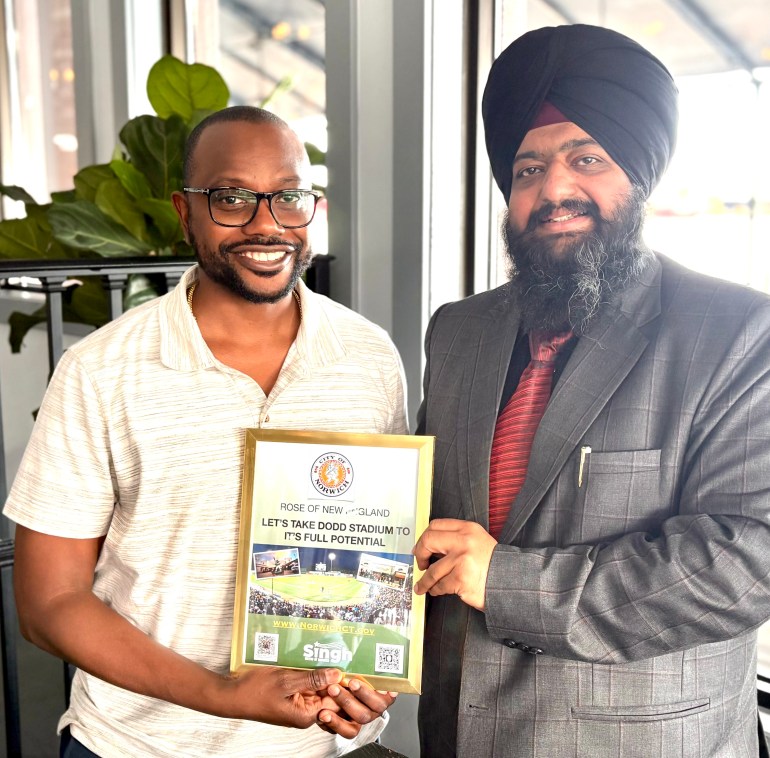
Under the terms of the lease agreement, the Connecticut Sports Group will take over stadium operations in early 2027 with its first term ending in 2029. The lease comes with three options for extension, with periods ranging from one to 10 years. The baseball team will continue to play in Dodd Stadium as part of the agreement.
The deal closes the yearslong saga over where CT United FC will play, a question that had long loomed over the team. In selecting Norwich, a city centrally located in the eastern part of the state, the team has found a home stadium that looks much different than the large-scale plans Swanston had for a $1 billion waterfront stadium and mixed-use development project in Bridgeport.
Rather than viewing that as a negative, Swanston says that the stadium change simply presents a different type of opportunity.
“It resonated with us in terms of our mission of serving communities that I think are oftentimes under-appreciated, or under-represented in the state,” he said.
“If you think about Norwich, it’s smaller than Bridgeport, it’s in a different part of the state, but I think it has a lot of those same qualities,” he added. “It’s a diverse community. It’s—if you look at it—historically under-invested in by the state.”
First-term Norwich Mayor Swarnjit Singh views the deal as a way to save a beloved sports facility by giving Dodd a stable tenant that will keep the stadium open for longer each year. But even more than that, Singh hopes that the soccer team has an even bigger impact: a wave of new activity in his city and a boost to Eastern Connecticut’s economy more broadly.
“This will be another way to help eastern Connecticut,” Singh said in a recent interview. “Eastern Connecticut has things to offer, and our economy definitely depends upon tourism.”
Though the deal is still in its beginning stages, the lease agreement gives the mayor and the sports team owner a unique opportunity: a chance to boost interest in tourism and recreational activities in the region while also breathing new life into professional sports in the state. And if successful, Dodd Stadium could become part of a growing effort to revitalize eastern Connecticut as the region seeks to build on a wave of new jobs and development spurred by growth in the region’s manufacturing industry.
A new deal in a new region
The Norwich stadium deal exists largely because other opportunities fell through.
When Swanston first announced CT United FC in 2024, getting a stadium built in Bridgeport was a high priority. Supporters hoped the project, which initially included a hotel, public park space, a riverwalk and hundreds of new apartments would breathe new life into Connecticut’s largest city.
While Swanston never publicly stated exactly how much money he had put together for the project, he said that the amount of private investment was “significant.” He hoped that additional funding, around $127 million, would come from the state.
Speaking to the Connecticut Mirror last year, Swanston said that the proposal should be an easy one for the state to get behind.
“If you evaluate this on the merits,” he said, “it should be seen very favorably.”
The pitch was supported by local Bridgeport officials, as well as the city’s legislative delegation. But Gov. Ned Lamont disagreed, ultimately passing on calls to support the stadium project.
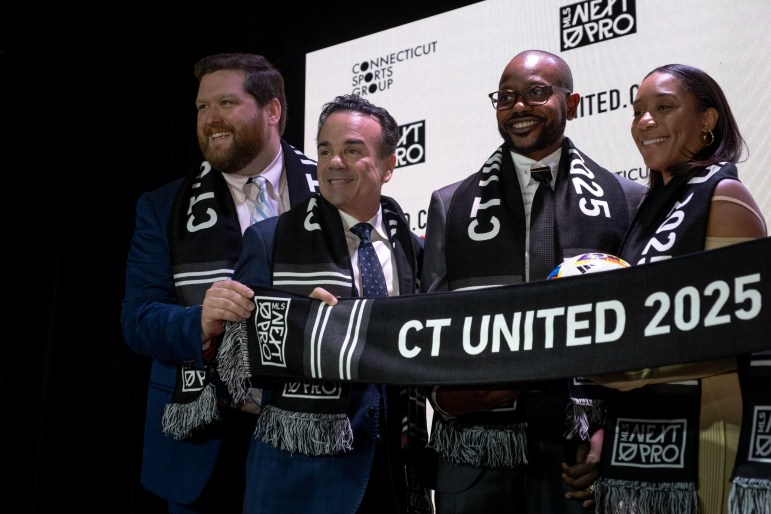
That decision was frustrating for Swanston, but the team decided to move forward with its launch as it explored other stadium options. In the months since, the team has spread out across the state. In addition to playing its first home games of the season in Storrs and the upcoming schedule of matches in New Haven, the team has also continued to do community work in Bridgeport and runs a youth academy in Danbury.
Maintaining a statewide presence is something the Connecticut Sports Group always planned on, but the team also continued its search for a permanent home. Norwich, according to Swanston and Singh, emerged as a frontrunner soon after the Bridgeport deal fell apart. The agreement with Norwich was reached in a matter of a few months.
And that was good news for Singh, a former Norwich city councilman elected as part of a Democratic party surge that flipped several GOP mayoral seats last November. The first-term mayor was looking for a way to save Dodd Stadium, which faced a $350,000 debt and needed a more stable tenant willing to help with repairs.
“This is bringing opportunity,” he said of the deal. “Not just for Norwich to save Dodd Stadium, but to turn this into an asset, which will help Norwich fiscally.”
“At the same time, it’s gonna pump up a lot of energy in the whole of eastern Connecticut,” he added.
A potential boost for eastern Connecticut
While the new stadium deal has generated a lot of good press in the days since it was announced, both Swanston and Singh acknowledge that things are extremely early in the process.

For now, the attention turns to repairs, which could begin as soon as the summer. The stadium will need several alterations to accommodate the soccer team, including changes to the field, improvements on the HVAC system, flood and drainage repairs, and other structural fixes. Swanston notes that if a professional women’s team is added, which he hopes will be the case, the stadium will also need facilities that can accommodate the additional team.
CT United FC could begin playing in the stadium as early as next year, though the exact timeline will depend on how the repairs go.
Swanston said that he could not provide an estimate for how much the needed work will cost, but he framed it as an “order of magnitude” smaller than the projected Bridgeport development costs.
Singh says that while the city of Norwich will also pitch in on funding some of the repairs, he hasn’t ruled out asking the state for help. State funding played a big role in the initial construction of Dodd Stadium, with the state spending several million to support the initial construction.
While it will take months for many of the details of the deal to be worked out, Singh said that he is hopeful that the stadium will have a big impact on the city and the broader region.
He noted that the soccer team is coming to eastern Connecticut at a time where the region is experiencing significant growth, with the expansion of submarine manufacturer General Dynamics Electric Boat fueling a new wave of development to accommodate an influx of workers. Last October, the company acquired Waterford’s Crystal Mall, with plans to convert the building into office space for thousands of engineers, software developers and support staff. The company plans to hire some 8,000 workers this year.
“If somebody is coming to eastern Connecticut, we want them to be like, ‘All right, we’re gonna go to the casino, then we’re gonna go to the game, and then we’re gonna go to the Mystic Seaport,’” he said of the opportunities created by the improvements. “You get your weekend covered, you know. And that’s money. It has a good return on investment.”
And for Swanston, the new stadium could be a launchpad for more projects down the line. While he is focused on the improvements for now, he said that additional development work and entertainment options could be considered in the future.
“We’re really focused on the stadium,” Swanston said. “That, frankly, is the anchor to make anything else viable.”
