



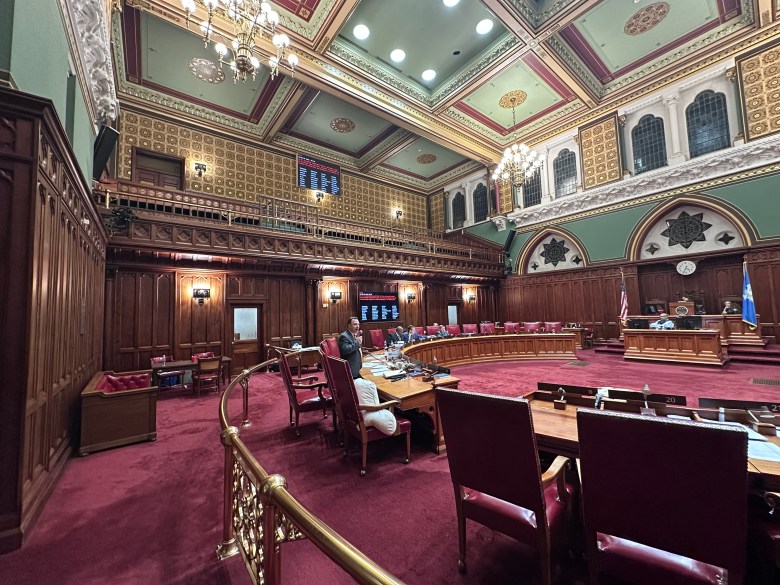
The Senate stayed overnight at the state Capitol to pass a gun control bill and legislation that would make millions of dollars in revisions to the state’s recently adopted state budget and — among other things — delay Hartford’s revaluation by one year and help struggling Ansonia revive a failed and ruinously expensive fuel cell project.
The budget revisions and unrelated changes to other bills and laws arrived Tuesday afternoon in an 111-page amendment Democrats intended to tack onto an unrelated measure, Senate Bill 477. It ignited a Republican slowdown that pushed action on other bills well past midnight and into Wednesday morning, the final day of the legislature’s annual session.
“The Republicans dared us to go all night because they didn’t like a bill,” said Senate Majority Leader Bob Duff, D-Norwalk. “They thought we’d blink, and we didn’t.”
With 105 sections, the budget measure would increase judicial salaries by 4.5%, adjust film tax credits, increase Medicaid rates for optometrists, enable municipalities to abate certain delinquent taxes, increase funding for Shore Line East railroad service by at least $3 million and specify how $100 million in municipal grants would be shared by the state’s 169 cities and towns.
It also would place Sue Bird, the former University of Connecticut and WNBA basketball star, alongside the American robin as the state bird of Connecticut.
The Senate met until nearly 8 a.m., not leaving until passing House Bill 5043, controversial legislation banning the manufacture and sale of Glock handguns and other “convertible” firearms that can readily be made to function as an illegal machine gun.
Debate on the gun bill, a measure proposed by Gov. Ned Lamont, opened at 3:15 a.m. with no one in the public galleries. By 4:30 a.m., Sen. Rob Sampson, R-Wolcott, was debating Sen. Gary Winfield, D-New Haven, in a nearly empty chamber, and the Senate’s clerk seemed to briefly doze. Passage came at 7:22 a.m. on a 22-11 vote, with three senators missing.
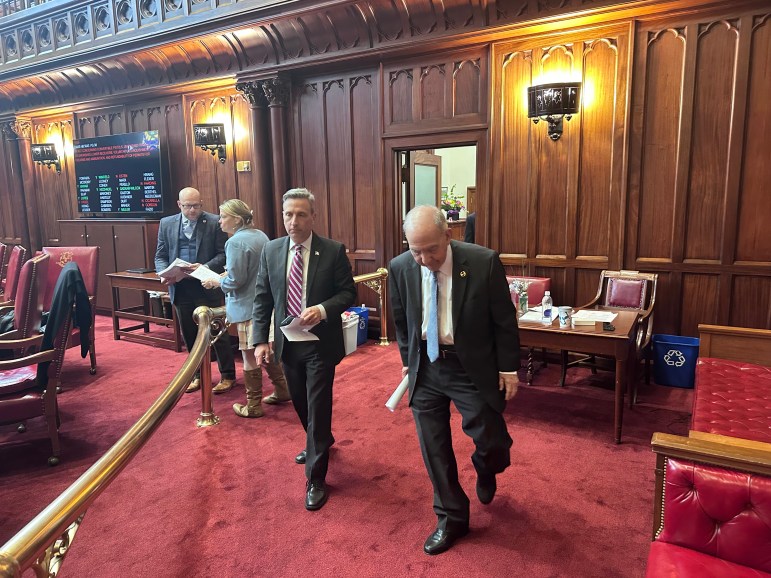
The House had quit for the night at 10 p.m. Tuesday, scheduled to return at 10 a.m. Wednesday for the final 14 hours of the 2026 session. Among the bills awaiting them was the budget revision, S.B. 477, which passed the Senate on 25-11 party-line vote.
The bill was packed with new funding to nonprofits, their legislative benefactors unclear. Its breadth outraged Republicans on a day when the legislature’s tradition of unlimited debate allows the GOP minority to control the flow of business simply by talking.
Senate Minority Leader Stephen Harding, R-Brookfield, said the amendment to S.B. 477 essentially was a second budget implementation bill drafted just three days after the budget was adopted by the both the Senate and House.
The amendment was signed by the top Democratic leaders of the House and Senate, as well as the co-chairs of the Finance, Revenue and Bonding Committee.
Some of the provisions initially were hard to decipher, especially sections that seemed to neutralize jurisdiction by the Public Utilities Regulatory Authority and the Connecticut Siting Council over a $63.6 million fuel-cell project in Ansonia.
“This is not how our state government should operate. It not an open, transparent and reasonable process,” said Sen. Ryan Fazio, R-Greenwich.
Under the administration of former Republican Mayor David Casetti, the financially strapped Ansonia sold its water and sewer system to Aquarion Water Co. for $41 million and got into the business of generating electricity with a fuel-cell project with a partner, Johnson Controls, located at 345 N. Main Street.
But there was a problem. As the Valley Independent Sentinel reported in March, the Connecticut Siting Council had already approved an application for a fuel cell at the same location from another company, HyAxiom out of South Windsor. But Cassetti never signed a final agreement with HyAxiom, questioning the financing.
He then made an agreement with Johnson Controls, agreeing to pay $37 million to the company to install the fuel cells. An obstacle to going forward is that the Siting Council’s approval rests with HyAxiom, not Johnson. A provision of S.B. 477 would negate the council’s approval.
Cassetti lost his reelection bid last year and was succeeded by a Democrat, Frank Tyszka, who took office on Dec. 1 to find a surprise bill for nearly $700,000. It was a payment due on the fuel cell, which was supposed to be up and running in 2025.
Harding said many of the provisions in the sweeping budget revisions violated arrangements made to keep business flowing.
“There were earmarks and absentee ballot changes never agreed to,” Harding said. “So, we’re fighting for our members to be able to have an opportunity to actually read bills before we vote on them. And part of that is talking on bills.”
And talk, they did.
Before S.B. 477 was called, Republicans spent six hours on Tuesday quizzing Sen. Christine Cohen, D-Guilford, co-chair of the Transportation Committee, about the contents of an omnibus transportation measure, House Bill 5464. It was theater, not real opposition. It passed easily, 32-4. Cohen posed for a photo by the tally board.
They turned to S.B. 477, which passed at 1:58 p.m., and then the gun bill. They passed a few other bills after the gun measure.
Senate President Pro Tem Martin M. Looney, D-New Haven, who is not seeking reelection after 46 years in the General Assembly, said, “We passed all the bills we planned to pass. It just took a little longer.”
Duff told the senators to return by 1:45 p.m. Wednesday for a group portrait, then more business.
“Dress sharp,” he said.
