An omnibus transportation bill that pushes off Connecticut’s plans to electrify the state’s school and transit bus fleet cleared the House on Wednesday with a 99-51 vote.
Officials say the measures come in response to changes in environmental policy under the Trump administration.
The legislation, House Bill 5464, would walk back sections of the state’s 2022 Clean Air Act, which prohibit the state Department of Transportation from purchasing new diesel buses.
The restrictions, in effect since 2024, made it difficult for the state to maintain its existing fleet of over 600 transit buses due to a national backlog in the availability of battery-powered alternatives. In March, DOT officials told lawmakers that the ban on purchasing diesel buses had made it difficult for the agency to keep enough buses in service for riders across the state. (The bill does not seek to change a requirement to transition at least 30% of the state’s transit fleet to zero-emission vehicles by 2030.)
Another section of the bill would eliminate a requirement for all school buses to run on zero-emission or alternative fuel engines by January 2035 and reduce the requirement for a complete transition to zero-emission school buses to 90% by 2040.
House Speaker Matt Ritter, D-Hartford, said disappearing federal subsidies have made the transition to electric vehicles much more costly to the state and municipalities.
“The world changed,” Ritter said. “We’re pushing the bus mandate off.”
Pushing out the deadlines allows for the possibility of a change in federal policy — that brings back subsidies and grants — or technology improvements that would make clean buses cheaper, Ritter said.
The House initially took up the bill on Monday, but pulled it temporarily during debate over the provisions related to the diesel buses, as well as DOT’s clearing of homeless encampments.
The bill would codify a requirement that DOT offer 14 days’ notice before clearing homeless encampments. The agency cleared dozens of encampments on agency property last year, and some former residents of those encampments complained that their personal belongings were destroyed or thrown away.
Advocates say clearing homeless encampments is inhumane, while local and state officials say they pose health and safety hazards.
Diesel bus debate
Lawmakers were generally in agreement on allowing DOT to resume buying diesel buses, but Republicans argued that the rules should also be relaxed on school districts that have to transition most of their bus fleets to zero-emission vehicles by 2040.
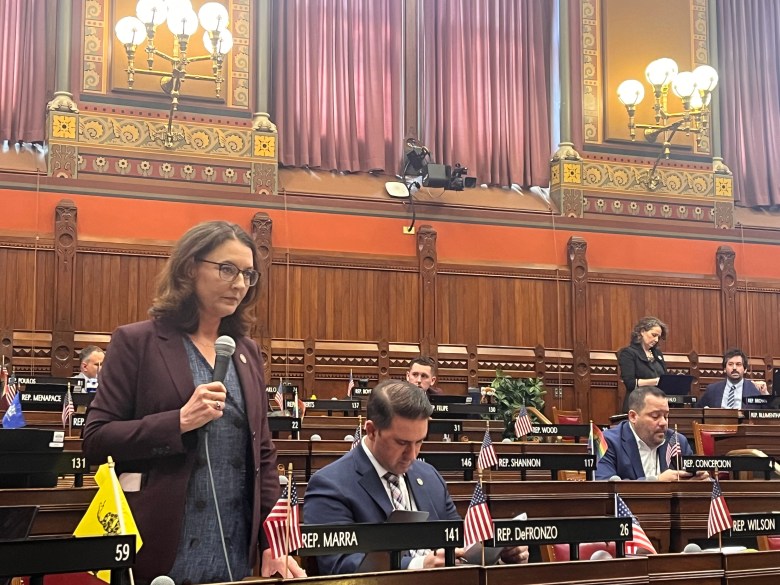
“The facts are that electric buses are going to be a huge expense,” said state Rep. Tracy Marra, R-Darien. “Our towns, when they’re looking at education right now, they’re already struggling just to pay for teachers’ wages, pay for health care. They have no idea what’s coming at them with these electric buses.”
Democrats beat back one amendment from Marra that would have allowed towns to use cheaper alternatives, including buses that run on propane, in order to meet the state’s clean air requirements.
But after Republicans continued to eat up time debating the mandates, Democrats agreed to allow a second amendment requiring school districts to adopt specialized fire safety plans for electric buses in exchange for allowing the bill to move forward.
It heads next to the Senate.
CT Mirror reporter Ginny Monk contributed to this story.