


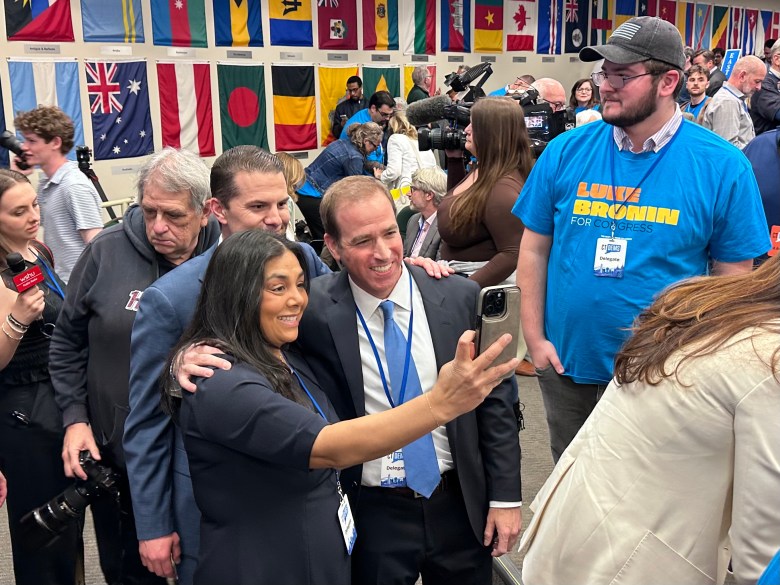
Former Hartford Mayor Luke Bronin won the Democratic endorsement for Congress in Connecticut’s 1st Congressional District on the second ballot Monday night, upsetting the 14-term incumbent, John B. Larson, and setting the stage for a primary in August.
Bronin praised the 77-year-old Larson in his acceptance speech then pivoted to an assertion marking the moment: No one in Connecticut ever has forced a primary against an incumbent congressman, much less besting one by winning a party’s endorsement in a contested convention.
“We just saw a political earthquake in this convention,” Bronin said. “Every Democrat in this room believes that we need to stop the damage that Donald Trump is doing to our country every single day.”
Rep. Jillian Gilchrest of West Hartford qualified for the primary by the slimmest of margins, winning 15.04% of the delegate vote on the first ballot with the help of Larson allies who prefer a three-way primary to a one-on-one fight with Bronin. Assured of the primary, she withdrew before the second ballot.
Ruth Fortune, an appointed member of the Hartford Board of Education, ended the first ballot with less than 1% of the vote, too little to go further.
In a two-way race, Bronin beat Larson on the second ballot, 51.2% to 48.8%.
Larson left the convention hall at Goodwin University after the loss, retreating to a private room. He emerged to tell waiting reporters the campaign was not over and foreshadowed a campaign built on his upbringing in the Mayberry Village housing project of East Hartford versus Bronin’s youth in Greenwich.
“This is democracy at work,” Larson said. “But this is the first step. And now, I think it’s going to be very clear: It’s Mayberry against Greenwich. We’re in this fight on behalf of the working people that I have served for 28 years in the United States Congress.”
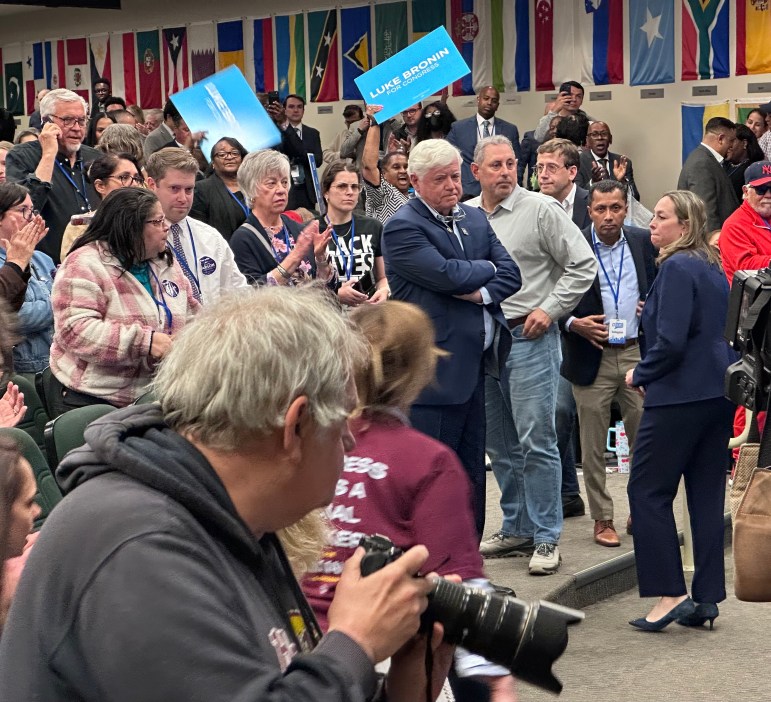
Larson led Bronin after the first round of voting, 46% to 43%, with Gilchrest at 8.8%, far short of the 15% necessary on any ballot to qualify for a primary. But falling short of the 50% plus one to win the endorsement, Larson allies directed delegates to switch to Gilchrest before balloting closed.
Under the rules, there is a 10-minute period in which vote switching is allowed. After the switches, the final tally on the first ballot was 45.58% for Bronin, 38.6% for Larson and 15.04% for Gilchrest.
Gilchrest said she had no hesitation in making a deal with Larson to produce the three-way primary sought by the congressman’s campaign.
“It’s been constant conversation in the last few weeks about deals, and who’s going with who, and who’s gonna talk, and that is across the board,” she said. “At the end of the day, in order to get on the ballot, I had to play politics today. And I’m on the ballot, and I’m gonna work for the people and ensure that we get the change we want in Washington.”
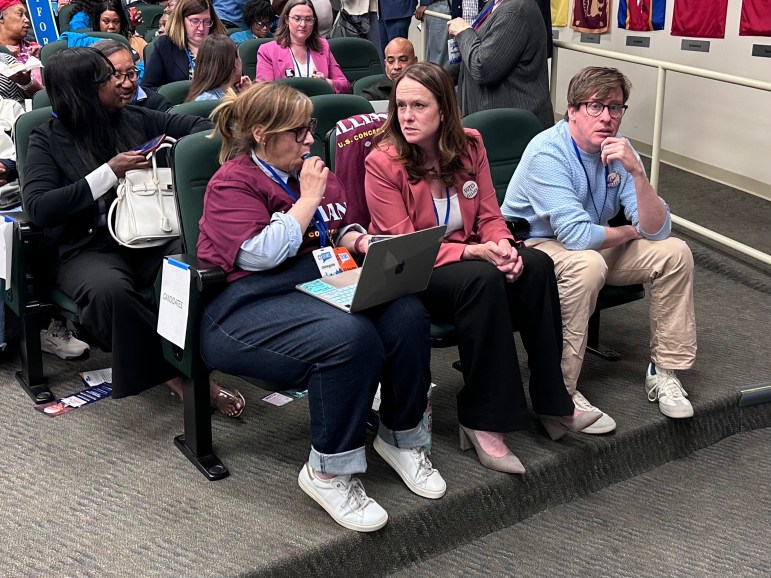
She begins the primary campaign far behind Bronin and Larson in fundraising. As of April 21, Bronin had $1.7 million in his campaign account, compared to $1 million for Larson. Gilchrest had $19,188.
Larson is a Baby Boomer elected to the U.S. House of Representatives during Bill Clinton’s final term. Bronin, 46, is the former two-term mayor of Hartford. Gilchrest, 44, was elected to the state House in 2018, unseating an incumbent. Fortune is 38.
Bronin ran on a message that it was time for a generational change. He made no serious issue of Larson’s voting record.
On Monday night, he said his campaign was about helping the Democratic Party regain its footing, refocusing on pocketbook issues and tax equity.
“We need to fix all of those things. But of part of doing it right now is recognizing that we have to build a strong Democratic Party that helps win back the people who lost faith in our fight,” Bronin said. “The younger Democrats, who are giving up on our politics altogether, because they don’t see us getting stuff done. That’s what this race is about.”
In a prepared statement emailed to reporters while he still was accepting congratulations, Bronin tried to nudge Larson towards retirement.
“I respect John Larson deeply,” Bronin said. “But I hope he listens to the message that was sent tonight by the most active, loyal Democrats in our party — that it’s time to pass the torch.”
Other Congressional districts
While the 1st District swept up most of the attention Monday night, the Democratic incumbents representing the four other congressional districts all locked up party endorsements at their separate conventions around the state.
Democratic delegates in each district renominated them to run for another two-year term: U.S. Rep. Joe Courtney in the 2nd District, U.S. Rep. Rosa DeLauro in the 3rd District, U.S. Rep. Jim Himes in the 4th District, and U.S. Rep. Jahana Hayes in the 5th District.
All of their challengers failed to secure the 15% of votes to get a spot on the primary ballot. But the closest candidate to almost reach that threshold was in the 3rd Congressional District.
DeLauro received nearly 87% of the local delegates, compared to her challenger Andrew Rice, who got a little over 13% and fell short of the necessary votes to make the primary through the convention process.
Rice, a scientist seeking to run to the left of the congresswoman, has confronted DeLauro and other congressional Democrats over policy disagreements on various occasions in recent months.
When House Minority Leader Hakeem Jeffries came to Connecticut in February to campaign for Larson, Rice was part of a group of protesters urging the New York Democrat to support abolishing U.S. Immigration and Customs Enforcement, or ICE.
And at last week’s “shadow hearing” organized by DeLauro on election changes, Rice interrupted panelists to argue that the way to protect elections in the U.S. is by pursuing impeachment, freeing Palestine and stopping FISA’s 702 program, according to CT Insider.
DeLauro, the longest-serving member in Connecticut’s delegation, is hoping to reclaim the gavel of the influential House Appropriations Committee if she wins a 19th term and Democrats retake the House in November.
From the Vernon convention in the 2nd District in eastern Connecticut, Courtney got more than 90% of the vote from local delegates over his challenger Kyle Gauck, an Army veteran.
In the southwestern corner of the state, Himes easily prevailed over challenger Joseph Perez-Caputo. The ninth-term congressman won overwhelming support from the local delegates at the Norwalk convention in the 4th District, with 98.3%, compared to Perez-Caputo’s 1.7%.
Perez-Caputo was one of the protesters who showed up to Himes’ event in Westport in late March to rally against the congressman’s support for a controversial surveillance law — Section 702 of the Foreign Intelligence Surveillance Act or FISA — that was at risk of lapsing.
As the ranking member of the House Intelligence Committee, Himes was tapped by Democratic leaders as a point person to help the party navigate the issue. Critics have pushed for reforms to help protect privacy and Fourth Amendment rights.
Section 702 of FISA allows the U.S. to monitor foreigners outside of the U.S. without obtaining a warrant and is largely used to help with counterterrorism efforts. A consequence is that the communications of those targets with Americans can also get swept up.
Last month, Himes was the only member of Connecticut’s House delegation to support FISA 702’s years-long renewal, but that bill later blew up and instead got a short-term reauthorization. Himes sees that as an opening for Democrats to lobby for more reforms in the coming weeks.
In the sprawling 5th District, Hayes was quickly renominated minutes into the nominating convention held in Waterbury. She didn’t face any competition on Monday night.
Hayes’ seat is typically seen as one of the only competitive districts in the state when it comes to the general election. While she eked out a win in 2022, Hayes won reelection by a wider margin in a 2024 rematch with Republican George Logan.
During a midterm election, the party in power traditionally faces electoral headwinds and loses seats in Congress. Republicans control both chambers as well as the White House.
Democrats are expected to have that historical advantage in the fall, though the redistricting battles happening in other parts of the country are complicating that edge for the minority party to regain control of the House.
There are a few Republicans seeking to challenge the four-term congresswoman, including retired Navy SEAL Chris Shea, who narrowly outraised Hayes in the most recent fundraising quarter. But she still has a substantial amount of money in the bank that she can tap into compared to Shea. Republicans’ campaign committee tasked with maintaining their House majority have so far not included Hayes’ district as a top targeted seat this year like it has been in previous election cycles.

