Amtrak is launching a two-year study of rail improvements between New Haven and Providence, reopening a decade-long debate over the future of the Northeast Corridor — this time with more public input.
The New Haven to Providence Capacity Planning Study differs from earlier federal planning efforts, which drew widespread opposition in shoreline Connecticut. This time, Amtrak said it will put more emphasis on community engagement before recommending any changes.
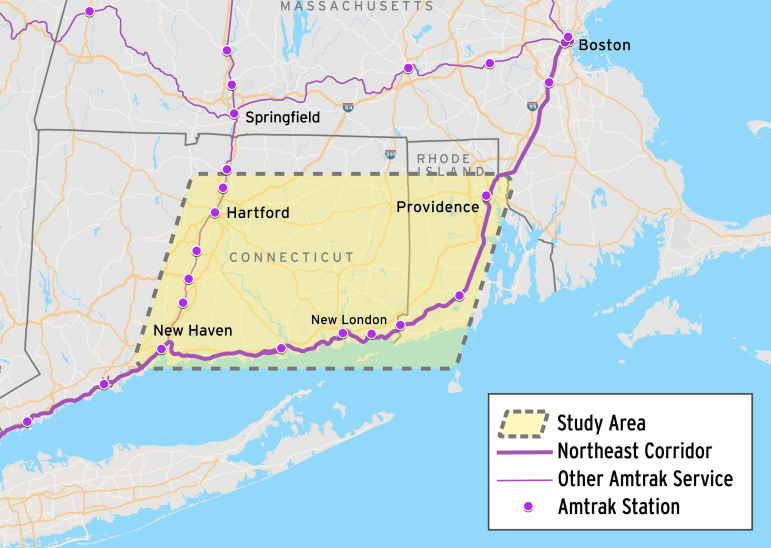
The study seeks to address two longstanding challenges: limited rail capacity and curved shoreline tracks that slow train speed.
As part of the process, Amtrak plans to host about 30 outreach events across the study area. The agency has also launched a website where residents can receive updates, learn more about the study and submit feedback.
“More and more people are riding the Amtrak through the Northeast Corridor, especially in Connecticut,” wrote Sen. Chris Murphy in an emailed statement to the CT Mirror. “We need to invest more in our rail system to meet that demand, and it’s really important that the families, small businesses and local officials in the communities near those lines have a seat at the table as we start having those conversations.”
The new study follows the controversial NEC Future project, a multimillion-dollar federal effort led by the FRA from 2012 to 2017 to identify future investments in the rail system from Boston to Washington, D.C.
In 2016, the FRA proposed a rail bypass through Old Lyme that would have resulted in a high-speed route between Old Saybrook and Kenyon, R.I. The proposal drew almost unanimous opposition from local residents and officials who complained they were consulted only after the route had been decided. Although the FRA later held a meeting in Old Lyme, attendees were not allowed to ask questions, fueling further criticism.
Following the backlash, the FRA eventually abandoned the bypass proposal. Its 2017 Record of Decision instead called for a further study of the entire New Haven to Providence segment. While the Record of Decision established broad goals for increasing capacity and speed, it did not identify a preferred solution for the corridor.
An Amtrak summary of the study states that it will not build on NEC Future, acknowledging that the earlier effort was “unable to undertake the levels of public engagement necessary to respond to concerns raised by the public regarding that proposal.”
“This study does not include a preconceived preferred alternative alignment or set of improvements. The study also does not include any activities beyond conceptual design and analysis of alternatives,” it states.
Jim Gildea, chairman of the Connecticut Public Transportation Council, welcomed the new approach, saying he appreciated that “it will be an open process allowing communities to participate.”
“I think listening to the shareholders and stakeholders is certainly an important step in the process,” he said.
Sam Gold, executive director of the Lower Connecticut River Valley Council of Governments, said he is optimistic that “the communities between New Haven and Providence will be heard, and we’ll hopefully get a better result out of the study.”
Meanwhile, Gregory Stroud, editor-in-chief of CT Examiner who helped lead opposition to previous rail proposals, questioned whether the pop-up events would be enough to educate the public about what he described as a rather complicated process.
Stroud said his concerns go beyond outreach to the structure of the study itself.
Unlike NEC Future, the new study is not being conducted under the National Environmental Policy Act (NEPA), a federal law that requires agencies to evaluate the environmental impacts of major infrastructure projects before approving them. Any improvements that emerge from the study will need to go through a separate environmental review before construction.
However, Stroud said, the lack of a formal review process makes it difficult for the public to understand how the planning process will work.
“The first thing is not whether this is a good plan or bad plan or whether it’s good outreach or bad outreach,” Stroud said. “How do you engage with a federal process if you don’t know what rules it’s governed by?”
Experts have long argued that Connecticut often bears the greatest impacts while seeing the least benefits from these projects.
Gold said the interests of passengers traveling between New York and Boston differ from those of Connecticut residents, who want minimal impact and local service, putting those priorities at odds with faster service and reasonable fares.
“It’s really about balancing those interstate national transportation interests versus local concerns, and I think this study has a better chance of balancing those in a more advantageous way to us than the previous NEC future study,” he said.
Gildea argued that Connecticut should prioritize improving the reliability of existing lines rather than focusing only on increasing speed.
“The average rail commuter is still much more focused on reliability. So anything that works to improve the reliability of the line, on-time performance and getting to our destination at the time we expect to get there, I would say, is always the first priority greater than speed,” Gildea said.
The study is funded in part by a nearly $4 million Federal Railroad Administration grant awarded to Amtrak in November 2023 during the Biden Administration, along with matching funds from Amtrak.