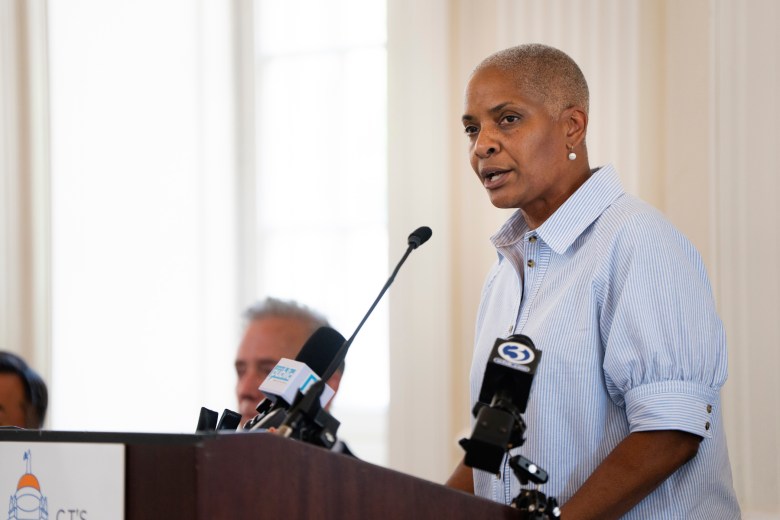
Four days after President Donald Trump fanned doubts about the security and accuracy of American elections, Connecticut Democrats offered a well-practiced rebuttal in a press conference at the Old State House in Hartford.
“The president used a prime time address to tell Americans that voting systems can be manipulated and elections can be stolen. Here in Connecticut, that is just plain wrong,” Secretary of the State Stephanie Thomas said. “It comes down to three things: people, paper, and proof.”
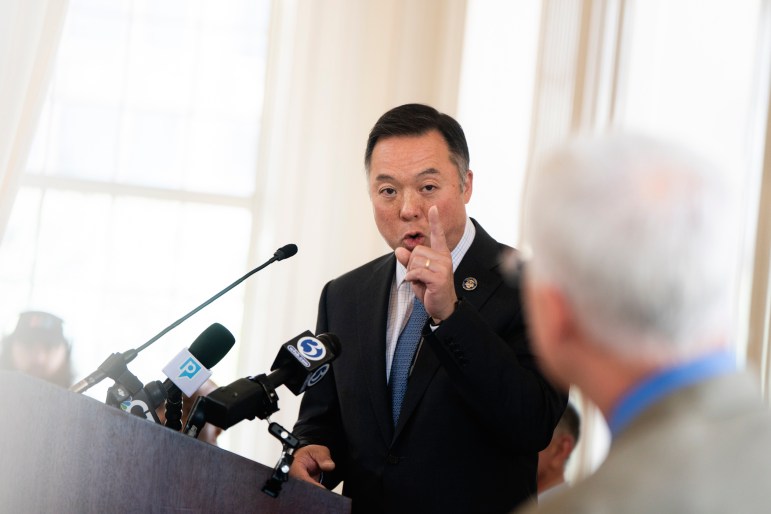
Thomas was joined by a half-dozen others, including Gov. Ned Lamont, Lt. Gov. Susan Bysiewicz, Attorney General William Tong, Rep. Matt Blumenthal, a member of the League of Women Voters and a UConn professor.
“Elections do not run themselves,” Thomas said. “They aren’t run by some faceless bureaucrats in Washington. They’re run in every single Connecticut town by registrars, town clerks, moderators, poll workers — people from both parties, people who live in the communities they serve.”
She noted that votes are cast on paper ballots, tabulated by scanners that are not connected to the internet as a guard against hacking. The “proof” she referenced at the post-election audits conducted at UConn, overseen by a computer science professor, Alexander Russell.
Russell said those audits never have found a significant discrepancy in the original count and the tally produced during an audit when the ballots from randomly selected polling places are scanned again.
“So you don’t have to choose between trusting a politician and trusting a machine. You can actually look at the proof,” Thomas said.
In a televised speech Thursday night, the president suggested that U.S. elections are vulnerable to fraud. The White House called it “a bombshell.”
“If you look at voting today, it’s in such bad shape in so many states,” Trump said. “And we are committing to fix it, and we are also committing to be working with those states and local jurisdictions to help them fix and patch known technical vulnerabilities before the midterm elections.”
But he offered no evidence that votes were changed due to those supposed vulnerabilities.
The next day, a federal judge in Connecticut dismissed a Trump administration lawsuit that sought access to Connecticut’s full voter registration data, including confidential information such as driver’s license numbers and Social Security numbers.
In her decision, U.S. District Judge Kari A. Dooley found that the Department of Justice had no authority under the Civil Rights Act of 1960 to require Connecticut to hand over its voter registration list, as the list was created by the Secretary of the State and not covered under the federal law.
Tong said in a statement, “This lawsuit was an illegal attempt to disenfranchise Connecticut voters, and today, the court shut it down. The Constitution is clear: the president does not control our elections and has no right to manipulate Connecticut voter rolls. … We will not be bullied into handing over sensitive voter information just because Trump demands it.”
The dispute began in January when the DOJ’s Civil Rights Division filed a lawsuit against Connecticut after Thomas declined to provide the DOJ with all of the voter registration information that was requested. She said Connecticut law prohibited her office from disclosing driver’s license numbers and Social Security numbers to the public or government agencies.
The lawsuit was one of 22 that the DOJ filed against other states and the District of Columbia. Some have been dismissed; others are ongoing.