


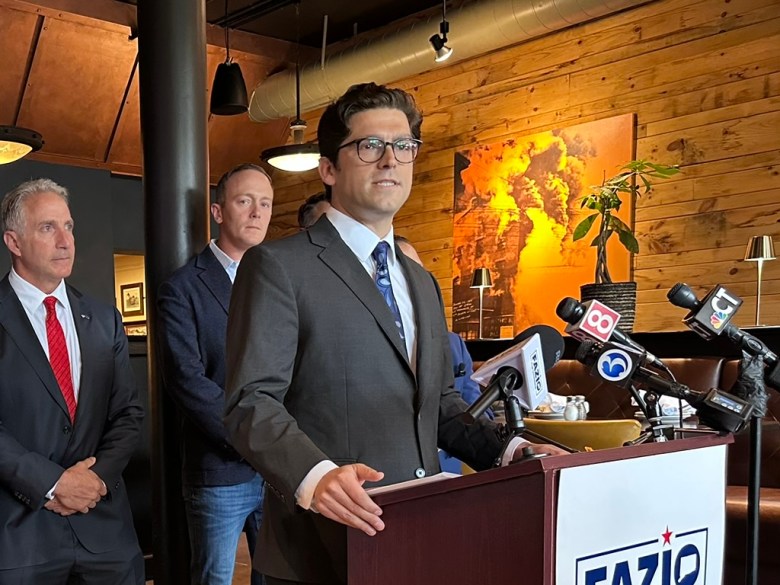
Republican gubernatorial candidate Ryan Fazio nibbled Thursday at the edges of a national controversy over data centers that grew hotter Monday with President Donald Trump mocking opponents, even those who are in his own party and on the ballot this year.
“The only reason that communities throughout the U.S.A. should not want Data Centers is if they want to end up being backwards and poor,” Trump posted on his Truth Social site. “If they want to be successful and rich, with far lower taxes and jobs all over the place, let Data Reign. The good news is that there are plenty of other places that want them.”
Fazio sidestepped the broader controversy — or any conflict with the president — by focusing his opposition to a bipartisan economic development measure that Gov. Ned Lamont signed into law five years ago with hopes of drawing NASDAQ, the tech-heavy stock index, to Connecticut.
The law offered a sales tax rebate that has been used by just one company: Cigna saved an estimated $17 million of the $21 million in sales taxes on a projected $386 million in improvements to its data center in Windsor through July 1, 2025, according to the Department of Economic and Community Development’s annual report.
“We now have a very clear example of unfairness and unaffordability in the case of the Windsor data center — $17 million in a special tax subsidy for a data center in Windsor paid for by you, the taxpayer,” Fazio said in a press conference in Windsor.
Fazio, the ranking Republican on the legislature Energy and Technology Committee, said he was not calling for a blanket ban or moratorium on data centers, which are major consumers of electricity that are blamed for increasing rates by driving up demand.
“We’re calling to end this special tax benefit for data centers, to put guardrails on the industry, and to require that they bring their own power if they are to plug into the grid,” Fazio said. “These are common-sense reforms that will protect taxpayers, will protect ratepayers, make Connecticut more affordable.”
Public and private polling indicates that the rapid growth of artificial intelligence and the data centers necessary for A.I. are a potent issue.
The National Republican Senatorial Committee warned in a recent memo reported by the New York Times and others that former U.S. Sen. Sherrod Brown, a Democrat seeking a comeback in Ohio for the seat once held by Vice President JD Vance, is using data centers to generate opposition to U.S. Sen. Jon Husted, R-Ohio.
“Ohio is one of the leaders in building these AI factories. Brown has made his opposition to them the centerpiece of his campaign against Husted. Brown is using it because it works. More than any other thing in this race, data centers are the anchor hanging around Husted’s neck,” the NRSC wrote in an Aug. 18 memo.
Fazio said he was unaware of Trump’s widely reported social media mockery of opponents to data centers.
The bill passed five years ago preceded the A.I. revolution — and the growing hostility to data centers.
“This was not about hyperscale data centers and what we’re all thinking of now. This was for data centers that could be used for biotech companies,” said Sen. James Maroney, D-Milford, the legislature’s expert on A.I. “It was about insurance companies being able to better provide the services and keep their data centers and invest in an existing data center.”
Legislative leaders fast-tracked the bill with an emergency certification that bypassed the normal process of review by legislative committees or a public hearing. It passed on votes of 29-5 in the Senate and 133-13 in the House and was signed by the governor on March 4, 2021.
Only one Republican in the Senate was opposed. Fazio won his Senate seat in a special election five months later.
Maroney was dispatched by the governor’s campaign to offer a rapid rebuttal to Fazio.
“We passed this back at a time before hyperscale data centers were envisioned, and many other states did the same thing,” Maroney said.
The majority of states waive at least some of the sales taxes on computer hardware equipment for data centers, he said, citing a survey by the National Conference of State Legislatures.
“And some even give incentives reducing the cost of electricity for data centers, which we do not do,” Maroney said.
The 2021 law authorizes DECD to reach tax incentive agreements with “qualified data centers” for 20- or 30-year terms, depending on the size and location of the investment. To be eligible, a data center must agree to make a “qualified investment” of at least $50 million if located in an enterprise zone or a federal opportunity zone or $200 million if located elsewhere.
The law also exempts the improvements from the property tax, while allowing host communities to negotiate offsetting fees.
The program is one of many offering tax incentives for capital investments and job creation and retention. Their efficacy is a frequent source of legislative debate.
Fazio counted himself among the doubters.
“I think that everybody needs tax relief in this state, and when you give one dollar to a large corporation, that tax relief is coming at the expense of everybody else,” Fazio said. “Why isn’t this small business that we’re in today getting a special tax benefit? They create jobs. They create more jobs than the data center, and yet they don’t have access to a special tax benefit.”
The press conference was in the bar of a downtown restaurant in a converted firehouse.
