


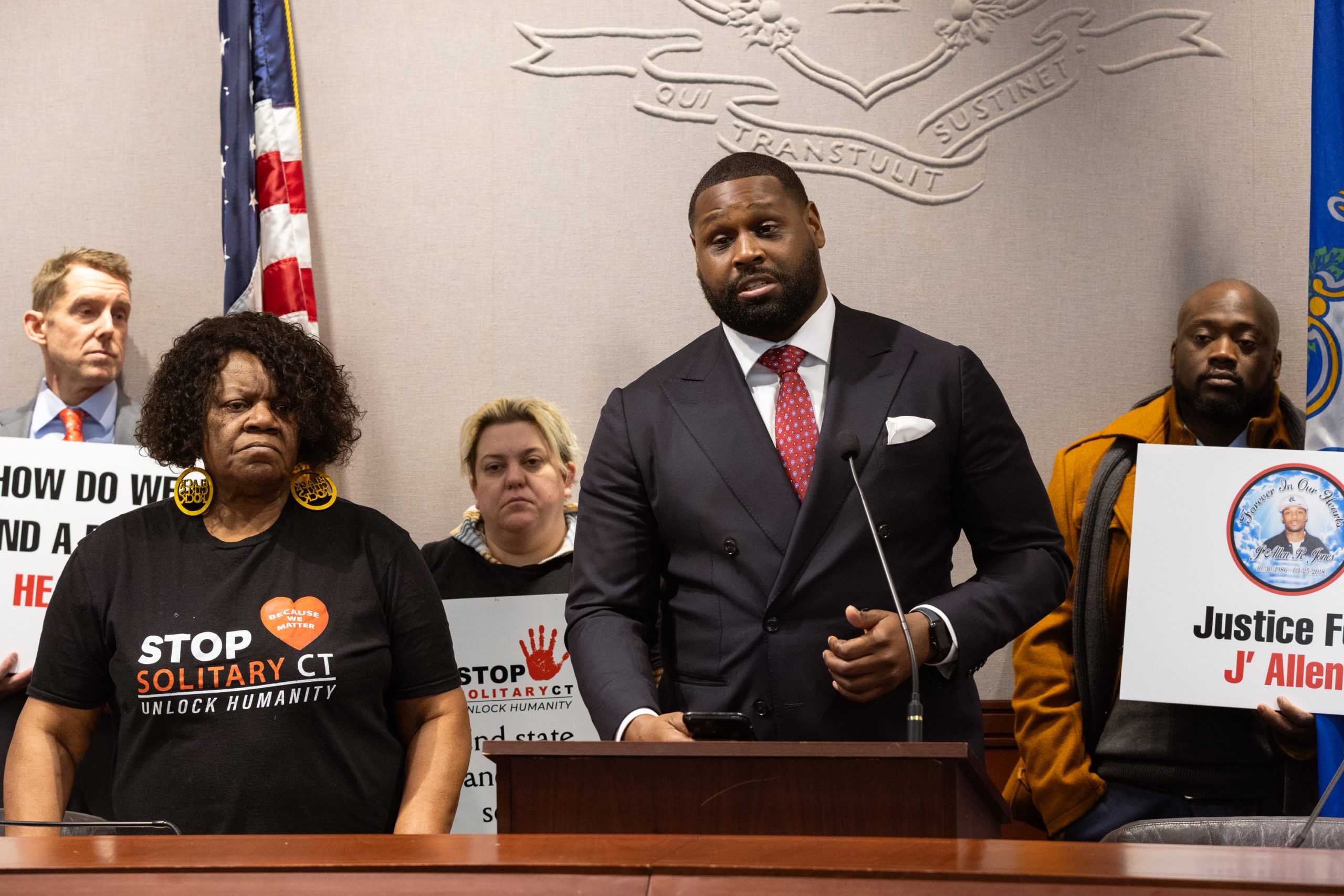
Connecticut’s independent prison watchdog DeVaughn Ward said Tuesday he plans to leave the post next month and join a personal injury law firm.
Ward’s appointment in September 2024 made him Connecticut’s first correction ombuds since the office shuttered in 2010 to cut costs. His term was slated to end in January 2027, but according to the press release announcing his departure, Ward’s last day will now be Oct. 16.
In a phone interview, Ward explained that the timing of his early departure was dictated by the needs of the law firm he’ll be joining. He expressed hope that the announcement of his upcoming departure might speed up the process of selecting his successor.
“It has been an honor being able to serve the incarcerated population in Connecticut,” he said. “I’m very proud of the work that we’ve done, and I’m very much looking forward to the next chapter.”
The next ombuds will serve in the post for four years. The state legislature passed a law last year extending the term length of the appointment.
Ward said his main accomplishments as ombuds were obtaining increased funding for the office and bolstering its statutory authority.
The Office of the Correction Ombudsman initially had an annual budget of $400,000 and Ward was its sole employee.
“It really didn’t speak to the challenge that was laid out for the office in terms of providing oversight over all the correctional facilities and the dozens of halfway houses we have here in the state,” he said.
Since Ward began urging lawmakers to increase the office’s funding, its annual budget has tripled, surpassing $1.2 million. Ward now works with four staff members, and he said the office will expand to 10 or 11 staff members by the end of 2026.
Ward also pushed for necessary “statutory tools” for the office, such as subpoena power and the ability to carry out unannounced prison inspections and use electronic devices to document prison conditions.
His office released regular reports on its findings, including a March report that spurred the Connecticut legislature’s elimination of medical copayments for incarcerated people and the Department of Correction’s planned rollout of healthcare reforms.
Before assuming the role of ombuds, Ward worked as a criminal law and personal injury attorney and litigated high-profile cases against Connecticut’s Department of Correction. He secured settlements in lawsuits alleging inadequate medical care in Connecticut prisons, including a class-action lawsuit filed by incarcerated residents who said they were denied treatment for Hepatitis-C.
Cindy Prizio, executive director of Connecticut civil rights group One Standard of Justice, praised Ward’s performance as ombuds. She described him as a “strategist,” highlighting his successful lobbying efforts to increase the office’s funding.
“I’m just delighted with his track record,” Prizio said. “I don’t think anyone could have come in and done a better job than he did.”
But Barbara Fair, who runs the criminal justice advocacy group Stop Solitary CT, expressed frustration about what she described as a lack of transparency from Ward’s office. (Fair previously applied for the ombuds role and was ranked second in early 2024 by the Correction Advisory Committee, which reviews applications for the role and presents the governor with three finalists.)
She noted that at the start of Ward’s tenure, she’d urged him to hold regular meetings to keep community members informed about his work. The office scheduled its first public town hall for Sept. 23, two years after Ward assumed the role.
Ward said he spent most of his term getting the office up and running by hiring staff, visiting Connecticut’s 13 correctional facilities and investigating complaints from incarcerated people.
“I was really heavily focused on the operational needs of the office, and I think now we’ve reached a point where the operational capacity of the office is stabilized, and I think now we actually have something to talk to the community about,” he said.
Fair, whose advocacy group opposes strip searches and solitary confinement, said Ward did not respond promptly to her questions about what his office was working on.
For example, Fair said she repeatedly asked Ward if he had set up confidential drop boxes for prisoners to submit complaints to his office. She said she only learned that these drop boxes were being implemented in Connecticut prisons in Tuesday’s press release announcing Ward’s departure.
Ward said the design for the drop boxes hadn’t been finalized until a few weeks ago and his office is in the process of installing them in Connecticut’s prisons.
“Barbara Fair is somebody who applied for this job, didn’t get it, and has been frustrated by my entire term,” he said. “I hope that she finds a way to work with my successor in a way that she could not find to work with me.”
Both Prizio and Fair voiced concerns about the timeline for finding Ward’s replacement, citing how lengthy the process had been just to place Ward in the role.
After the law reestablishing the ombuds’s office passed in 2022, the Correction Advisory Committee posted the job application in June 2023 and later narrowed down the applicant pool to three finalists. Though the committee in January 2024 recommended civil rights attorney Ken Krayeske for the role, Gov. Ned Lamont instead appointed the third-place finalist, public defender Hilary Carpenter.
Lamont faced fierce backlash following Carpenter’s appointment, and the legislature never confirmed her for the role. Instead, the governor and lawmakers formed an agreement that he would collaborate with the Black and Puerto Rican Caucus to appoint an interim ombuds that summer. The Correction Advisory Committee then reopened the hiring process for the permanent role that September.
Lamont announced Ward’s nomination as interim ombuds in August 2024, and Ward took office the following month. Ward was confirmed by the legislature as permanent ombuds in April 2025.
