



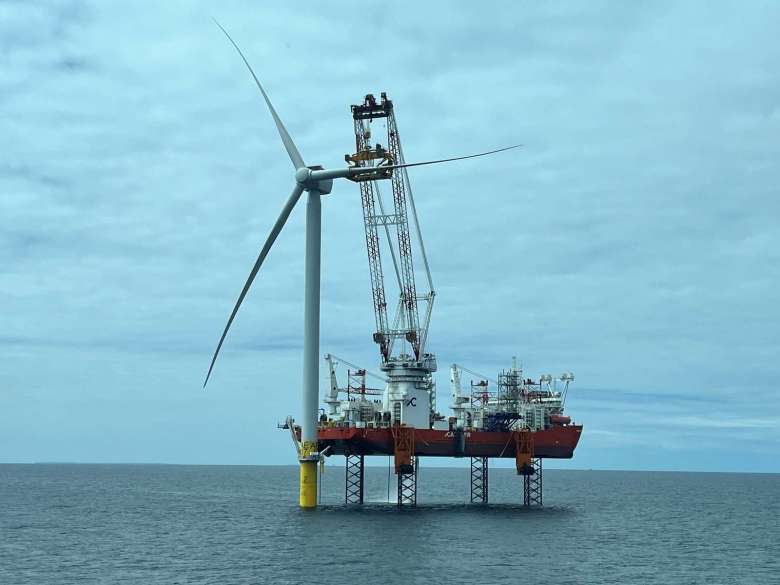
Another offshore wind project just wrapped up turbine construction in the U.S., despite the Trump administration issuing not one but two stop-work orders against the installation.
The $6.2 billion Revolution Wind farm has installed its 65th and final turbine. The project has been producing carbon-free power for Rhode Island and Connecticut since March, but at partial output. It will be able to deliver up to its full 704-megawatt capacity “later this year,” per one of its developers, the beleaguered Danish energy giant Ørsted.
“The completion of Revolution Wind is an important milestone for Rhode Island, Connecticut, and the broader New England region,” said Hillary Bright, executive director of offshore wind advocacy group Turn Forward in a Thursday statement. “As electricity demand continues to grow, the region needs more generation that can strengthen reliability, diversify the power supply, and provide greater certainty for consumers.”
Offshore wind was once meant to anchor Northeast decarbonization plans. But, at least for now, the Trump administration has dashed those hopes. President Donald Trump has pursued a relentless line of attack against the sector and managed to essentially halt new development.
When Trump was elected in November 2024, research firm BloombergNEF expected the U.S. to build 39 gigawatts of offshore wind by 2035. By the end of 2025, it had slashed that figure to just 6 GW — an amount that assumed only the five offshore wind projects already underway would get built.
Trump tried to stop these in-progress projects, too. The Interior Department issued a stop-work order to Revolution Wind in August 2025 due to unspecified national security threats. That order was thrown out by a federal judge one month later. The agency had issued — and then revoked — a similar order to the Empire Wind project in New York months earlier.
In late December, the Trump administration threw a Hail Mary pass and issued new stop-work orders to all five projects underway. Project developers and state attorneys general challenged each one in court, and beginning in January, judges struck down the orders, one by one.
The Trump administration has since shifted from trying to stop these projects to offering refunds to energy developers who are willing to forfeit the offshore wind leases they had previously purchased. So far, the administration has agreed to hand out nearly $4 billion in taxpayer funds via these deals — moves that serve only to, as one analyst put it, “shoot a corpse.”
Along with Revolution Wind, two other large-scale offshore wind projects are fully complete in the U.S.: the South Fork Wind project near New York and Vineyard Wind 1 off the coast of Martha’s Vineyard. The Coastal Virginia Offshore Wind installation — a whopping 2.6-GW project — began delivering power to the grid in March and should wrap up construction next year. Two others, Empire Wind and Sunrise Wind, are both expected to be fully operational in 2027.
Revolution Wind will help bolster New England’s constrained grid.
During the historic Winter Storm Fern earlier this year, Vineyard Wind 1 showed up big for the region even before the project was fully operational. The South Fork Wind farm performed well for New York during the same frigid stretch. No surprise there: Offshore wind is known for its strong winter performance.
Then offshore wind came through again when record-setting heat descended on New England this summer. During the July heat wave, carbon-free electricity from Vineyard Wind 1 and Revolution Wind allowed utilities to rely less on dirty, expensive oil-burning peaker plants.
As President Trump continues to try and thwart the industry’s prospects in the U.S., Revolution Wind and the other projects that make it across the finish line will keep proving their worth: They provide clean electricity that states, particularly in the Northeast, desperately need.
This story was first published Sept. 18, 2026 by Canary Media.