



Later, while working at a well-staffed daily in New Haven, I would have the luxury of time to write feature stories and occasional, extended, polished pieces, but it was at the Hartford Times, in Connecticut’s capital, that I learned to write under pressure, a few times dictating a breaking news story from a pay phone as I composed it in my head from notes.
Once, back in the office, I had two editors reading over my shoulder as I typed an article that was going to run on the front page. A newbie, I was amazed that they were literally holding the presses for my piece. It was an exciting, highly competitive, rapid-fire business, and I thrived on it.
American cities used to have multiple daily newspapers, and it was also at the Hartford Times that I learned that most cities were destined to have only one — which today is in itself a challenge. Fifty years ago, on October 20, 1976, only eight months after I started there, the Hartford Times, once Connecticut’s largest and most prestigious newspaper, folded after 159 years. Even its 1962 Pulitzer couldn’t save it.
My first day at the Times, I had been assigned to cover an evening meeting in Bolton, 14 miles outside the city. Late that night, on my way back to Hartford, I came to an emergency scene where 150 firefighters from eight towns were trying to save an almost-300-year-old burning house. Built in 1689 and once a stop on the underground railroad, the house had many historic features, as well as art and antiques.
A photographer from my paper lived nearby and heard about the fire on his police radio; he showed up, so we had photos and the story. Unfortunately, the house was a total loss. The next morning, when the first of several rolling editions of the Times came out, I had my first page one story, at the top of the page, my first day on the job.
The dozens of news stories and personal memories I have from my brief career at the Hartford Times don’t capture the sadness of the passing of a daily newspaper and what a great loss it is to a community. I only lost a job and had another within days. The city, the metropolitan area and the state, lost a newspaper. On the community level, that’s like losing an arm or a leg. I miss the time when just about everyone got a morning or evening paper — and some got both.
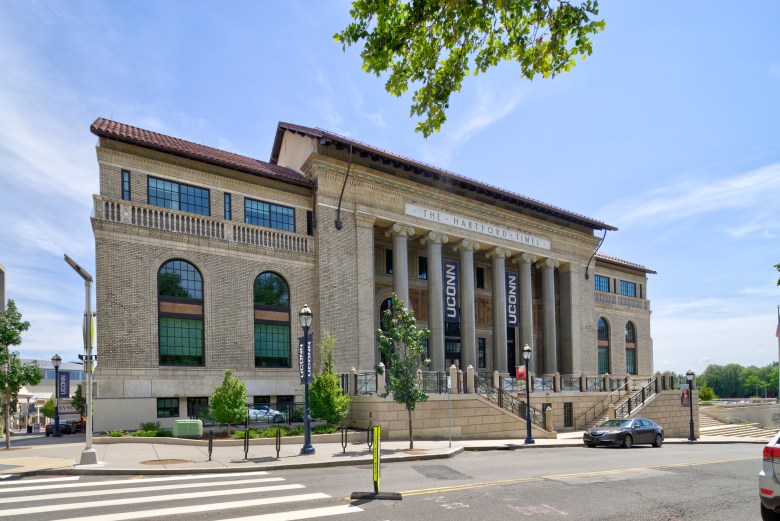
The Times was founded in 1817, and a century later, then the largest-circulation and most influential newspaper in the state, it built a grand, Beaux-Art style, six-columned building adjacent to Hartford City Hall. Presidents Truman, Eisenhower, Kennedy and Johnson would all speak at the top of the dual stairways. After the newspaper closed, the building endured, and a decade ago, keeping the beautiful façade, it was rebuilt and expanded to house the downtown Hartford campus of the University of Connecticut.
A mile away is the nondescript building that once belonged to the Hartford Courant, which was founded on October 29, 1764, America’s oldest newspaper in continuous circulation. I delivered copies of the 200th anniversary issue on my paper route in 1964. About then, the Courant, with a circulation of 137,000, exceeded the Times for the first time, and 12 years later it became the only show in town. During Covid, the severely depleted staff vacated the building to work remotely, and later it was sold.
According to a 2014 New York Times article about the Courant’s 250th anniversary celebration, the paper had peaked in 1993, when Sunday circulation hit 323,892. Then came the internet. By 2000, daily circulation was down to 216,000, and by its big anniversary in 2014, Sunday circulation was down to 180,000 and weekdays were down to 120,000. According to the Sept. 30, 2026, Courant publisher’s statement to Alliance for Audited Media, the Courant’s print circulation is down to 24,948 on Sunday, and 14,695 to about 21,000 on various weekdays; however, paid digital circulation is up to 50,976.
I grew up in a newspaper family. Back in hot-type days, my dad was a linotype operator at the Courant for three decades, my brother worked in the Courant composing room for several years, and I worked there four summers. The Courant had seven editions, and my dad would bring the first one home with him at 1 a.m.
When I was 13, I got a Courant paper route, and delivered it every morning, seven days a week, for over three years. I took over a route with many apartment buildings but barely 30 customers, and I built it to 80 daily and 125 Sunday customers. Little did I know I was contributing to losing my first reporting job a decade later.
Sixty years ago, I got hooked on daily newspapers, and after all this time, there is still no better, more enjoyable way to get news. Even with online options, there is nothing as good as a venerable broadsheet. When daily newspapers reigned, we were a better-informed, more cohesive society. With a common source thoroughly covering our city or town, our state, and nation, we started our day on the same page, and those bent on spreading misinformation and disinformation had a much harder time doing so.
Over the summer, I spent a day in downtown Hartford, the city where my father’s family settled in the 1850s and where my mother’s family arrived in the 1920s, where I grew up, and where I have lasting ties. I visited the former Hartford Times building, which still bears its name on the portico. Without UConn ID, I couldn’t go far beyond the café, where I had lunch, but I didn’t need to go any farther.
Inside, nothing was the same. I was almost as sad as I was the day paper closed.
Tom McKone is a retired teacher, principal, and library administrator in Montpelier, VT.