


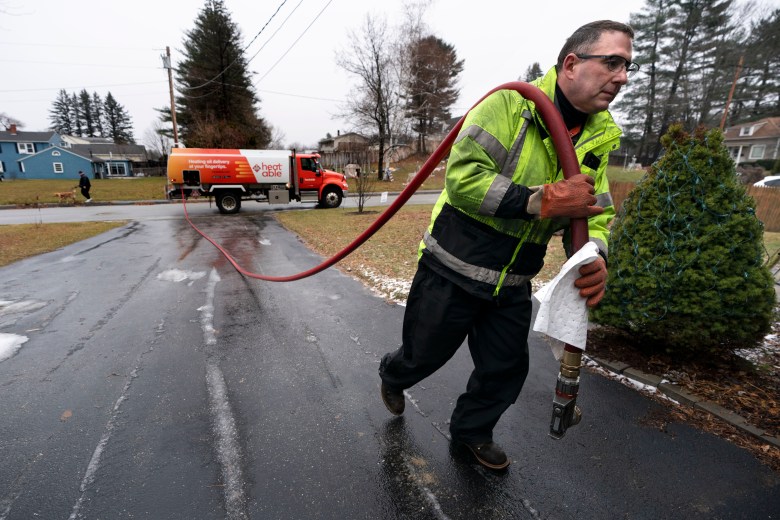
State officials thought two years ago they’d stemmed the exodus of fuel oil vendors from Connecticut’s heating assistance program.
But those numbers continue to slip.
And with U.S.-Iran war driving oil prices sharply higher than last year, an industry leader said this week the state’s failure to fix compensation issues is putting the program’s future in jeopardy.
“Why shouldn’t we have a program that’s transparent? Why shouldn’t we have a program that’s fair?” Chris Herb, president of the Connecticut Energy Marketers Association, said Tuesday. “The price-volatility risk is no longer tolerable.”
But state Department of Social Services spokeswoman Christine Stuart said Wednesday programmatic reforms have been made — including increased compensation for vendors — and that enough fuel oil companies are participating.
“Though we may have fewer vendors overall, we expect to meet our statutory requirement to have an adequate supply of vendors who have historically indicated a willingness to take on new customers,” she said.
At issue is the Connecticut Energy Assistance Program, which is expected to help more than 94,000 households earning less than 60% of the statewide median income to keep warm this fall and winter.
Though run by the state, the program chiefly doles out federal funds, made available through the Low-Income Household Energy Assistance Program, commonly known as LIHEAP.
But while federal funding for energy assistance generally has grown modestly since the early years of the COVID pandemic in 2020 and 2021, demand has surged faster.
Gov. Ned Lamont’s administration estimated in August that Connecticut’s LIHEAP grant would be $86.3 million this heating season, up 5.6% from last year. Meanwhile, projected demand is up about 11%.
But even before COVID, fuel oil companies were beginning to leave a program they said often was costing them money.
CEAP relies on a complex system that limits how much participating businesses can charge program-eligible households. And that retail price isn’t set at the same time a fuel distributor purchases home heating oil at one of the terminals spread across Connecticut.
So, what happens when a vendor pays much more to a fuel wholesaler than it gets in reimbursement from the state?
CEAP lost more than one-third of its vendors, from 325 to 214, between the 2016-17 and 2023-24 heating seasons, according to the nonpartisan Office of Legislative Research.
Katie Childs, vice president of Tuxis-Ohrs Fuels in Meriden, said her company had participated in energy assistance for decades until it dropped out five years ago.
The unstable pricing mechanism was always problematic, and Tuxis-Ohrs did its best to manage.
“We will do that because that is what we do,” she said. “We want people to be warm.”
But when the Russian invasion of Ukraine began in February 2022 and home heating oil prices jumped more than $2.50 per gallon in less than three months, the potential losses became too much for many small and mid-sized vendors to absorb, she added.
Connecticut lawmakers tried to fix the problem in 2023 and 2024, enacting laws setting county and regional pricing standards and mandating fair compensation for vendors.
Fuel distributors participating in heating assistance jumped up from 214 to 259 immediately after lawmakers finished those changes.
And while Stuart said Wednesday that vendors are paid “actual date of delivery prices,” the industry insists the price lag remains — and that the numbers back them up.
Vendor participation in heating assistance was down to 207 companies last winter, and Stuart said it now stands at 192.
Further complicating matters, the average retail cost of home heating oil stood at $5.71 per gallon earlier this week, as reported by the state Department of Energy and Environmental Protection. That’s 55% higher than where prices stood in early November last year and more than double the price when the war with Iran started on Feb. 28.
Nora Duncan, vice chairwoman of the state’s Low-Income Energy Water Advisory Board and director of the AARP’s Connecticut chapter, said it’s crucial this problem be addressed now.
“We can’t keep people warm with a program if they can’t get their fuel,” she said.
Lamont dedicated $12.7 million in state funds to the current CEAP program to allow more rounds of assistance grants to be issued earlier in the heating season.
And U.S. Rep. Rosa DeLauro, D-3rd District, ranking member of the House Appropriations Committee, said in late October that many vulnerable households are at risk this winter because of “the president’s war of choice,” adding she’s hopeful both parties in Congress will support additional LIHEAP funding for states.
“This is not a partisan issue,” she said.
Stuart said the department has authorized a 15-cents-per-gallon increase in overall reimbursement for vendors this season.
The social services department “always wants to provide our residents with as much choice as possible in selecting vendors while staying within our budget,” Stuart said. “This is a constant challenge in administering a federally funded block grant program with fixed funding.”
