


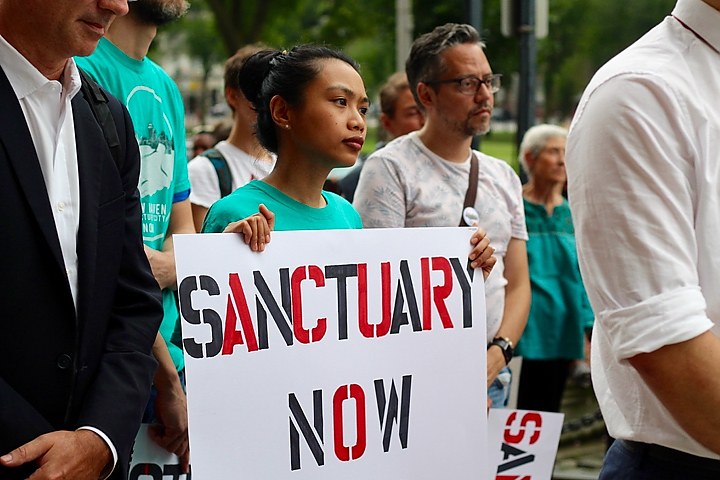

Washington – While President Donald Trump’s campaign is accusing Joe Biden of wanting to “defund the police,” the Justice Department has been doing just that, withholding federal policing money from Connecticut and some of its municipalities over their “sanctuary” policies.
Connecticut and its cities are not the only target – federal policing money for a number of “blue” states, including California, New Jersey and New York, has been withheld too –and split federal court decisions make the issue ripe for U.S. Supreme Court review.
In 2017, the Justice Department imposed new conditions on states and municipalities that applied for public safety grants known as the Edward Byrne Memorial Justice Assistance Grants, or Byrne JAG grants. Congress created the program in 2006 to provide “flexible” funds for state and local law enforcement programs.
Connecticut has received about $1.5 million a year in Byrne JAG grants and municipalities here got about another $1 million.
But since the 2017 conditions were imposed, applicants must certify they are not “sanctuaries” in order to obtain the grant money. That means they had to certify that they allow federal immigration agents access to prisons and that they provide advance notice when prisoners wanted on an immigration detainer are being released. They must also certify compliance with a federal law, known as Section 1373 of the Aliens and Nationality Act. It says states and localities can’t bar local officials from communicating with the immigration authorities about the citizenship status of an individual.
Those new requirements were rejected by most “sanctuary” jurisdictions and touched off an avalanche of lawsuits against the Justice Department.
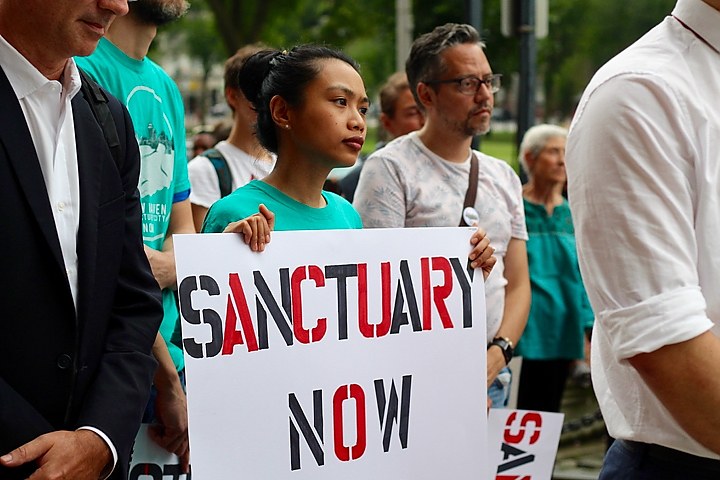
The state joined a lawsuit brought by New York, New Jersey, Washington state, Virginia and Massachusetts that called the imposition of the conditions “arbitrary and capricious.” Connecticut Attorney General William Tong has called the conditions “an overt and obvious retaliation against the state of Connecticut,” and “an attack on the people of this state.”
Last year Connecticut strengthened its Trust Act, a law that limits information sharing with federal immigration agents and prohibits state law enforcement from detaining someone wanted by those agents unless they have been found guilty of a serious felony.
Meanwhile, many Connecticut towns have their own policies about cooperating with federal immigration authorities.
Some of them — Norwalk, East Hartford, Hartford, Bridgeport, Stamford, Waterbury and New Haven — sued the Justice Department separately as part of a lawsuit led by the city of Evanston, Ill, and the U.S. Conference of Mayors.
The plaintiffs all argue that the Trump administration’s actions violate federal law and put communities at risk because they can no longer rely on these public safety grants. The lawsuits also say the conditions are unconstitutional since, in authorizing the grants, Congress has not placed those conditions on Byrne grants.
“The Constitution is clear cut – it gives Congress the power of the purse,” said William David Gans director of the civil right project at the Constitutional Accountability Center.
The so-called “sanctuary” cities and towns won most of their lawsuits in federal courts across the nation.
For instance, a federal district court in Illinois has permanently enjoined Attorney General William Barr from imposing Byrne grant conditions against Evanston and all towns involved in that legal challenge including Norwalk, East Hartford, Hartford, Bridgeport, Stamford, Waterbury and New Haven.
But, earlier this month, the U.S. Court of Appeals in the 2nd Circuit rule against the New York challenge to the Justice Department that had been joined by Connecticut and several other states.
The 2nd Circuit concluded that the Byrne restrictions requiring applicants to certify compliance with “all other applicable federal laws” is broad enough to require applicants to comply with federal law prohibiting restrictions on communicating citizenship information to federal immigration authorities. The court also held that adding this condition didn’t violate the 10th Amendment or the Constitution’s spending clause.
If the decision stands, it means the Trump administration can continue to withhold millions of dollars from law enforcement agencies in states and cities that do not cooperate with U.S. immigration authorities.
“I believe it’s a classic case for the Supreme Court, because there’s a split in the circuits about a federal law,” Gans said.
Presidential campaign’s focus on police funding
Meanwhile, one of the most dramatic television ads in support of Trump’s re-election, called “Break In,” incorrectly ties presumptive Democratic presidential nominee Biden to the “defund the police” campaign born of social justice protests over George Floyd’s death at the hands of Minneapolis police.
The ad shows an elderly woman watching TV while someone is trying to break into her home. In the background, Sean Hannity of Fox News can be heard falsely reporting, “Joe Biden said he’s absolutely on board with defunding the police.” Biden is then heard saying, “Yes. Absolutely.
The woman calls the police and hears this message “You’ve reached 911. I’m sorry that there is no one here to answer your emergency call. But leave a message and we’ll get back to you as soon as we can.”
These words flash on the screen: “You won’t be safe in Joe Biden’s America.”
While many Democrats like Biden have rejected the “defunding the police” movement, they support tying federal policing money, like the Byrne grants, to voluntary reforms, including the banning of choke holds.
