



As my home, Hartford has made me into the individual that I am today. Because I have been fortunate enough to rise to an office that allows me to serve the people that made me who I am, I am truly a product of my environment. Growing up in Hartford not only gave me a local perspective, but I also gained a more inclusive perspective because of the experiences I had in my youth, which were unique from any other area of Connecticut. These diverse experiences I speak of range from gentrification, to the wage gap, to mass incarceration.
CT Viewpoints
We welcome informed and responsible commentary about local, state and national public policy from all Connecticut residents and organizations. Submit one here.

Posted inCT Viewpoints
Children of color need better trauma screening
There is ample evidence affirming that racial and ethnic disparities beginning in early childhood persist over an individual’s life-course. Many of these disparities are linked to adverse childhood experiences (ACEs) that if properly detected could be amenable to treatment.

Posted inCT Viewpoints
CSCU must be more transparent about ‘Students First’ plan
Connecticut State Colleges and Universities Communications Director Leigh Appleby’s recent editorial, attempting to counter the fears of a student who had written a previous editorial, does a disservice to the people of Connecticut and unfairly castigates the student. Moreover, Appleby’s editorial points out many of the issues those of us working at Connecticut’s community colleges have with “Students First.”

Posted inCT Viewpoints
In response to ‘Mental health patient safety must come first’
I write this letter to the editor in attempt to dispel some of the myths tied to requirements necessary for a psychologist to prescribe medication. In Dr. Tichianaa Armah’s April 1 article, she states, “SB 966 would permit psychologists to prescribe medications after taking a 400-hour online class, and supervision by an MD, or APRN for as little as 1,000 hours.” This is particularly troubling as Dr. Armah’s fails to distinguish between credit clock hours and clock hours. Presumably, her calculations come from dividing 400 didactic hours by 40-hour weeks. In doing so, she comes to 10 weeks of training. Similarly, she suggests only 25 weeks of patient contact. However, this is unequivocally false.
Posted inCT Viewpoints
Philanthropy to the rescue? Not in New Haven schools
Last Friday, Gov. Ned Lamont announced a $100 million donation to the state of Connecticut from the Dalio Philanthropies “to strengthen public education and promote greater economic opportunity.” The five year initiative is to be matched two-to-one by the state and unspecified private donors, with state funds this year coming from surplus dollars. On its surface, this sounds like good news. The New Haven Public Schools face a staggering $30 million deficit. Our children, ages 4, 8, 9, and 11, attend Columbus Family Academy and the Engineering Science University Magnet School.

Posted inCT Viewpoints
CT schools must close the achievement gap more quickly
The following essay — one of four to be published this week — appeared in the recently released 2018 KIDS COUNT Data Book, Taking Stock: Considering the Future of Child Well-Being and Family Opportunity in Connecticut. It is published by The Connecticut Association for Human Services (CAHS), an affiliate of the Annie E. Casey Foundation’s KIDS COUNT […]
Posted inCT Viewpoints
Legislators, if this is noble work, please fund it that way
They say that there are two most important days in our lives, the day that we are born and the day that we find out why. Many people are never fortunate enough to experience that second day. I was born on June 5, 1980, and I started working for Oak Hill, the state’s largest private provider of services for people with disabilities, on April 30, 2001. I was 20 years old, and I had no idea what I was doing or what I was getting myself involved in.

Posted inCT Viewpoints
Child poverty in Connecticut hurts us all

Decades of research continue to confirm the obvious; poverty is bad for children. As evidenced by a 2015 report from the Urban Institute, the more time children spend living in poverty, the worse their outcomes are across nearly every domain. Compared to their peers who are never poor, the nearly 40 percent of children who experience poverty at some point during their childhood fare worse in educational achievement and employment, teen births, and even involvement with the criminal justice system. When we fail to alleviate generational poverty we prevent our children﹘and our society as a whole﹘from reaching their fullest potential.

Posted inCT Viewpoints
It’s time for a People’s Budget — and it’s doable
To close observers of state politics, Gov. Ned Lamont’s budget proposal was no surprise. More cuts in vital services and investments, but no tax increases for the wealthy. The General Assembly will undoubtedly produce a rather different document, but for now the governor’s budget is still the only game in town. However, progressives might look to Washington for inspiration.

Posted inCT Viewpoints
Keeping health insurance statements private
Is it right to force a 25-year old man or woman to share intimate health details with his or her parents or spouse, for instance, when he or she is being treated for a sexually transmitted disease, substance use, or depression?

Posted inCT Viewpoints
Joe Biden and a brave, impersonal, new world
I have always admired people like Joe Biden — people who are not only capable of genuine, physical expressions of affection for perfect strangers, but who also seem to relish in it. Sure, I consider myself a compassionate person and I can physically express love and affection without hesitation with my wife and kids. But I have something of a mental-block for it when it comes to strangers and even for people in my church and my friends, and I recoil with horror at the thought of bringing that sort of feeling into the workplace.

Posted inCT Viewpoints
Expand eligibility for the Care4Kids program
For every dollar invested in high-quality early childhood education, the public saves $13 in the place of costs for special education, public assistance, unemployment benefits, and crime. Expanding eligibility for families in the Care4Kids program would greatly improve the lives of not only children and families but Connecticut taxpayers as well.
Posted inCT Viewpoints
Forget ‘trickle down.’ It’s time for ‘bubble up’ economics
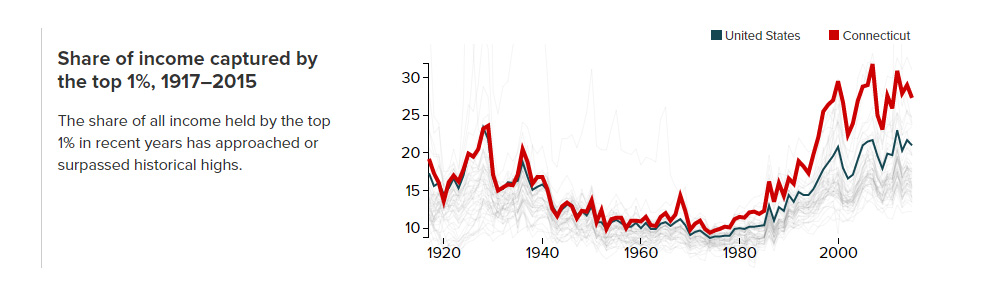
My interest in politics was sparked by a college course. It was late 80s – early 90s and my professor made no attempt to disguise for his distaste for Reaganomics, epitomized by the “trickle down” economics policy the president embraced. I graduated into the worst job market in decades and, brief Internet bubble aside, the years have shown the falseness of the premise that putting money in the hands of the top 1 percent of shareholders, investors and titans of industry would make its way down to stimulating economic prosperity for the majority of Americans– the recent tax cut to wealthy people and corporations included.

Posted inCT Viewpoints
PFAS threaten our water supply
Water is life! Clean water is essential to our health, our environment and our economy. As a public health advocate and a homeowner with a private well, I was alarmed to read reports of PFAs found in Greenwich wells and in water supplies all over the country.

Posted inCT Viewpoints
His impression of CSCU ‘Students First’ impact is wrong
This note is in response to a recent op-ed by a community college student published in CT Viewpoints. The Connecticut State College and University system fully agrees that community colleges can and must continue to be the most affordable, accessible option for students to receive a quality education in Connecticut. I applaud the author for being engaged in public discourse and making his voice heard on an important topic.