
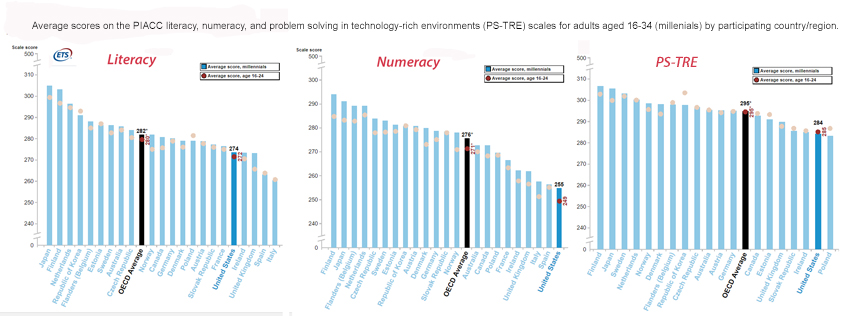

Connecticut Superior Court Judge Thomas Moukawsher wrote in his September school funding decision of the “alarming” condition of education in the state’s neediest districts, citing that “[A]mong the poorest, most of the students are being let down by patronizing and illusory degrees.” He has a point – one that extends far beyond Connecticut and our poorest students. The latest results from the National Assessment of Educational Progress (NAEP), referred to as the Nation’s Report Card, found that nearly two-thirds of 12th-graders in the U.S. perform below proficiency in reading, and three-quarters perform below proficiency in both math and science.
Schools/Child Welfare

Posted inCT Viewpoints
Eligibility cuts to childcare subsidies penny wise, pound foolish
Last week, parents, childcare providers, and legislators gathered in Hartford to discuss the crucial role childcare plays in supporting Connecticut’s economy. The forum was held in response to recent news that the Care4Kids childcare subsidy program, which helps low-income families pay for childcare, will be closed to almost all new applicants. The message of the forum was clear: childcare is a critical component of the state’s economic infrastructure. Removing access to childcare for thousands of Connecticut families will cost the state more money than it will save.

Posted inCT Viewpoints
A practical solution to funding special ed in Connecticut
Every student who walks through the doors each morning at one of Connecticut’s more than 1,300 public schools has their own unique skills and abilities, as well as their own needs and challenges. But despite their differences, each of these students has something in common: the right to a quality, equitably funded education. For Connecticut’s more than 74,500 students who need some type of special education service, this right is particularly important.
Posted inCT Viewpoints
Humanities need state funds to combat ‘fake history’
How do students learn about Connecticut? Let’s hope it’s not from a textbook that sugar coats Connecticut’s history of slavery. In 2015 the Department of Education recommended incorporating Connecticut content into the public school social studies curriculum and created frameworks for doing so. But that doesn’t actually get content into the classroom.
Posted inCT Viewpoints
Don’t shift Connecticut’s unfunded liability problem onto our children
Eroding revenues, red ink and poor fiscal management continue to undermine Connecticut’s state budget. Unaltered, the present approach will make it increasingly difficult, even impossible, for our children and future generations to have a state government that fulfills its fundamental and constitutional duty to provide for a healthier, safer and more equitable society. … But the problem is about to get far worse.
Posted inCT Viewpoints
Innovation necessary to solve persistent certification problems
A recent story described concerns raised over the State Board of Education’s rapid approval of a new teacher training program. According to that story, members of the Minority Teacher Recruitment Task Force are frustrated with the level of information that they had received about the program prior to its approval. These concerns, I am sure, can be worked out among our branches of government. What is more important is ensuring that Connecticut continues with its efforts to solve the longstanding problem of minority teacher recruitment.

Posted inCT Viewpoints
Vote Tuesday for our country’s future — our children
I am a pediatrician and I vote. I vote on behalf of kids who cannot speak up for themselves. I vote so that the needs of children are prioritized by our elected leaders. I vote on behalf of the children I see in my clinic every day.
In a few short days, all of us will have the opportunity to make a difference by casting our votes, and I plan to use my vote to support our country’s future – our children.

Posted inCT Viewpoints
When righting school funding wrongs, remember charter schools
In his historic and sweeping decision on Connecticut’s broken school funding system, Judge Thomas Moukawsher announced something we have been shouting from the rooftops for years – many of Connecticut’s kids are not getting the education they deserve and was promised to them under law. They’re languishing. Their rights are being violated. It’s unconstitutional, it’s unfair and finally it seems people have woken up and are taking notice.

Posted inCT Viewpoints
CT can do better for minority teacher candidates than Relay GSE
Without question, Connecticut needs more teachers who see themselves in their students (and vice versa), who have roots in the communities where they teach, and who are well positioned to instruct in ways that are academically challenging and culturally, linguistically, and community responsive. The pipeline into the profession for teachers of color is too often obstructed and unwelcoming, and change is imperative. … But the Relay Graduate School of Education is no panacea for our pipeline problems, and instead represents the tip of an approaching iceberg that threatens the education of the state’s most under-served students and sells short the very teachers to whom we owe the best preparation, support, working conditions, and compensation available.

Posted inCT Viewpoints
Free tuition would be a disaster for private colleges
When Hillary Clinton was struggling to win the Democrat party nomination against upstart Bernie Sanders, she co-opted his idea of free college tuition for all. To appease Sanders supporters, she allowed the idea to become part of the Democrat Party platform on which she is now running. If she really attempts to promote this idea, it will be a disaster for higher education in the country. Connecticut with its longstanding private school tradition will be especially hard hit.
Posted inCT Viewpoints
Fasano: ‘DCF failing in its core function, keeping kids safe’
I wholeheartedly agree with child welfare advocates who say that children should, whenever possible and when safe to do so, be kept in their homes. Frankly, I can’t imagine anyone who would disagree. But when obvious red flags are ignored for the sake of keeping a child at home, then there is a serious problem. That is why I disagree with Richard Wexler’s portrayal of what is happening in Connecticut, and his unfair criticism of the state’s child advocate and lawmakers who have raised concerns.
Posted inCT Viewpoints
Why Connecticut’s DCF has a waiver process for kinship families
What can be more terrifying to a small child than to be removed from home and placed with people — as well-meaning as they are — with whom the child is unfamiliar? When the Department of Children and Families confronts a decision about whether to remove a child from his or her parents, staff work closely with the extended family and other “natural supports” to see if the child can be safely maintained at home or, if not, whether a safe alternative exists to the trauma of placing the child with strangers in a traditional foster home.
Posted inCT Viewpoints
Infant Dylan’s case: How Fasano — and Eagan — are getting it wrong

In every child welfare system, certain things are inevitable. The only acceptable goal for child abuse tragedies is zero – but no system achieves it. Every system has horrible cases, including cases where it turns out the case file had more “red flags” than a Soviet May Day parade.
When such a tragedy occurs, one or more elected officials will try to play politics with children’s lives. That’s what Senate Minority Leader Len Fasano is doing now, in response to the near death of “Dylan.” He’s calling for Department of Children and Families Commissioner Joette Katz to resign. His whole approach to the case risks setting off a foster-care panic – a sharp sudden surge in needless removal of children from their homes.
Posted inCT Viewpoints
Connecticut needs more ELL teachers for growing Hispanic population
As we celebrate Hispanic Heritage Month, I’m asking you to think about what that actually means. Specifically, I want you to think about the thousands of young Latinos who are in our schools right now, learning a new language, a new educational system, and a new culture. Kids in the classroom who are learning English as a second language aren’t just struggling to learn a new way to communicate. These kids are trying to figure out what it really means to be an American.

Posted inCT Viewpoints
Opting out of testing in Connecticut — now a civic duty
Since implementation of the new teacher evaluation system by Gov. Dannel Malloy and the legislature, I have believed opting out of standardized testing was a student right. I now see it as a civic responsibility.