Connecticut is considering a partnership with New York and New Jersey to launch a tri-state contact tracing program, but has not committed to specifics in the effort to prevent another coronavirus outbreak.
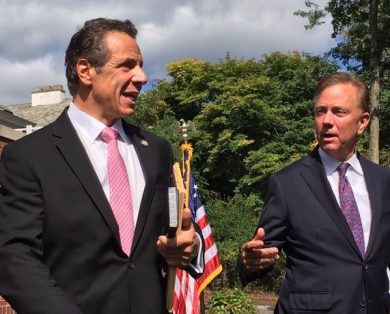
New York Gov. Andrew Cuomo on Wednesday said he will implement a regional contact tracing program — a “massive undertaking” in the tri-state region that will be key to reopening his state.
Lamont said the extent of Connecticut’s participation “is still to be determined.”
“We might be able to work together on this,” Lamont said. But the governor also said contact tracing here is “going to be a Connecticut operation” run through 64 local health departments.
As the nation begins taking its first tentative steps toward easing coronavirus restrictions, some states have increased efforts to track and isolate sick individuals and those who have come in contact with them. So far Connecticut has not.
The longtime public health practice of contact tracing is seen as a key requirement in the opening up of society and commerce, in conjunction with an increase in COVID-19 testing and perhaps antibody testing.
For Connecticut and other states to reopen, their health departments must be able to respond to any new outbreak of coronavirus immediately, and that will take an army of people trained in contact tracing. A legion of tracers will also be needed if new outbreaks of the virus erupt.
Massachusetts is among the first states to ramp up the contact tracing effort, hiring people to phone everyone who has had recent, close contact with someone diagnosed with the virus.
Other states, including Pennsylvania, Rhode Island and Vermont, have begun discussions on ratcheting up contact tracing as well.
Cuomo said New York’s contract tracing would be supported by a $10.5 million donation from former Mayor Mike Bloomberg and would be conducted in partnership with Johns Hopkins’ University researchers. Cuomo said the effort must be regional in its approach because “the virus doesn’t stop at jurisdictional boundaries.” On that, Lamont agrees.
Cuomo said a successful contact tracing effort will require an “army.” But Lamont chief operating officer Josh Geballe said there are currently only about 20 employees of the Connecticut Department of Public Heath involved in contact tracing in the state.
The federal government has said it will try to help states come up to speed. During a recent private call with governors, Vice President Mike Pence said that the Centers for Disease Control and Prevention will be sending teams to all 50 states and territories on a 12-18 month rotation “dedicated exclusively to coronavirus surveillance” and helping states with contact tracing efforts.
The CDC also said this week it is funding 650 health workers at state health departments to supplement more than 600 CDC staff already in place. Even so, many states are concerned they will not have the manpower to complete the labor-intensive work.
The National Association of State and Territorial Health Organizations estimates that the country may need to hire as many as 100,000 such “disease intervention specialists” at a cost of $3.6 billion. Others say that estimate is too conservative since the nation needs many more trained tracers.
CDC director Robert Redfield said his agency has begun talks with other federal agencies including the Census Bureau, as well programs like the Peace Corps and AmeriCorps, to determine if they might be able to provide some of the thousands of additional workers states will need.
Lamont on Wednesday cited a Yale-led effort as a model of how Connecticut will conduct contact tracing here.
Sten Vermund, dean of Yale’s School of Public Health, said students, staff and faculty are working on a New Haven COVID-19 telephone bank to help New Haven health officials locate people who have been near confirmed coronavirus patients. The tracing program began about three weeks ago.
Digital surveillance
To cut back on the need for manpower, some states may choose to modernize traditional contact tracing methods through the use of new technologies –including digital surveillance.
To help contain the virus, South Korea and Singapore used patients’ digital footprints to alert potential contacts. And Israelis receive texts from public health officials alerting them that, based on cellphone location records collected by the government, they had been near an infected person and needed to go into isolation for 14 days.
“We’re going to do it on an absolutely voluntary basis. We’re going to do it on an anonymous basis.”
— Gov. Ned Lamont
Tech giants Apple and Google have formed a partnership to build similar tools that would enable people and health authorities in the United States to track the coronavirus using Bluetooth data from smartphones. It would allow someone with the tool to log other devices when they come near so that users can be notified when they’ve had contact with an infected person.
But unlike the digital surveillance used overseas, the new tool would be voluntary. The tech giants say it could be available for downloading within several months.
Whether its done through personal contacts or through technology, Lamont said he’s concerned about privacy issues.
“We’re going to do it on an absolutely voluntary basis. We’re going to do it on an anonymous basis,” he said. “You know, you can decide whether you want to participate or not. If we go with one of the social platforms, it’s an opt in, so I want people to have confidence that we respect their individuality, their anonymity,” he said. “I do encourage people to participate,” he added, “because it will slow the rate of infection.”
The governor has already employed some smartphone technology in his effort to combat COVID-19.

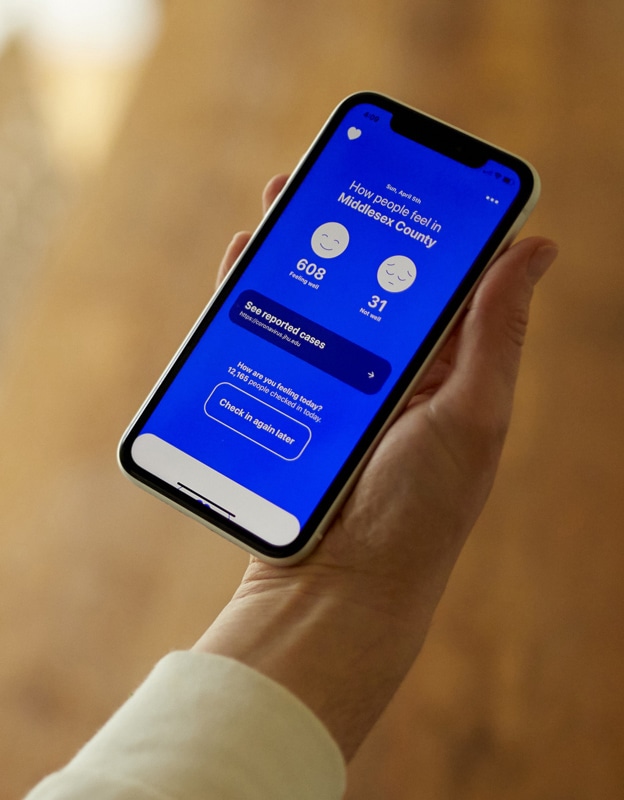
Connecticut this week unveiled the “How We Feel” app, available for free from Google and Apple, to try to determine where “hot spots” of COVID-19 will develop and where the state should shift health resources.
Nick Simmons, manager of the Strategic Initiatives Office of the Governor, said the state’s use of the app, created by the Massachusetts Institute of Technology and Harvard, will also be used “to get more data on how the whole of Connecticut is doing.”
Until now, the Lamont administration had relied solely on hospitalization information and the results of testing of a fraction of the state’s residents to try to determine the extent of the stranglehold coronavirus has on various parts of the state. But not everyone with the disease gets tested or is hospitalized, so Simmons hopes those people will report COVID-19-like medical symptoms on the How We Feel app. The app also asks questions about social distancing and mask wearing.
Simmons said those who download and use the app will have their privacy protected. Their Zip Code will be their only identification. Lamont said 32,000 people had downloaded and used the app since Monday, and he was able to see county-by-county data.
“This is a way to understand what’s going on in an anonymous way,” Simmons said. Because use of the app is voluntary, it will only provide a sampling of what’s going on.
The app is being promoted on billboards, texts to those who have registered to receive coronavirus updates from the government and the governor’s social media sites.
As far as using sharply increased people-to-people tracing, like Massachusetts and other states, or new technologies, Simmons said members of the governor’s Reopen Connecticut Advisory Group “are looking at everything.”
“It’s all on the table,” Simmons said. “It’s all in process.
Mapping by Google
Other states have used cell phone technology to determine the success of their stay-at-home efforts.
When California officials wanted to see how closely people were following social distancing guidelines last month, they tapped a map Facebook provided to state authorities derived from the location coordinates of tens of millions of smartphones.
When the map showed that large numbers of people were still gathering on beaches and in public parks. California Gov. Gavin Newsom ordered them closed to vehicles, sharply restricting access.
New Mexico officials are using such anonymous smartphone data to help anticipate surging hospital demand; and Colorado officials have used similar data to determine whether residents are traveling less, in compliance with the state’s stay-at-home order.
The technology relies on what is known as aggregated and “anonymized data” meaning it uses compilations of data that have been stripped of information that could be used to identify individuals.
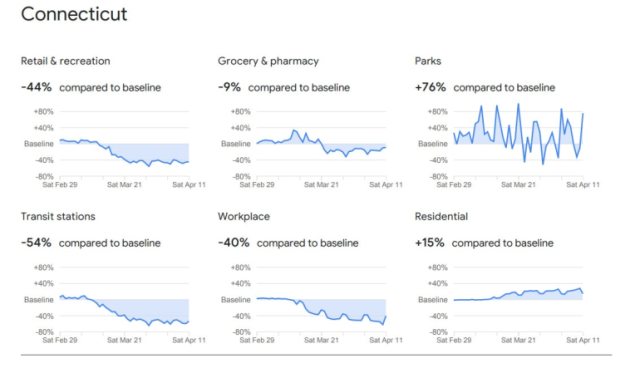
Google has used this type of anonymized data to graph “mobility changes,” or try to determine responses to social distance guidelines.
Using a baseline of a five-week period before the pandemic swept across the United States – Jan. 3 to Feb. 6 – Google harvested data from users who have opted-in to “location history” on their Google accounts to determine whether residents in each state – and even every county—were staying home more and shopping and visiting entertainment venues less.
The reports show trends over several weeks and are only a sampling of the nation’s population. “As with all samples, this may or may not represent the exact behavior of a wider population,” Google said.
The latest Google mobility charts, dated April 11, show Connecticut residents visited retail and recreation facilities 44 percent less than during the pre-crisis period, and workplaces 40 percent less.
Fewer people in Connecticut went to transit stations, too, 54 percent less, while staying home increased by 15 percent, close to the national average of 14 percent.
One thing jumps out in Google’s data about Connecticut. Visits to parks in the state increased 76 percent during the crisis, which could also be attributable in part to an improvement in the weather. Yet, because many states closed their parks completely, the national average for visits to parks dropped by 16 percent.