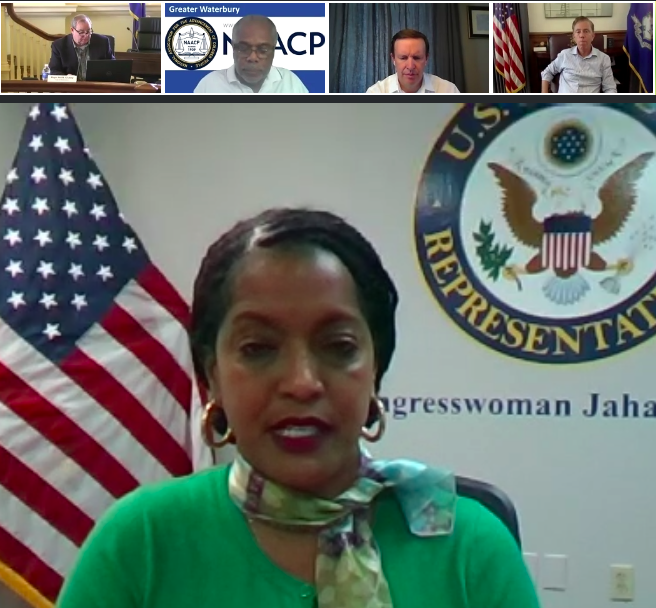
On the Zoom call was Connecticut’s governor, a U.S. senator, a congresswoman, a state’s attorney, a police chief, a mayor, civil rights leaders, clergy and others. Over 90 minutes, everyone agreed: The death of George Floyd in Minneapolis under the knee of an indifferent police officer demands urgent action.
But what? By whom? And when?
There were no firm answers Monday, not on the Zoom call organized by Waterbury Mayor Neil M. O’Leary. Not anywhere on a day when state and local officials in Connecticut sought common ground with protesters, and President Donald J. Trump berated governors for their reluctance to quell the demonstrations with force — then threatened to deploy troops if they don’t.
“This shouldn’t be normal in 2020 America,” said the Rev. Kelsey Hopson, the pastor of Mt. Olive A.M.E Zion Church.
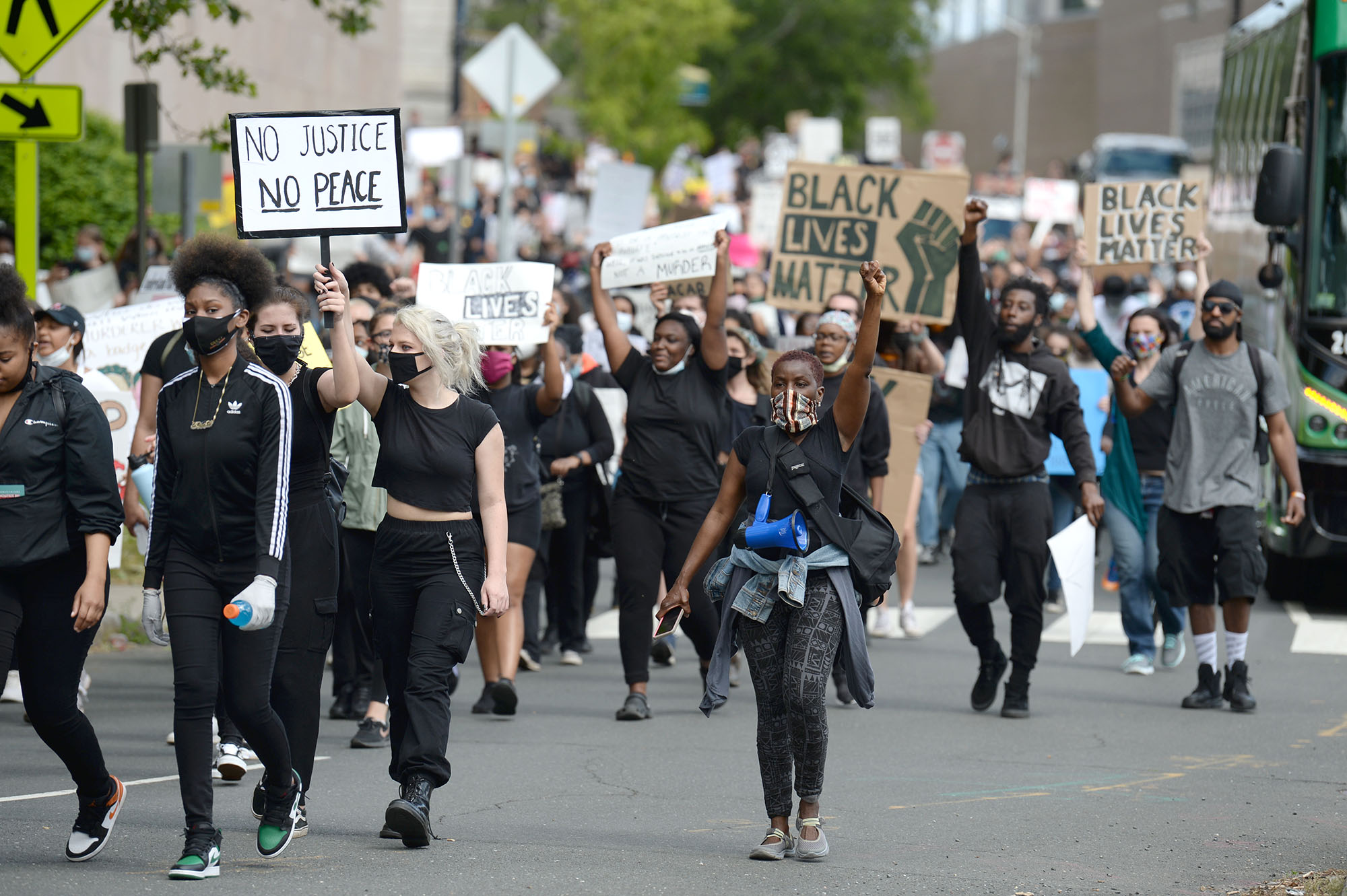
The violent death of a black man in police custody is an old story. But the stunning video of Floyd’s death is uniquely powerful, igniting protests in at least 130 U.S. cities over weekend, including one outside the White House that prompted the Secret Service to take Trump into a basement shelter on Sunday. A protest in Hartford on Monday was peaceful.
On the call in Connecticut, Floyd’s death was viewed unambiguously by the Waterbury state’s attorney, Maureen Platt, as a murder. It was the same word used by O’Leary, a police officer for 25 years and a police chief for seven.
“I don’t believe it is possible to watch the murder of Mr. Floyd on TV and not be profoundly affected by what occurred in that city,” Platt said. “This is a conversation that we need to have. It is not an easy conversation. It is a conversation where we need, as people involved in the criminal justice system, we need to listen, we need to learn and we need to speak to each other about how things can be made better.
Gov. Ned Lamont and U.S. Sen. Chris Murphy said they were on the call to listen, but Murphy added that there quickly would come a time to act, decisively and broadly.
“My only thought to open the conversation is that the days of incremental change are over,” Murphy said. “What we have been doing has not been working. We need to take a firm look in the mirror right now and recognize that unless we are talking about top-down change with respect to how societies are organized, how schools work, how the criminal justice system operates, how living patterns are effectuated, then we are simply not meeting this moment.”
Lamont, speaking on a call hours before the president threatened to send out federal troops, said the tone set at the top was not encouraging.
On a contentious conference call with governors, Lamont said, Trump displayed no sense of history or empathy, no understanding of the “depth of the pain felt by all the people on the streets” over the lack of progress in the half-century since the riots of the 1960s.
“His answer was, ‘Let’s declare war. Let’s declare war on these protesters. These are anarchists. These are people trying to tear down our country. What’s the matter with you governors?’ This is what he said,” Lamont said. “He called us fools and jerks and weak for not bringing out the armed forces and declaring war. My message to each and everyone of us is do not play into that cynical game.”
The legislature’s Black and Puerto Rican Caucus and others have worked in recent years on ways to standardize police discipline and accountability and encourage the recruitment of more minority officers. A limited accountability measure passed in 2019 with Lamont’s support.
The governor does not have any new legislation in mind, but he pledged to continue efforts to make state government reflect Connecticut’s population, particularly in its judiciary.
“I was a little surprised by the lack of diversity, especially in the higher courts,” Lamont said.
He called us fools and jerks and weak for not bringing out the armed forces and declaring war. My message to each and everyone of us is do not play into that cynical game.”
But Lamont said the absence of a new legislative agenda should not be mistaken for a lack of commitment or ideas.
“I think we have very clear ideas of what we want to do. It starts with education and making sure nobody is left behind. It starts with making sure that our distressed districts get a special leg up,” he said.
“It means when it comes to business, you get a fair shot at being able to start you own business. It means raising the minimum wage every year for the next four or five years, so these minimum-wage workers we now realize are essential workers, they are going to be lifted up,” Lamont said.
U.S. Rep. Jahana Hayes, D-5th District, the first black woman elected to Congress from Connecticut and the wife of a Waterbury police detective, said she went to church on Sunday rather than a protest of Floyd’s death. She called it “an execution.”
“We need to have some honest conversations,” said Hayes, a Waterbury school teacher and national teacher of the year before her election to Congress in 2018. She said she knows the fear of every mother and wife of a black man, that a chance encounter with police could prove deadly.
Hayes, who was on the Zoom call and part of the governor’s briefing, said most of the protesters over the weekend were too young to be active in the civil rights movement led by Dr. Martin Luther King, whose assassination in 1968 sparked rioting.
‘Damned if you do, damned if you don’t’
“They never experienced Dr. King. But what they did experience was when one of their contemporaries took a knee in protest and were told that’s not the right way to protest,” Hayes said, referring to Colin Kaepernick kneeling during the national anthem at NFL games. “So, it’s almost as if you’re damned if you do and damned if you don’t.
“And young people are looking for an outlet, they are looking to be heard. and it is our responsibility to hear people, to try not to explain away their concerns or tell them what they feel or why they should be feeling this. But just to sit and listen.”
Warren Leach, a community activist in Waterbury, said he feels like 50 years of progress by the civil rights movement was rolled back in the three years since Trump took office.

“It feels like the election of Donald Trump, regardless of where you stand on policies, has unearthed this underbelly of racism that seemed to have never abated since the Civil War ended,” Leach said. “George Floyd’s murder, and the way that it was executed and the visuals of it is the thing that cannot be denied.”
Black people thought the video of the police beating Rodney King a quarter century ago would forever change attitudes about police brutality, he said.
“Twenty-five years later, it changed nothing. Video after video after video after video. There’s always a justification,” Leach said. But the Floyd video is noteworthy not for an officer’s violence, but his casualness as he stared at a camera recording him kneeling on the neck of a motionless Floyd, he said.
He said it was as if the officer was saying, “Yeah, this is what I’m doing. This is what I’m doing right here, and there is nothing you can do about it.”
House Minority Leader Themis Klarides, R-Derby, and Deputy Minority Leader Vincent Candelora, R-North Branford, both called for a non-partisan approach in Connecticut’s search for ways to respond the unrest over Floyd’s killing.
“We have to all listen to each to each other, and we can’t make it political,” Klarides said. “We can’t do this right, unless we do it together.”
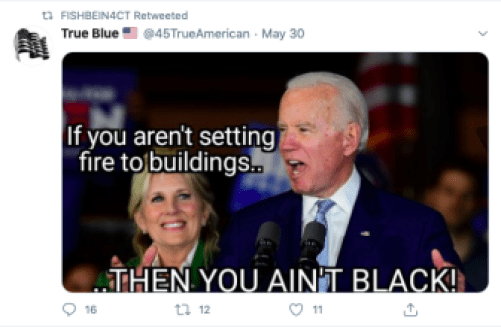
She spoke after a member of her caucus, Rep. Craig Fishbein of Wallingford, apologized for re-tweeting what he acknowledged was a racially insensitive meme playing off Joe Biden’s recent gaffe in which he said African American who supports Trump “ain’t black.”
“I shared the meme without comment in a subtle attempt to point out a double standard regarding political speech,” Fishbein said. “Without explanation, there was no context. I was wrong. The meme was offensive, period.”