Free Daily Headlines :

  • COVID-19
  • Vaccine Info
  • Money
  • Politics
  • Education
  • Health
  • Justice
  • More
    • Environment
    • Economic Development
    • Gaming
    • Investigations
    • Social Services
    • TRANSPORTATION
  • Opinion
    • CT Viewpoints
    • CT Artpoints
  • Donate
DONATE
Connecticut's Long-Form Journalism
    COVID-19
    Vaccine Info
    Money
    Politics
    Education
    Health
    Justice
    More
    Environment
    Economic Development
    Gaming
    Investigations
    Social Services
    TRANSPORTATION
    Opinion
    CT Viewpoints
    CT Artpoints
    Donate

LET�S GET SOCIAL

Show your love for great stories and out standing journalism

Senate passes controversial zoning reform bill

Measure nudges town officials to allow more affordable housing

  • Housing
  • by Jacqueline Rabe Thomas
  • May 28, 2021
  • View as "Clean Read" "Exit Clean Read"

Jacqueline Rabe Thomas :: CTMirror.org

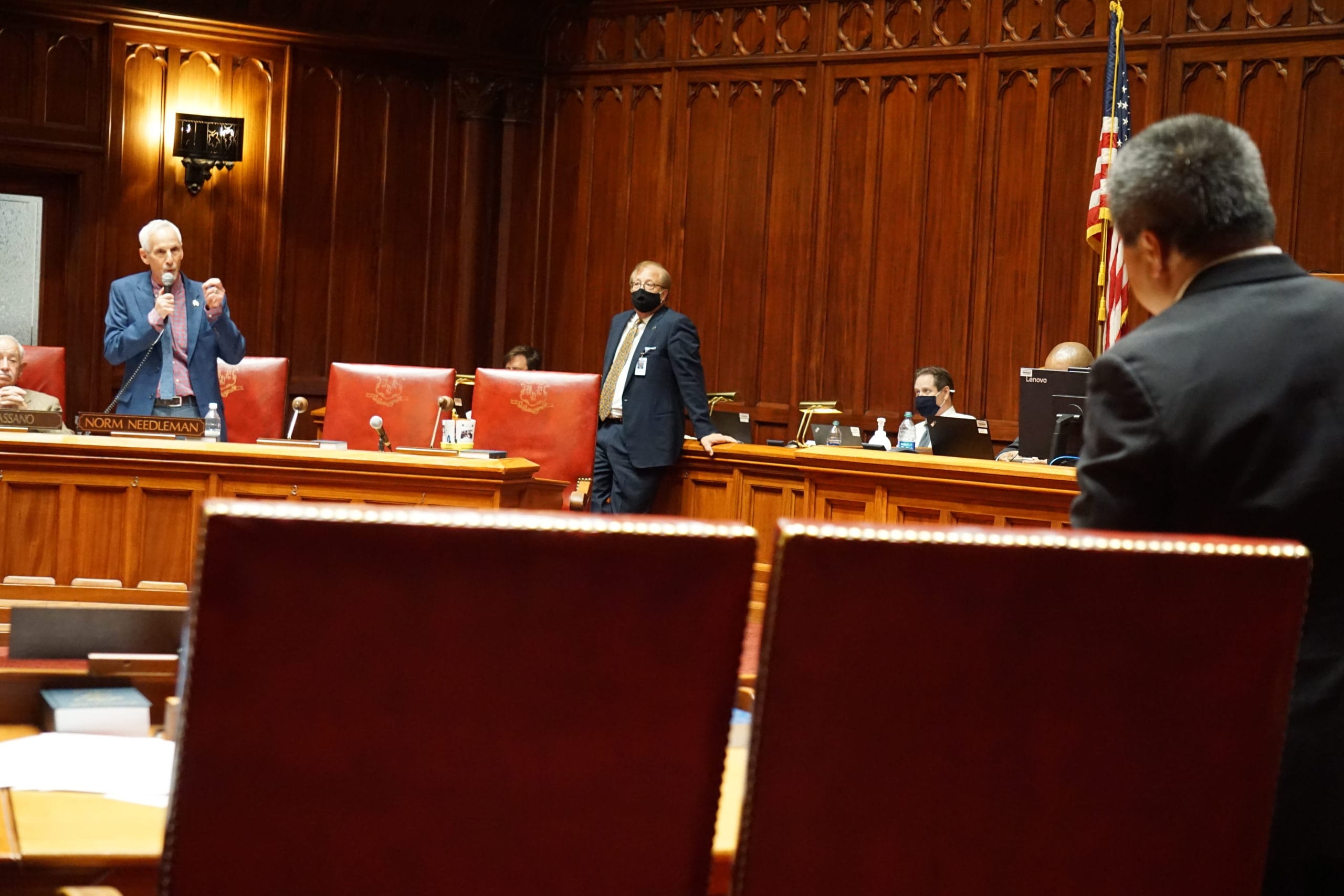
Sen. Norm Needleman debates the bill with Sen. Tony Hwang (foreground)

The state Senate late Thursday voted to send contentious legislation to the governor’s desk that nudges towns to loosen restrictive zoning policies that proponents say drive up housing prices, keep many affluent suburbs exclusive and Connecticut one of the most segregated states.

The legislation would require towns to allow single-family homeowners to convert parts of their dwellings or detached garages into so-called accessory dwelling units, nicknamed “granny pods,” without needing special permission from local officials — but it allows towns to vote to opt out. The bill places limits on how many parking spaces a new home or apartment must have — but also allows towns to vote to opt out.

Read related stories

CT legislators underwhelmed with housing reform bill that passes House Separated by Design: How Some of America’s Richest Towns Fight Affordable Housing Does ‘snob zoning’ lead to segregated suburbs in CT?

The bill also strikes current state law that requires zoning regulation to consider the “character of the district” with “physical site characteristics” that local officials must prescribe.

“The wealthy in Connecticut – forever –have always sought to insulate themselves from the rest of the state,” Senate President Pro Tem Martin Looney, D-New Haven, said on the senate floor before the vote. This bill “replaces the vague and often abused word ‘character,’ and defending regulations that are restrictive and exclusionary, as preserving the character of the town. That’s shorthand for white and wealthy. … The fact that we have so many land use decisions left exclusively to municipalities, acting to preserve the status quo and to keep change and equity outside their boundaries, creates the problems that we have seen.”

The Senate passed the bill after a four-hour debate in a 24-12 vote, with one Democrat, Sen. Joan Hartley, joining every Republican to vote against it.  The House of Representatives passed the bill in a partisan vote last week.

Approval didn’t come without huge concessions from the original legislation, debated in the Planning and Development Committee, presumably to garner enough votes from suburban Democrats.

Language was scrapped that would have required towns to allow the construction of multi-unit housing around some train stations and suburban towns’ commercial centers, as well as language that would have specified to each town how many affordable units they must allow — but would leave it up to them and a monitor to ensure it happens.

When the bill passed the house, House Majority Leader Jason Rojas, D-East Hartford, said it was “painfully incremental” because it had been scaled back so much.

Several senate democrats made similar remarks before approving it.

“There were compromises along the way,” said Sen. Norm Needleman, D-Essex, who led much of the debate for the proponents. “We’ve ended up with something that is a good start. We acknowledge there are significant equity issues in our state, and we also acknowledge that this does not solve all of the issues. But the voices out there are demanding solutions, and we have responded.”

“While I’m a bit frustrated at this bill, that it’s not as strong as it could be or should be, this vote tonight, and with the governor’s signature, is a very important step on our road to ensuring that Connecticut sheds itself from being one of the most segregated states,” said Senate Majority Leader Bob Duff, D-Norwalk.

The bold reforms initially included in the bill drew outrage from several residents and legislators who said their property rights and local control were under assault. Hundreds signed up to testify on the controversial reforms, and the public hearing lasted 24 hours.

Sen. Tony Hwang, a Republican who represents several well-off towns in Fairfield Country, led the opposition throughout the legislative session and during the Senate floor debate.

“I agree … that we need to do more, that the status quo cannot stand,” said Hwang, also the minority ranking member of the Planning and Development Committee.

Hwang said towns are forging a path toward open more affordable housing and don’t need what he characterizes as state mandates that are in the bill.

“We’re going to take away what has been a demonstrated success by communities that have been sometimes, and I believe strongly, improperly maligned and unfairly characterized, and not recognized for their great efforts and innovation.”

Other Republicans agreed that such decisions should be left to home rule and local control.

“Towns know what’s right for the individual towns, and I want to make sure that we protect the different areas that the town sees is important, that we protect our open spaces, that we protect just who we are in our towns,” Sen. Dan Champagne, R-Vernon.

A compilation of the zoning codes in every Connecticut municipality found that most communities allow single-family homes to be built without hassle, while many well-off towns don’t allow any multi-family housing to be built or allow it in only a sliver of their town. That research — conducted by Desegregate CT and its founder Sara Bronin, a professor at UConn School of Law — also found that nearly one-third of the districts zoned to allow single-family homes still require minimum square feet, several in excess of 2,000 square feet, despite a decades-old Supreme Court ruling prohibiting such practices.

Bronin and her coalition welcomed the Senate passage.

“We are united in the hope that communities across the state will be one step closer to the Connecticut we all deserve,” she said.


Mark Pazniokas :: CtMirror.org

The senate and housing chairmen of the Planning and Development committee congratulate each other on sending the zoning reform bill to the governor’s desk.

Sign up for CT Mirror's free daily news summary.

Free to Read. Not Free to Produce.

The Connecticut Mirror is a nonprofit newsroom. 90% of our revenue comes from people like you. If you value our reporting please consider making a donation. You'll enjoy reading CT Mirror even more knowing you helped make it happen.

YES, I'LL DONATE TODAY

ABOUT THE AUTHOR

Jacqueline Rabe Thomas was CT Mirror’s Education and Housing Reporter and an original member of the CT Mirror staff. She has won first-place awards for investigative reporting from state, New England, and national organizations. Before joining CT Mirror in late 2009, Jacqueline was a reporter, online editor and website developer for The Washington Post Co.’s Maryland newspaper chains. She has also worked for Congressional Quarterly and the Toledo Free Press. Jacqueline received an undergraduate degree in journalism from Bowling Green State University and a master’s in public policy from Trinity College.

SEE WHAT READERS SAID

Leave a Reply Cancel reply

You must be logged in to post a comment.

RECENT STORIES
CT Supreme Court hears arguments on Section 8 discrimination case
by Camila Vallejo | Connecticut Public Radio

In the case, the plaintiff argues that a real estate agent's comments about her source of income were discriminatory.

Fairfield County advocates want state to address housing shortage
by Camila Vallejo | Connecticut Public Radio

A new report says Connecticut is short more than 86,000 rental units for residents in the 0%-30% area median income.

Landlord spat offers peek into LLC deals
by Thomas Breen | New Haven Independent

A court battle over a landlord’s alleged theft offers a glimpse into how internationally backed real estate deals take shape.

Biden administration praises Lamont on COVID rental relief
by Mark Pazniokas

Once criticized by landlords and tenants, the Biden administration now hails Connecticut's rental assistant process as a model of success.

After court ends federal evictions moratorium, CT officials mull next steps
by Keith M. Phaneuf

Connecticut legislators must decide soon whether to act to protect tens of thousands of at-risk renters.

Support CT Mirror

You may not be on staff, but you can produce the journalism.
$
Select One
  • Monthly
  • Yearly
  • Once
Artpoint painter
CT ViewpointsCT Artpoints
Opinion Prison education can break the cycle of mass incarceration
by Marisol Garcia

To say my path has been different from that of most college seniors is putting it mildly.

Opinion Wild things down by the Eightmile River
by David Holahan

Species in disturbing numbers will be going extinct before our grandchildren are grown. Our species appears good with that.

Opinion The corruption of K-12 education via instruction on racism
by Jay Bergman

Like many Americans, I am despondent over the corruption of K-12 education in America.

Opinion Saving money on Metro-North
by Jim Cameron

Are you paying too much to ride Metro-North?  Maybe.

Artwork Grand guidance
by Anne:Gogh

In a world of systemic oppression aimed towards those of darker skintones – representation matters. We are more than our equity elusive environments, more than […]

Artwork Shea
by Anthony Valentine

Shea is a story about race and social inequalities that plague America. It is a narrative that prompts the question, “Do you know what it’s […]

Artwork The Declaration of Human Rights
by Andres Chaparro

Through my artwork I strive to create an example of ideas that reflect my desire to raise social consciousness, and cultural awareness. Jazz music is […]

Artwork ‘A thing of beauty. Destroy it forever’
by Richard DiCarlo | Derby

During times like these it’s often fun to revisit something familiar and approach things with a different slant. I have been taking some Pop culture […]

Twitter Feed
A Twitter List by CTMirror

Engage

  • Sign Up for Newsletters
  • Donate
  • Submit to CT Viewpoints
  • Submit to ArtPoints
  • Advertise With Us
  • Request a Speaking Engagement
  • Use CT Mirror Photography
  • Manage Your Membership
  • Send Us News Tips
  • Contact Us

Go Deeper

  • CT Mirror Events
  • Steady Habits Podcast
  • COVID Tracker
  • Economic Indicator Dashboard
  • Reporting Series
  • Five Things

Meet CT Mirror

  • About Us
  • FAQ
  • Announcements
  • Awards
  • Impact
  • History
  • Strategic Plan
  • Financial
  • Policies

Meet Our People

  • Board of Directors
  • Staff
  • Sponsors and Funders
  • Donors
  • Friends of The Connecticut Mirror
  • Community Editorial Board
  • Work for Us

The Connecticut News Project, Inc. 1049 Asylum Avenue, Hartford, CT 06105. Phone: 860-218-6380

© Copyright 2021, The Connecticut News Project. All Rights Reserved. Website by Web Publisher PRO