


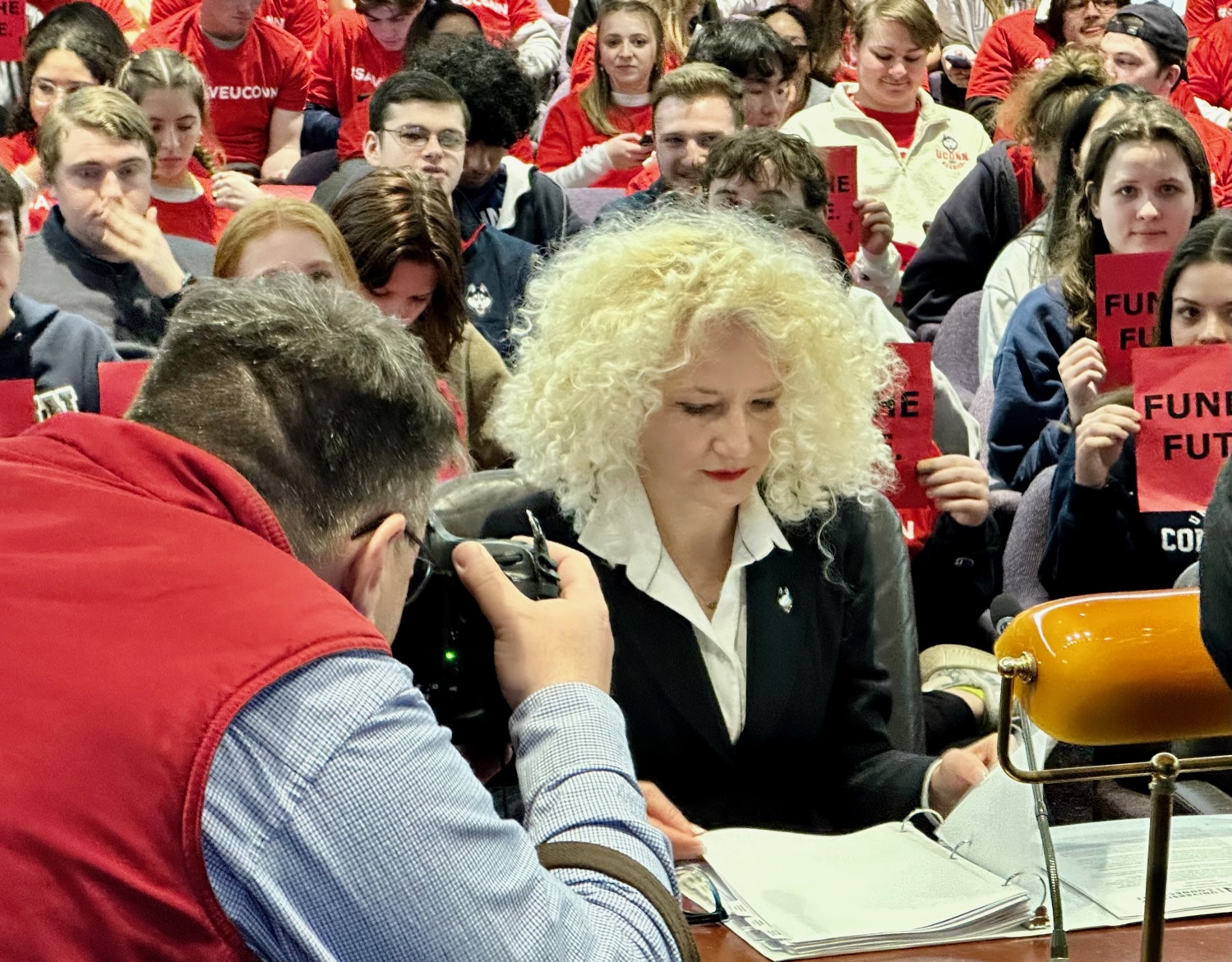
University of Connecticut’s new president, Radenka Maric, lowered the temperature of her budget fight with Gov. Ned Lamont on Wednesday without retreating from her position that his administration is trying to shortchange the flagship university by $357 million over the next two years.
Hundreds of students rallied outside the Capitol, a few directing profane chants towards Lamont, then applauding speakers who questioned whether a wealthy governor educated at Harvard and Yale understands the value of a public education to low- and middle-income families.
The rally was a prelude to Maric and other UConn officials defending their budget proposal for UConn and UConn Health Center to the legislature’s Appropriations Committee, which eventually must recommend to the full General Assembly whether the administration’s proposal is sufficient.
Maric cast her testimony in terms of what UConn needs, refraining from direct criticism of the governor or his administration, a tacit acknowledgement that open warfare with a recently reelected governor seldom is a productive way to make budgetary gains.
Her prepared opening statement was conciliatory.
“There are differences of opinion regarding the proposed state budget, especially with respect to funding for the state’s labor agreements and legacy costs — and they are significant issues — but we will always say ‘thank you’ to all those who help to make UConn the research and economic development powerhouse it is today,” she said.
After her presentation, Maric smiled and said her recent conversations with Lamont about the budget have been “lovely.”
Her seeming threat to end UConn games at the XL Center in downtown Hartford — largely seen as a gaffe at the state Capitol — was downplayed Wednesday, though not entirely abandoned. Every expense remains on the table, she said.
When Rep. Geraldo Reyes, D-Waterbury, asked about the economics of UConn playing at the XL, Maric deferred to Jeffrey Geoghegan, a UConn Health finance official whom she recently named as chief financial officer of the university system.
“We do pay rent to play at the XL Center,” Geoghegan said. “So, as the president said, that would be, you know, one of many things we look at, but there is no immediate concern of changing what we do there.”

In a statement issued in the brief interlude after the students’ rally and before the UConn president’s presentation, the Lamont administration pushed back hard at the notion it was shortchanging a university that the governor has described as a vital contributor to economic growth in a state with a labor shortage.
“Our budget proposal includes the largest block grant ever proposed for UConn in state history,” Lamont said. “I am a strong believer in UConn’s contributions to the economic growth of Connecticut, and that is why I’ve proposed increasing the state block grant funding for the university every year since taking office.”
Lamont is correct in asserting that he has increased UConn funding each year, but Maric notes that raises negotiated by the governor’s administration have increased costs, and the proposed block grant has not kept pace.
UConn says Lamont’s two-year budget would create shortfalls of $159.6 million in the fiscal year that begins on July 1 and $197.1 million the following year.
Outside the building, the rhetoric employed by students and union representatives was sharper.
Kathy Fischer, the president of the University of Connecticut Professional Employees Association Local 3695, said the Lamont administration and its predecessors have penalized UConn in how it assesses the school for its share in the state’s unfunded pension liabilities.
“The state continuing to shackle UConn with unfunded mandated legacy costs that the state covers for all other state agencies is unfair, to say the least, and an excessive burden to the university,” Fischer said. “The game of pretending to cover the costs and then take that funding out on the back end by reducing our base funding and block grant is sneaky and disingenuous and has been going on for decades.”
Three legislators said the governor’s proposal was wrongheaded.
“I’m here to say that that proposal is the wrong direction for the state, and the conversation inside has already taken a bad turn,” said Rep. Greg Haddad, D-Mansfield, co-chair of the Higher Education and Employment Advance Committee. “Legislators are talking about right-sizing public higher education in Connecticut. That’s a code word for shrinking it.”
Haddad and Sen. Mae Flexer, D-Windham, whose districts are home to the main UConn campus, have proposed legislation increasing the university’s funding.
“Your presence here today and your outreach and your outcry over the last week has been absolutely incredible,” Flexer said. “And I know that because of this we’re gonna turn the tide on this proposal.”
Flexer said the state has shifted UConn’s finances from a reliance on state funding to tuition. Half the budget came from state appropriations 30 years ago, she said.
“Today, that number is 26%, and under this proposal, it’ll be less than 25%,” Flexer said. “That is wrong. At what point does UConn stop being a public institution if there is not a public investment?”

Sen. Derek Slap, D-West Hartford, the other co-chair of the higher education committee, said UConn’s standing as a ranked public university was in jeopardy.
“Where’s UConn going to be ranked in 10 years from now? Is it still going to be a top 25 public university?” he asked.
The crowd shouted, “No.”
“So, it’s about today, and it’s about the next few months, right?” Slap said. “We all have to advocate.”
