


A Connecticut jury began hearing testimony this week in a high-profile criminal trial that will test the limits of how the state handles police shootings and determine whether a Connecticut State Police officer is convicted for killing a 19-year-old Black man.
The case involves Brian North, a 33-year-old state police trooper who was charged with manslaughter for shooting and killing Mubarak Soulemane, a young man with a history of mental illness who led police on a high-speed chase on Interstate 95 in early 2020.
That police pursuit began in Norwalk after Soulemane allegedly brought a knife inside an AT&T store and later stole a Lyft driver’s vehicle. It ended with North firing seven bullets through that vehicle’s driver side window after police eventually stopped and surrounded Soulemane roughly 30 miles away in West Haven.
The trial, which is expected to continue into next week, is groundbreaking for Connecticut in several respects.
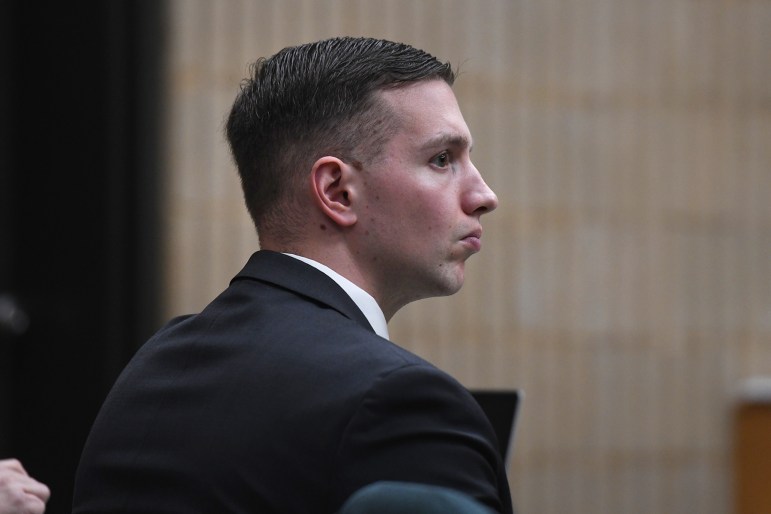
It’s the first time a Connecticut State Police trooper has been charged for killing someone while in the line of duty. It’s also the first major trial to be prosecuted by Connecticut’s inspector general, a new position that was created to independently investigate police shootings and to determine whether officers were justified when they use force.
The creation of the inspector general’s office was one of the most important components of a large package of criminal justice reforms that Connecticut lawmakers passed in 2020 in the wake of George Floyd’s death at the hands of police in Minneapolis. It was meant to remove local prosecutors, who frequently work with police while investigating other crimes, from deciding whether to charge an officer when they kill someone.
Robert Devlin, a retired judge who was chosen as the state’s first inspector general, determined in North’s case that the trooper’s actions were not justified when he fired seven bullets into the car, which was boxed in by police near a highway off-ramp in West Haven.

North, who served as a trooper for roughly five years by the time of the shooting, told investigators that he fired his handgun because he believed Soulemane was preparing to attack another state trooper and a West Haven police officer, who broke through the passenger side window of the vehicle and attempted to use a Taser on Soulemane.
“I believed that (Trooper) Jackson and the West Haven Officer were at imminent risk of
serious physical injury or death, and could have been stabbed in the neck or face as they attempted to enter the vehicle and remove the suspect,” he and his attorneys wrote in a statement.
After reviewing the case, however, Devlin concluded that there was no reasonable evidence showing that any other officer was in “imminent danger” from the knife that Soulemane was carrying and, as a result, he argued North was not justified in firing his handgun through the car window into Soulemane’s chest.
The shooting was captured on body worn cameras and police dashboard cameras, which every active-duty police officer in Connecticut is now required to use.
Devlin, who stepped into the role of inspector general in September 2021, has investigated numerous police shootings in the past two years, but the case against North is the first trial managed by Devlin and his team.
On Monday, Devlin kicked off the trial by calling Soulemane’s family members and girlfriend to the stand to testify about his medical history, including his diagnosis for schizophrenia and bipolar disorder.

Devlin sought to humanize Soulemane with the jury by asking his family members about his life, including his high school sports career playing lacrosse and basketball.
Omo Mohammed, Soulemane’s mother, told the jury about how her son first started having mental health episodes in 2015 when he was in high school. She explained that he frequently sought treatment at a hospital and that he was prescribed medication to treat his schizophrenia.
“It was hard for Mubarak,” she said, “because he was fighting the sickness.”
Soulemane’s sister, Mariyann, also told jurors that there were times when her brother would not take his medication consistently, leading to manic episodes.
“He would be kinda in and out of the ER when the manic episodes arose,” she said. “There was just a constant readjustment of medication and efforts to get him to take them consistently.”
The night before the shooting, Julia Johnson, Soulemane’s girlfriend, testified that he was acting “erratic, paranoid and disorganized” and ultimately didn’t sleep. She told jurors that he also admitted to being “in a psychosis.”
Johnson said she repeatedly tried to convince Soulemane to go to the hospital that night, but he refused.
The next day, she said, Soulemane told her he was going to take the train from New Haven to Norwalk to play basketball and to get his haircut. Unbeknowst to her, she said Soulemane took a knife from the kitchen in her apartment.
North’s defense attorney, Frank Riccio, went on to question Johnson about how anyone outside of Soulemane’s family and herself would know that he is schizophrenic and bipolar when encountering him in public.
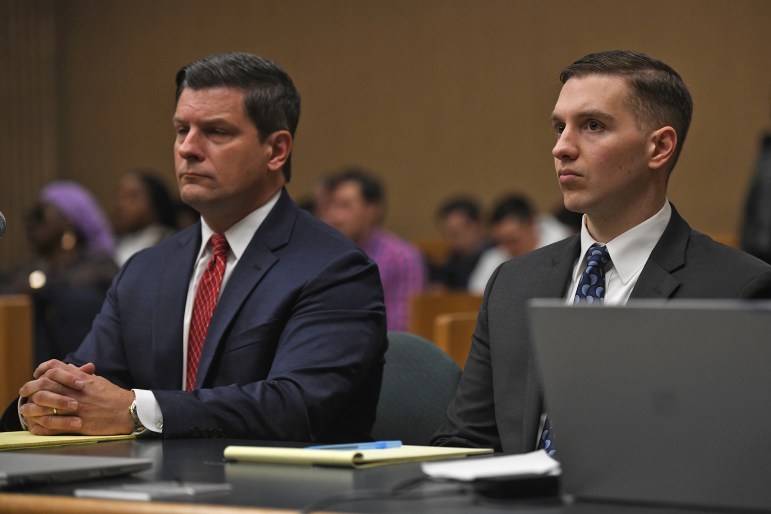
“You would have only known that he had or suffered from mental illness if you knew him personally, or if you had prior occasions to talk to him and speak to him, correct?” Riccio asked.
“Correct,” Johnson replied.
North’s defense team also highlighted the fact that when Norwalk Police notified them of the vehicle that Soulemane stole, it was reported as a “carjacking,” which means the vehicle was taken by force.
Devlin attempted to correct the record, however, by noting that Soulemane took the vehicle without violently attacking the Lyft driver.
That line of questioning continued into Tuesday’s testimony in the Milford courtroom filled with dozens of people.
Soulemane’s family settled on the side of the aisle closest to the jury, with some of them wearing circular green stickers showing the young man’s smiling face. Family members of the indicted officer wore pins bearing the words, “I support Trooper North,” behind the defense table where North and his attorneys were seated.
The state first called to the stand Daniel Green, a Lyft driver and owner of the white Hyundai Sonata, who outlined for the jury what he experienced on the day of the incident. Green testified that he picked Soulemane up and feared for his life when Soulemane slapped him in the back of his head after he refused to give the 19-year-old his cellphone.
The driver said he traveled to a nearby gas station, where he exited the vehicle, pulled out a firearm and demanded that Soulemane exit the car. Soulemane withdrew from the Hyundai, Green said, and reentered through the driver’s seat, put the car in drive and took off down the road.
Officer Daniel Vazquez of the Norwalk Police Department was present when Soulemane drove off and initially pursued him in his patrol car. The incident was captured on camera at the gas station and played in court.
The state questioned Vazquez, Lt. Stephen Samson, who oversees the implementation of training and policy for the State Police, and Sgt. Kevin Duggan, the lead investigator in the State Police’s probe of the shooting.
Devlin’s co-counsel, Andrew Slitt, questioned Samson about the State Police’s vehicle pursuit policy, which notes that certain crimes, like stealing a vehicle, are not cause to engage in a car chase absent exigent circumstances. North’s attorneys pushed back with questions that suggested that Soulemane was a danger to the public.
During Duggan’s testimony, the state presented a bevy of evidence, ranging from Soulemane’s blood-stained white T-shirt and dark Hollister jacket with Taser wire hanging from the right arm to the gun North used to kill him. Photos in court also showed the Hyundai occupied by Soulemane boxed in by two police cruisers and a Chevy Trailblazer, leaving him with nowhere else to go.
North’s defense brought up the fact that Soulemane drove the stolen vehicle at speeds above 90 miles per hour during rush hour and that he hit two police cruisers with the car prior to being stopped in West Haven.
“In all the towns that you testified this pursuit went through, Mr. Soulemane continued to drive recklessly through each and every one of those towns, correct?” asked Riccio, North’s attorney.
“Correct,” responded Duggan, the State Police investigator.
In the final questioning of Duggan, Slitt asked if Soulemane’s actions warranted prosecution, to which he replied in the affirmative.
“But he didn’t deserve to be killed though, did he?” Slitt continued, just before the judge ordered that the remark be struck from the record.

