


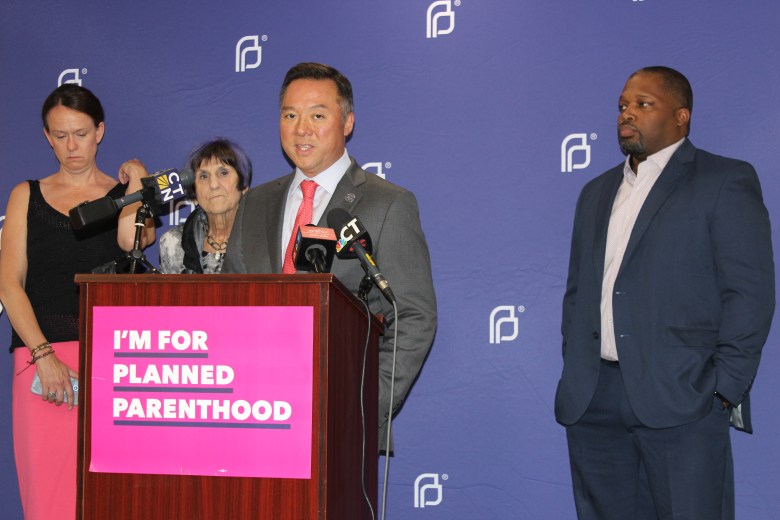
A day after a federal judge in Massachusetts blocked the Trump administration from ending Medicaid funding for Planned Parenthood, officials from Connecticut and 22 other states filed their own lawsuit to keep the clinics from losing federal dollars.
“Planned Parenthood plays an irreplaceable role in our health care system. For many communities, Planned Parenthood health centers are the sole provider of their sexual and reproductive healthcare,” Gretchen Raffa, Chief Policy and Advocacy Officer for Planned Parenthood of Southern New England, said Tuesday during a press conference with Connecticut Attorney General William Tong and others.
Tong, Raffa and Democratic state lawmakers who spoke at a press conference on Tuesday argued that Planned Parenthood does more than perform abortions. The loss of the clinics, they said, would also mean the loss of services like contraception, OB-GYN care and cancer screenings.
“This isn’t about abortion, per se. This is about health care, not just life affirming health care, but life-saving health care,” Tong said.
They also noted that federal Medicaid funding does not pay for abortions.
Tong said the states decided to file their own lawsuit because the loss of funding for Planned Parenthood clinics would mean a cost to the states.
In their complaint, filed on Tuesday, the states argued that Congress had “forced the States to harm themselves,” giving them a choice between “crippling the States’ medical health care ecosystems” with the loss of the clinics or “using the State’s own funds to keep those health care centers operating.”
Tong said covering the cost of the 14 Connecticut clinics would amount to about $6 million.
“I don’t think we have $6 million just lying around to cover that, especially when there’s so many other cuts falling on us now. And so we’ve sued because it’s unconstitutional,” he said.
U.S. Rep. Rosa DeLauro, D-3rd District, the ranking member on the House Appropriations Committee, noted that if Connecticut had to pay an additional $6 million to Planned Parenthood, it would come at the same time that Congress was cutting $13 billion in funding for Medicaid in Connecticut.
“As a result, the state of Connecticut is going to be forced to make difficult choices with respect to who and what is covered,” DeLauro said.
A spokesperson for the U.S. Department of Health and Human Services criticized the lawsuit in a statement Tuesday to CT Mirror.
“States should not be forced to fund organizations that have chosen political advocacy over patient care. It is a shame that these democrat attorney generals [sic] seek to undermine state flexibility and disregard longstanding concerns about accountability,” the spokesperson said.
Earlier this month, the Planned Parenthood Federation of America filed a lawsuit against the Department of Health and Human Services to block the enforcement of a provision in the federal budget bill — known officially as the One Big Beautiful Bill Act — that would have blocked Medicaid funds from going to clinics that perform abortions who received more than $800,000 in federal and state funding in 2023.
In their lawsuit, the organization argued the provision, which would apply only to Planned Parenthood clinics and two other organizations, was directly targeting Planned Parenthood. They also argued they were being targeted both because of their “long history of providing legal abortions to patients across the country” as well as their “unique role in advocating for policies to protect and expand access to sexual and reproductive health care, including abortion.”
U.S. District Judge Indira Talwani, an Obama appointee, last week granted a preliminary injunction that would temporarily prevent funding cuts to individual Planned Parenthood member associations who either didn’t perform abortions or who hadn’t received more than $800,000 in annual reimbursements through Medicaid. On Monday, she extended that order to cover all Planned Parenthood clinics indefinitely.
In her order, Talwani said Planned Parenthood was likely to prevail in its claim that the federal government had singled out the organization “with punitive intent.”
In a brief opposing the preliminary injunction, the Department of Health and Human Services argued that Congress was performing its legal right to “alter, amend or repeal” any provision of the Medicaid program. The federal agency also said the provision in the budget bill was “consistent with their electoral mandates from the American people as to how they want their hard-earned taxpayer dollars spent” and that it “neither targets nor punishes Planned Parenthood; it merely declines to fund entities (not limited to Planned Parenthood) that perform elective abortions.”
“Planned Parenthood has no right to taxpayer money, and this Court should not invent such a right. The Court should uphold Congress’s lawful exercise of its authority to decide to whom it will entrust taxpayers’ hard-earned dollars,” the agency wrote.
Raffa said that over 52,000 patients visited the organization’s 14 Connecticut clinics last year, and that 46 percent of those patients were on the state Medicaid program.
According to Planned Parenthood of Southern New England’s 2024 Annual Report, about half of the people who come to the organization’s 15 clinics — 14 in Connecticut and one in Providence, Rhode Island — are Black or Hispanic. Last year, the clinics performed 13,300 abortions. They also conducted about 185,500 tests for sexually transmitted diseases and 11,800 cancer screenings.
About half of the people who sought services at the clinic were between ages 20 and 29. Young people under the age of 20 made up about a tenth of their patient count, and 13 percent of their patients are over the age of 40.
Connecticut has increased funding for Planned Parenthood clinics — in June, the state legislature passed a budget allocating $800,000 in one-time emergency funding to Planned Parenthood of Southern New England. They also received a one-year increase in the state’s social services block grant.
In a statement to CT Mirror, House Minority Leader Vincent Candelora called for greater scrutiny on Planned Parenthood of Southern New England’s finances.
“Connecticut Democrats concerned about Planned Parenthood of Southern New England funding should start by examining how money is spent by a state-subsidized organization whose director earns $400,000 annually. Last winter, they rejected our amendment requiring greater transparency from this and similar organizations —information that would help Democrats make a stronger case to taxpayers than simply saying ‘they need the money.’” he said.
