When Superstorm Sandy sent a nearly 10-foot storm surge into Bridgeport’s South End in 2012, workers at United Illuminating’s Singer substation watched as the floodwaters crept down Atlantic Street before arriving at the base of the plant.
Had waters risen much higher, those workers would have had to cut off the flow of electricity to protect the station’s critical infrastructure — potentially disrupting power for tens of thousands of people across the region.
“The water level got to under the door and we had people stay here, getting ready to open up circuits,” said Ben Acampora, a construction chief for the utility.
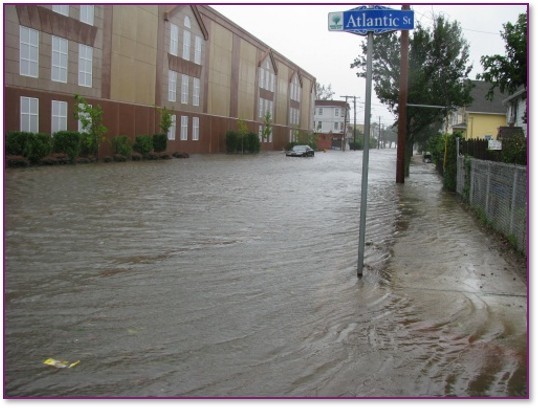
It was not the first time that the substation, which sits in a coastal floodplain, was threatened by a storm surge. A year before, the neighborhood was similarly inundated by Hurricane Irene.
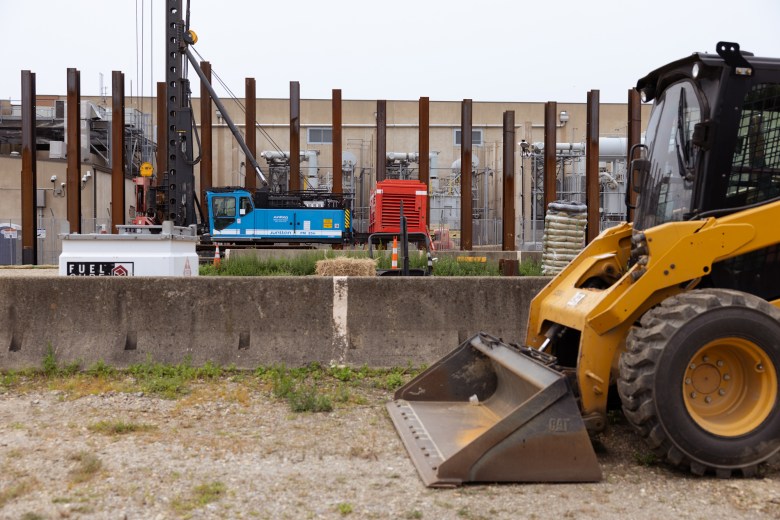
Luckily, neither storm caused much damage to the substation, even as they ravaged other parts of Connecticut. But to avoid more serious consequences from future storms, United Illuminating recently began construction of a 16-foot-high steel floodwall around the substation to keep the waters at bay.
The Singer project — which is expected to be completed in 2027 at a cost of $47 million — is one of three similar floodwalls that the Orange-based utility has either constructed or is planning to build to protect coastal substations.
Last year, UI finished construction of its first floodwall around the Congress Street Substation, also in Bridgeport. The final project, a wall protecting the Grand Ave./Mill River Substation in New Haven, is due to be completed in 2028, officials said.
The combined cost of all three projects is expected to be $146 million, according to a UI spokeswoman.
Utilities such as United Illuminating generally operate two types of substations: transmission stations, which send bulk electricity from power plants long distances over high-voltage transmission lines, and distribution stations which take that electricity, lower the voltage and feed it into the local distribution system where it arrives at homes and businesses.
Renni Pavolini, the unit manager of substation projects at UI, said the consequences of flood damage to a transmission station such as Singer could potentially be “catastrophic” for parts of the New England power grid.
“We will have to shut down the substation, and depending on the damage… it could take days, or it could be just hours,” to restore power, Pavolini said. “Our system, the grid, it’s done in a way that if this [station] is down, we probably could feel it with other substations.”
Connecticut’s other major electric utility, Eversource, is also in the process of adding a layer of protection to its network of substations.
Since 2019, Eversource has spent $9.5 million completing flood mitigation projects at five of its distribution substations around the state, and two more have been scheduled for upgrades. In addition, three substations in the coastal towns of Guilford, Branford and Madison have been removed from service due to the risk of flooding, according to a spokeswoman for the utility.
Elli Ntakou, Eversource’s manager of system resilience and reliability, said the utility recently completed a climate vulnerability assessment to determine which substations or other infrastructure were vulnerable to sea level rise, inland flooding or other climate threats such as drought and extreme heat.
‘We have a granular analysis so we understand the impact to specific assets,” Ntakou said. “The specific stations that we think are higher risk, that’s where we target our mitigations so we make it cost efficient.
The risk that climate changes poses to electric infrastructure is not confined to either utility’s service areas, Connecticut or even coastal regions in general.
Power outages, which can be costly for both utilities and their customers, are growing in frequency across the country due to extreme weather, according to the most recent National Climate Assessment. The same report found that climate change could push expenditures on electricity transmission and distribution infrastructure up an additional 25% by 2090.
The report, released in 2023 under the Biden administration, was removed from government websites after President Donald Trump took office earlier this year.
Locally, the threat floodwaters pose to electric infrastructure is especially concentrated in and around Bridgeport Harbor with its network of substations, transmission lines and power plants.
An ongoing project to build a flood protection system around the city’s South End, known as Resilient Bridgeport, was slated to receive more than $47 million from the Federal Emergency Management Agency’s pre-disaster grant program before the latest round of awards were cut off by the Trump administration earlier this year. (In response, Connecticut Attorney General William Tong joined a lawsuit last month seeking to order the release of that money.)
UI’s Singer Station project, meanwhile, is not reliant on federal funding. Like the utility’s other floodwall projects, it is being paid for by UI customers through transmission and distribution rates within their utility bills.
The Singer floodwall is being built to withstand FEMA’s estimates for a 100-year flood event, plus an additional three feet of water, Pavolini said.
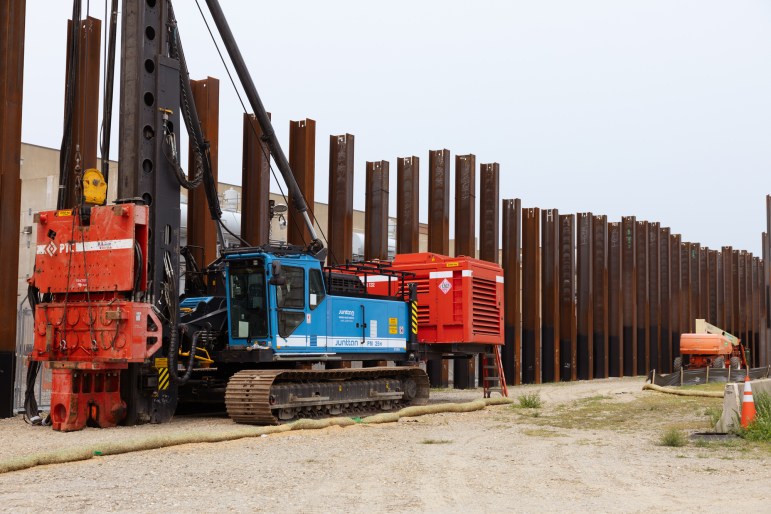
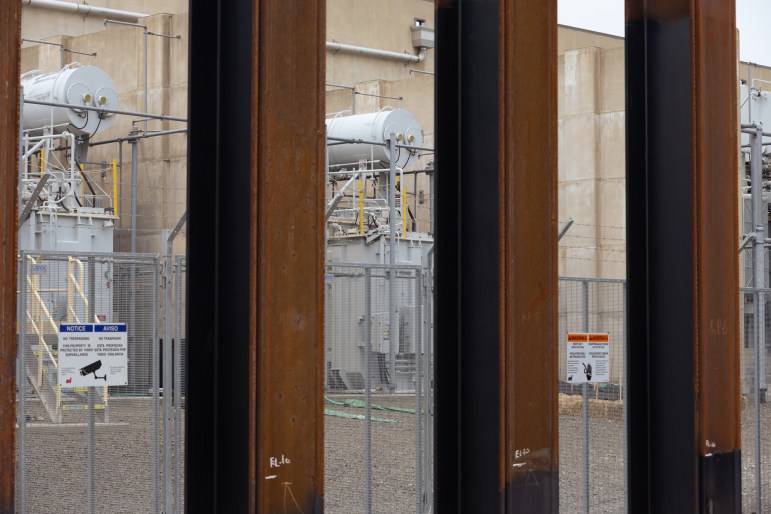
In the first phase of construction, crews drove a series of 57 king pile beams into the bedrock below the substation, with their exposed tops forming the skeleton of the wall. From there, steel sheet piles are currently being installed between the beams to form the protective layer around the facility. Two gates allowing access to the substation will be able to be sealed in the event of a storm.
As a last step, the wall will covered with a layer of concrete so that it blends in aesthetically with the rest of the building, before being topped with a security fence.
In addition to the building of walls, UI recently completed construction on its brand new $142 million Pequonnock Substation in Bridgeport. The new substation, which is located on higher ground further back from the Pequonnock River, replaced an older facility that was vulnerable to coastal flooding.