


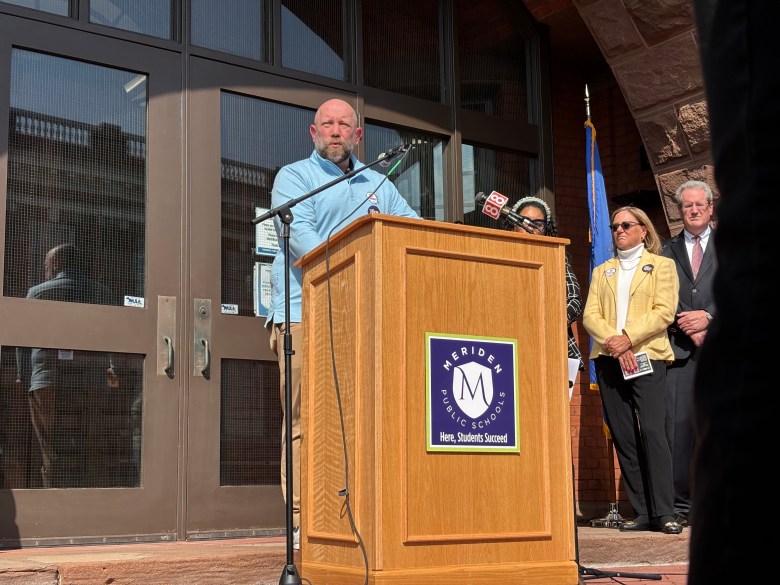
Students, teachers and school administrators were gathered at the steps of the Meriden Board of Education building Tuesday in support of an increase to Connecticut’s core school funding grant when they got some bad news from their state senator, Jan Hochadel.
The legislature’s Appropriations Committee had proposed flat-funding the grant for yet another year.
A wave of “boos” passed through the crowd.
“Oh yeah. We need it louder!” Hochadel said.
“Boo!” several members of the crowd shouted.
Their disappointment stemmed from the fact that the grant in question — known as “ECS,” short for Education Cost Sharing — has not seen any adjustment for inflation since 2013. This has led to a funding gap for Connecticut’s public school districts that some estimates put at over $800 million.
With special education and health care costs rising, many districts say they need multimillion-dollar budget increases but see few ways to secure them.
Legislators had signaled things would change this year. Two priority bills, Senate Bill 7 and House Bill 5002, both sought to end the 13-year wait for ECS inflation adjustments.
But those changes required funding that leaders of the Appropriations Committee didn’t include in the budget they released earlier this week. That’s prompted concerns the state may once again leave schools hanging.
“We knew this was gonna be a fight from the start,” said Meriden Federation of Teachers President Matt Banas. “I expected a lowball number. I didn’t expect another year of flat funding.”
Meriden has already whittled down its staff by about 20 positions this year to offset rising costs, and the city has signaled a willingness to kick in some additional funding from local taxpayers. But Banas said there’s still a $4 million hole the district needs to fill. If all else fails, Banas said, that will likely mean cutting more staff.
Although it’s not up to Banas how the district’s budget gets balanced, he anticipated the necessary cuts could be orders of magnitude larger than what Meriden has already trimmed.
“[Cutting] 16 teachers, two paras, two administrators, saved just under $2 million,” Banas said. “So, you know, it’s going to be upwards of 20, 30 [additional positions].”
Banas warned that further cuts would imperil the district’s ability to meet its legal obligations around special education and could force class sizes to grow even bigger.
William Nixon, a senior at Meriden’s Maloney High School, said his statistics class already has 30 students.
“My teacher is fielding questions nonstop. Often, we leave the class with some of our questions unanswered,” Nixon said.
Other districts around the state are facing similar challenges. In Hartford, the mayor and school board are embroiled in a dispute over whether the district should close school buildings to offset an estimated $70 million deficit.
In the state’s northeast corner, 45 miles away, members of Putnam’s board of finance spent hours Monday debating whether to spend up to $900,000 of the town’s reserve fund to help cover a 7% cost increase for their school system.
The man who requested that increase, Putnam Superintendent Steven Rioux, said it’s “very disappointing” to see the Appropriations budget, given how much he and other educators had advocated for boosting ECS this year.
Connecticut’s strict spending caps are a key reason legislators struggle each year to increase school funding. Rioux, however, said he doesn’t find that explanation satisfying.
“In my opinion, the legislators have the authority, they just don’t have the political will to make adjustments to the [spending] cap,” Rioux said.
The need is plain to see in Putnam, which Rioux said is desperately short-staffed.
“I’ve got 550 [elementary school] kids where more than half of the kids are below grade level in math, and I have one math interventionist,” he said.
Connecticut Education Association President Kate Dias said she’s disappointed but not surprised to see Appropriations leave ECS funding as-is. It’s the second year in a two-year budget cycle, and the caps make major changes challenging.
Plus, she said, Appropriations budgets tend to be conservative.
“It ain’t over til it’s over,” Dias said. “The Appropriations Committee is making the recommendation, and the legislature has to make the decision.”
What that decision will be remains to be seen.
Legislative leaders will now negotiate with Gov. Ned Lamont in an attempt to reach a consensus, after which the budget will be taken up in the House and Senate. An ECS increase could yet find its way into the budget, though it could be a challenge given the spending caps.
It’s not all bad news for public school advocates.
Legislative leaders have made school funding a centerpiece of their agenda for this year, with both Democrats and Republicans endorsing an ECS increase. And while the budget that came out of Appropriations keeps ECS funding flat, the effort to get more state money into school districts that need it could still advance along a number of other paths.
One of those moved forward this week when the Finance, Revenue and Bonding Committee advanced an effort to divert funds from a special state savings program into various forms of relief — including an estimated $150 million or so that would go to towns to help cover rising school budgets. While technically not an ECS increase, that money would still represent additional school funding from the state, and it wouldn’t count against the spending caps.
That alone would likely not satisfy municipal leaders, however, who say they’ve lost much, much more over the years to the stagnant ECS formula. And big questions remain about how the initiative would work.
“My concern is, if the legislature is intending for those resources to be dedicated to education, they’re going to have to draft that in such a way that that’s the only option,” Dias said.
In unveiling the $150 million plan, legislators said they do not intend for the money to be a one-off. But Dias said it’s still unclear how reliable that funding would be in the coming years, especially if it isn’t tied to a recurring grant like ECS.
“[Do] we end up with the same concerns in about six months?” Dias said. “Are we able to sustain the program or have we just kicked the can down the road?”
Rioux said he appreciates the effort behind the $150 million plan, but he also had reservations.
“My frustration with it is: How are those funds going to be distributed?” Rioux said. “Are rural communities going to get recognized?”
And he said if the state is going to dole that money out, it needs to get a move on.
“The legislative session doesn’t end til May 6,” Rioux said. “Well, that’s not going to help us, because we’ll be almost done with our [town budget] process.”
