



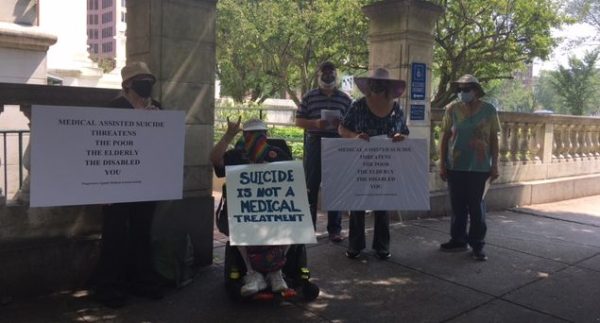
The claims made in the recent opinion editorial advocating for Connecticut to legalize assisted suicide deserve a closer look.
As a physician myself, assisted suicide contradicts the physician’s most basic calling, to provide cure and hope for the patient. The prescription is no longer aimed to prolong life and delay death. Instead, death is the treatment.
The author places a large emphasis on autonomy. However, even if a terminally ill patient appears to have free choice, their choice can still be shaped by fears such as financial stress, access to care, fear of being a burden, family dynamics, etc. The annual Oregon report on assisted suicide in the state does not track subtle forms of influence; absence of evidence is not the same as evidence of absence.
What is portrayed as “choice” will be in reality closer to coercion. When life sustaining care is expensive and inaccessible, “choice” becomes limited. Assisted suicide becomes a cheaper alternative to years of expensive medical care and disability accommodations.
Following the attacks on Medicaid, Medicare, and other benefits like SNAP, this legislation will naturally coerce patients struggling financially toward the cheaper and more accessible option, assisted suicide. The state would rather pay for your early exit than life-sustaining care. What an egregious message to send to our loved ones, neighbors, and friends.
Furthermore, the author mentions that safeguards within assisted suicide policy are effective. However, in the tragic case of Eileen Mihich , every safeguard failed in Washington state, a state where assisted suicide has been legal for 17 years! Eileen suffered from serious mental illness, she was not a Washington resident, no doctor verified she was terminally ill, and no waiting period was enforced. Eileen was able to access assisted suicide drugs while side-stepping every safeguard. This can happen again to someone else’s daughter, sister, or friend.
The author also cites that assisted suicide laws are limited to terminally ill patients. Even the best doctors with all the latest technological advances at their fingertips cannot accurately predict if a patient has six months to live. If eligibility for assisted suicide is based on an estimate, how narrowly confined are these laws?
Unfortunately, misguided notions of “quality of life” means freedom from suffering in the name of a false compassion. This is a violation of patient autonomy. Yet assisted suicide celebrates despair as freedom to choose. The terminally ill and chronically infirm are among the most vulnerable in society and deserve legal protection. It is not the role of government to determine who does or does not have more human value than others.
Yes, Connecticut is a state that leads in quality patient-first centered care. Let’s keep it that way. Connecticut should focus on expanding access to hospice and palliative care, not intentionally ending another human’s life.
Dr. Stephen M. Ward is an internist in Cheshire. He has been a practicing primary care physician for 16 years.