



Most college students scrape by on lean budgets, eating ramen noodles or staking out campus events serving food. And in recent years, with both the cost of living and the price of higher education on the rise, many have found themselves pinching pennies even more while pursuing postsecondary degrees.
Connecticut’s public college and university leaders have taken note. Several campuses are expanding access to food pantries and free dining services, to ensure both mind and body are well-fed.
“It blows my mind how many students we have here that are food and housing insecure, and you know that they’re getting their college degrees…that’s a lot of pressure,” said Courtney McDavid, organizer of the on-campus food pantry at Central Connecticut State University.
Central surveyed its undergraduate and graduate students in 2024, finding more than half said they couldn’t afford to eat balanced meals “sometimes,” “often” or “very often.”
University leaders have worked to address that need, relocating the school’s food pantry — from a closet on the edge of campus to a more central area — and expanding its offerings. There are also auxiliary popup locations, including one at the school’s drop-in child care center.
Central’s pantry receives donations from food banks like Connecticut Foodshare, as well as grocery stores and community and campus support networks. In addition to food, it offers items like laundry detergent and toiletries.
Since the 2024-25 school year, visits to Central’s food pantry have risen from just under 2,500 to over 3,000, and the number of clients served has increased by 50%. McDavid said most of the clients are students, but some faculty shop at the pantry, too.
Hunger in Connecticut
The proportion of Connecticut residents who are “food insecure” — uncertain where their next nutritious meal will come from — has been rising. As of this year, hunger-relief organization Feeding America found that 14% of the state’s residents, roughly 500,000 people, face food insecurity. That’s the highest rate among New England states.
State lawmakers and officials have worked to respond to the rising need. Connecticut boosted funding to the state’s food pantries in its biennial budget last year. And in October, the state provided an emergency $3 million grant to Connecticut Foodshare.
The infusions into the state’s emergency food system came in response to federal cuts to the program known as the Supplemental Nutrition Assistance Program, SNAP. The U.S. Department of Agriculture also cut a pair of programs last year that had purchased fresh food from local farmers for schools and food banks: the Local Food Purchase Assistance Cooperative Agreement Program and Local Food for Schools.
Gov. Ned Lamont has been reluctant to create a state-funded benefit to assist former recipients of SNAP. But he successfully pushed this year for Connecticut public schools to adopt universal free breakfast for all K-12 students. Of the 500,000 Connecticut residents who are food insecure, 120,000 are children, according to Feeding America.
And Connecticut’s college campuses have also been doing more to raise awareness of hunger among their students — and to address it.
Last calendar year, Connecticut Foodshare delivered about 893,000 lbs. of food to 27 college food pantries around the state, a 20% increase from the previous year. Jason Jakubowski, chief executive of Connecticut Foodshare, said college food pantries represent the fastest-growing segment the organization serves.
“Just because you graduate high school and turn 18 years old and go to college doesn’t magically mean that all of a sudden you don’t need three meals a day anymore,” Jakubowski said.
As colleges and universities continue to face growing demand, Jakubowski said investing in infrastructure is the most important thing they can do, noting that most campus pantries began in small closets and have expanded over the last few years.
“The good thing about colleges and universities is that they have a lot of resources, they have a lot of buildings, they have a lot of employees, they have a revenue stream through their tuition and fees, and in many cases, they are able to provide space for a food pantry,” he said.
Central’s McDavid said the school has funded its expanded pantry through dining retail sales, donations and fundraising.
“We want to help any student however we can,” McDavid said.

Students helping students
Connecticut’s community colleges have seen the demand grow too, with many campuses reporting increased usage of their food pantries and repeat visits throughout the academic year.
Melissa Lamar, a spokesperson for CT State, said data shows close to 20,000 students visiting the 12 campuses’ pantries, out of the 60,000 students enrolled each year.
CT State Community College Norwalk opened its food pantry 11 years ago, and the school has expanded what it offers there in the years since.
Students can visit the pantry every day to pick up grab-and-go items and shop for grocery items once a week to bring home. In addition to nonperishable food items, dairy and meats, they have a hydroponic grow wall where they cultivate fresh produce — 160 plants at a time.
The school’s culinary arts department classes also support the pantry. For example, if instructors are demonstrating how to make lasagna, the final product gets portioned out, frozen and distributed through the pantry.
Students at the University of Connecticut in Storrs also contribute in their own way to help the pantry serve as many in their community as possible.
UConn’s Undergraduate Student Government hosted a “pop up” event with the campus’ parking services office in April, where students could donate nonperishable goods to the Storrs food pantry in exchange for relief from their outstanding parking tickets. The value of each item a student contributed was subtracted from what they owed to parking services, including late fees and tickets.
“The food pantry is in great need and in USG we have always been really passionate about advocating for them,” said Jibreel Akbar, the director of student services at USG.
The pantry received over 150 bags of mixed goods from 105 participants in the event — half were consumable food items and the rest were toiletries and personal care products.
Reducing stigma
College and university leaders have made concerted efforts to reduce the stigma around food assistance and increase awareness of, and access to, free food. The growing numbers of clients at campus food pantries could be an indicator that those efforts are working.
Michael White, executive director of dining services at UConn — who oversees the Storrs pantry — said he’s seen the number of visitors rise at both the food pantry and popup events they host on campus.
“We don’t want to know anything about your economic situation, how much financial aid you get or don’t get. Like, none of that matters really,” White said. “The only requirement is you have a UConn ID, which then makes you eligible.”
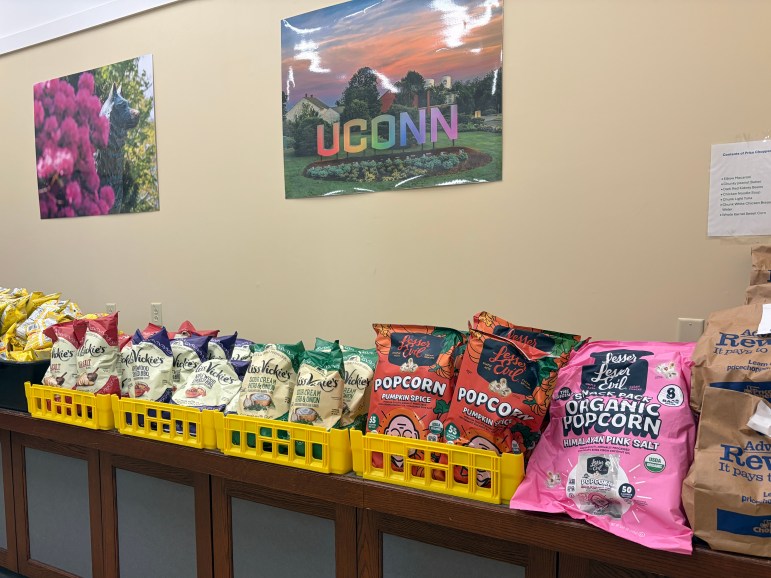
White decided to relocate the Storrs pantry at one of the apartment complexes on campus, since many students who live in apartments aren’t on the school’s meal plan. However, the pantry is available to anyone who wants to visit. White said commuter students, graduate students and faculty are all regular clients.
The pantry is one of seven “Husky Harvest” locations across UConn’s regional campuses in Hartford, Waterbury, Avery Point and Stamford, as well as UConn Health and the law school. The Storrs location offers nonperishable food items and refrigerated cases for frozen meats and produce. It also has hygienic products.
“I think it’s been helpful. It’s certainly not the end all be all to solving food insecurity, but it’s a tool,” White said.
Central’s pantry organizer McDavid, along with university President Zulma Toro, expanded food assistance over the past few years with a vision to create an inviting place where students feel welcome and supported.
Central has also partnered with Swipe Out Hunger, a national nonprofit organization for college students to end hunger, for the past two years to distribute free meal swipes to students experiencing food insecurity. McDavid said if students meet the criteria, they receive a card that is concealed as a guest swipe of President Toro.
While McDavid said she has seen the stigma surrounding food insecurity wear off, she offers to go with students the first time to the pantry if they are looking for that support.
“I feel like we do a really good job of supporting those students and to watch them succeed and flourish. It does my heart good,” McDavid said.
