


In case you missed news of President Donald Trump’s declaration of a trade war with Canada, the administration of Gov. Ned Lamont strove Monday to ensure that the White House gets all due credit for the dollar-for-dollar retaliatory tariffs coming next month from Connecticut’s largest trade partner, Canada.
Lamont, a Democrat seeking reelection in a year when “affordability” is on the lips of most candidates, decried Trump’s trade policies at an official event, not a campaign one, attended by representatives of the state’s large business group, the Connecticut Business and Industry Association.
“If you want to institute a trade war with Canada, next up will probably be tariffs on hydroelectric power and natural gas. What does that do to electric prices? A 50% tariff on aluminum. What does that do to having a cool frosty at the end of the day?” Lamont said, adding he was “just trying to give people a sense of context where these costs are coming from.”
CBIA offered a preview of surveys to be released Sept. 17, when Lamont and his Republican opponent, state Sen. Ryan Fazio of Greenwich, are to take questions on the economy. Slightly more than half of CBIA members say the tariffs will hurt them, and 70% said in a consumer survey they will mean higher prices.
“Our total trade with us and Canada is over $7.6 billion, and new uncertainty with that trade relationship does nothing but create a greater degree of uncertainty as businesses are planning future investment,” said Dustin Nord, director of the CBIA Foundation for Economic Growth & Opportunity. “Tariffs at the end of the day are taxes and leave higher costs for businesses and consumers alike.”
Fazio offered no defense of the tariffs, but questioned the purpose of Lamont’s news conference.
“I have been critical of excessive and broad-based tariffs in the past, but neither I nor the governor are running to hold positions with power over trade policies,” Fazio said. “What the governor announced today is a distraction from the governor’s failure to make the state more affordable.”
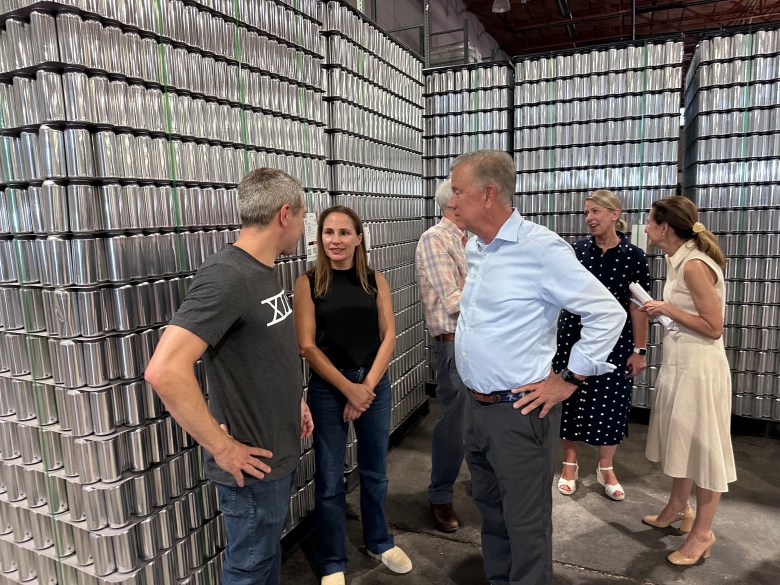
The setting was the Twelve Percent Beer Project, a contract brewer in North Haven, the backdrop a tall stack of shiny, ever-more-expensive aluminum cans awaiting labels for beers, ales and hard seltzers, including Aggravation, a potent IPA made for a brewer named False Hope.
Bridget Blank, a co-owner of Twelve Percent, said the brewery is profitable, despite endless challenges since it opened in 2020 during a global pandemic.
“Our latest over the past year and a half has been ever-rising costs, and aluminum alone has gone up 50% in the past year and a half,” she said. “So we appreciate the governor coming and raising visibility on the challenges that we face.”
Lt. Gov. Susan Bysiewicz said perhaps the visibility would reach the White House.
“We need to be very clear: These tariffs are hurtful to both our residents and our businesses,” she said. “Exports represent 6% of our economy, and they support more than 50,000 jobs in our state. The Federal Reserve Bank of New York has told us that nearly 90% of the tariffs last year in 2025 were paid for by American consumers and businesses, and we know from the Yale Budget Lab that the president’s trade wars have cost Connecticut families more than $1,100 every year.”
Rounding out the presentation were two Democratic state senators, both owners of small businesses: Christine Cohen of Guilford, who owns a bagel business with her husband, and Norm Needleman of Essex, owner of Tower Laboratories. Cohen talked about being squeezed between suppliers who are charging more and customers who won’t pay more.
Tower Labs is a manufacturer of store-brand effervescent products such as denture cleansers, antacids and over-the-counter pain and cold relief medicines. It also produces effervescent products for contract customers. Needleman noted Monday that he was surrounded by aluminum cans at the brewery.
“We have our packaging materials based on aluminum and paper because they’re foil laminate materials, and our costs have gone up 40 or 50%,” Needleman said. “We had the owner of, actually the CEO of the packaging company we deal with, in our factory the other day. He was apologetic, but we’re now in the same position that Christine was talking about. We’re squeezed between the manufacturers and the importers of the aluminum and our customers, who are saying, ‘We’re not accepting any price increases,’ so our margins on a daily basis are shrinking.”
Trump recently imposed a 50% tariff on about $20 billion in Canadian goods, including aluminum, after trade talks failed. He threatened an additional 50% tariff on other cars and steel, beginning in January. Last week, he signed an executive order renaming Lake Ontario as Lake America.
Needleman said he understands targeted tariffs aimed at unfair competition.
“But we have an administration in Washington that doesn’t care about any of that,” Needleman said. “It is personal. It is petty. It is serially transactional and not strategic. And I’m afraid that we’re all paying the price.”
