



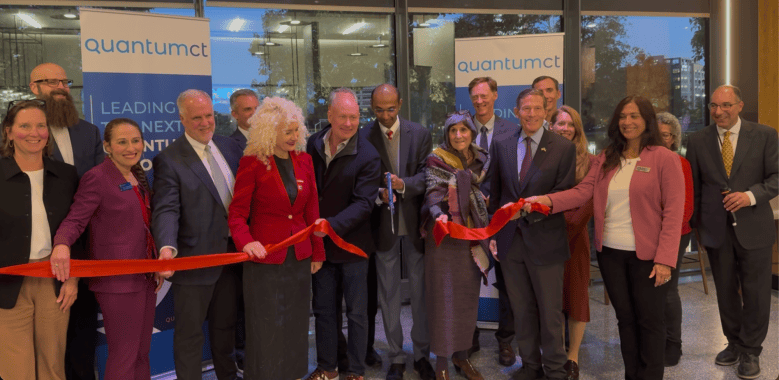
Officials gathered in one of New Haven’s new bioscience towers to cut the ribbon on a tech innovation hub — and on a dream for our state’s future as a quantum version of Silicon Valley.
The ribbon-cutting Tuesday evening marked the opening of a 4,500 square-foot center for researchers, students and entrepreneurs run by QuantumCT, a nonprofit formed to jump-start quantum computing research and company hatching. (Or, in policy parlance, to build out the quantum “ecosystem.”)
The hub is on the first floor of 101 College St., the second of three Carter Winstanley-constructed bioscience lab-office buildings transforming a stretch of downtown atop the former Route 34 Connector.
The goal is for Yale and University of Connecticut quantum computing researchers to share ideas at the hub and make connections with students looking to enter the field and with businesses looking to incubate new companies. Network. Train. Research. Maybe make deals. Actual companies would be housed in the third building, recently approved to be built down the block at 2 Church St.
The broader dream is to make this stretch of New Haven the epicenter of Connecticut’s emerging quantum computing sector — Quantum Alley, say, or the Quantum Corridor — and to make the state a national leader in a projected $200 billion industry by 2040.
[RELATED: CT is trying to kickstart a quantum computing sector]
Quantum computing — quantum physics-based technology that can conduct computations at super-speeds and on multiple levels at once rather than based on binary, yes-no answers — promises to revolutionize fields from health care (like personalized medicine) and drug discovery (cure for cancer, perhaps?) to aerospace to finance.
“We want to make Connecticut the quantum center of the nation,” QuantumCT Interim CEO Vivek Ramakrishnan declared at the formal part of Tuesday’s event.
“A global leader,” said another pre-ribbon-cutting speaker.

Connecticut isn’t alone in seeking to seize the moment to become the next Silicon Valley. Greater Chicago, Boulder/Denver, Santa Barbara (California) and College Park, Maryland, already have similar efforts underway.
The betting money at Tuesday evening’s event was that the transition from research to the first wave of market-ready lucrative “real-world applications” and company-building will happen fast over the next two years. Then we’ll see which regions emerge as the winners.
In informal conversations before and after Tuesday evening’s ceremonial snip, as they checked out the new QuantumCT hub space and volunteered to try to explain quantum computing to reporters and politicians who never majored in physics, officials and investors offered a more nuanced version of the dream.
They spoke of how Connecticut can become one of the new quantum Silicon Valleys, rather than the one new hub.
For instance, state Economic and Community Development Commissioner Dan O’Keefe played up the “global leader” dream in his formal remarks to the crowd of 100 or so community leaders and techies gathered at 101 College. In a conversation afterwards, he played down competition among different U.S. regions. He, like others interviewed, spoke of how we have unique strengths based on which we can carve a leading role.
Our advantage would be based on the two decades of leading quantum research already conducted at Yale and University of Connecticut; and on the presence of leading financial/insurance, military contracting and pharmaceutical firms here that will become prime customers and partner developers of quantum innovations.
UConn President Radenka Maric said Yale’s researchers have led the field in the processing-information end of quantum computing, while her university’s 65 (soon to be 70) quantum researchers have carved out a specialty in quantum sensors. (One definition of the latter: devices that “exploit properties of matter at the smallest scales — like those of electrons and atoms — to measure quantities such as temperature, distance and magnetic fields with unprecedented sensitivity and precision.”) The strength of that two-campus combination is at the heart of the emerging state hub’s competitive strategy, she said.
Money has already poured into the effort: The state committed $50.5 million to the emerging New Haven life sciences-quantum corridor, including creation of QuantumCT here (as part of a broader $121 million “quantum revolution” investment). It won a competitive $15 million National Science Foundation grant to seed that hub, with the possibility of an additional $145 million over the next decade.
Private investment has begun flowing as well. For instance, Florida-based D-Wave this year plunked down $550 million to buy a 65-member Yale-hatched start-up called Quantum Circuits. D-Wave’s Luke Harvey, on hand Tuesday evening, said the company made a bet on the quality of Yale research in picking the emerging New Haven corridor for expansion at what he sees as the transition point from quantum research to commercial applications.
“Innovation is happening so quickly in the quantum space,” said Harvey, the company’s senior director of advanced computing business. “Key breakthroughs will happen in the states nurturing the ecosystems.” He said D-Wave is looking to invest in the New Haven ecosystem and double Quantum Circuits’ workforce here.
Tuesday’s event attracted a representative from at least one European company (who declined to be publicly identified in an article) impressed with Connecticut’s efforts and considering expanding its U.S. operations here.
Quantum Circuits is located across town at 25 Science Park, which developer Carter Winstanley filled up a generation ago in an earlier wave of tech-sector development. Winstanely jumpstarted the city’s biosciences/tech boom at the time by also transfoming the former SNET headquarters at 300 George St. into a health and life sciences center. His firm is now building the three downtown bioscience towers fueling the city’s quantum leap into a more ambitious economic bet. He didn’t give a speech before the crowd Tuesday evening; a steady stream of government and business leaders gravitated to him instead for one-on-one confabs.
This story was first published Oct. 7, 2026 by New Haven Independent.