



As you enter The Preserve in Old Saybrook, stop and look up. A cool, moist air escapes the forest and lightly touches your face. With feet firmly planted, close your eyes and take in a deep breath. Your lungs fill with fresh, oxygen rich air, emanating from millions of respiring oak leaves. Their motto: carbon in, oxygen out. Just what we humans need for a livable planet.
Now, with every cell in your body energized, step on in.

Moving along a winding path, shaded by a grand old tree canopy, listen to birds singing their happy songs. Neuroscience tells us bird song, or simply walking in a forest, calms the senses and elevates the mood. It’s a nice break from our hectic days.
As you meander, watch closely. Squirrels forage and watch you pass by from the limbs above. And if you’re lucky, you catch a glimpse of a chipmunk, scurrying under and across downed tree trunks, sharply chirping to his or her community, that visitors have arrived. Trees are their home, whether standing tall or sprawled across the forest floor.
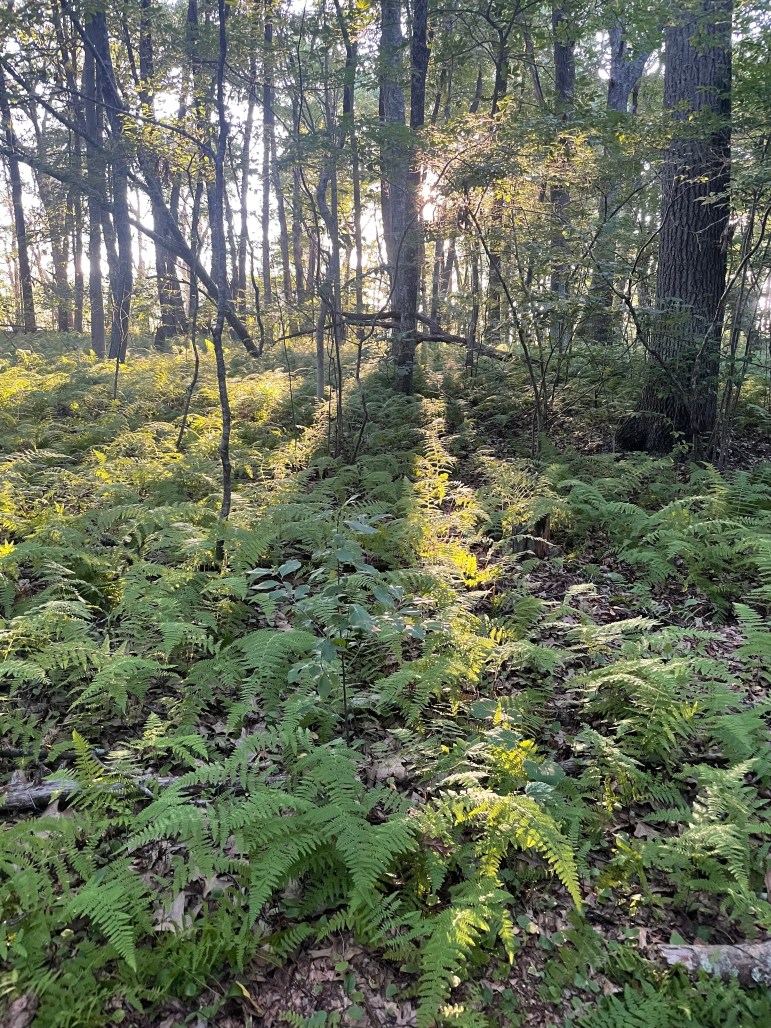
Look closer still into the dense understory. Mushrooms, moss, and ferns grow in abundance, protected from the sun’s heat by expansive tree canopies whose branches seem to hold hands in cooperation, not one willing to overgrow or push into another. Pollinators buzz about the native Mountain Laurels, one of the world’s most unique blossoms. The gentlest touch sends blasts of pollen showers over a bee’s body. Your attention quickly diverts to a butterfly, haphazardly fluttering on the way into the safety of their home, high above.
Keep walking, there’s more wonder inside.
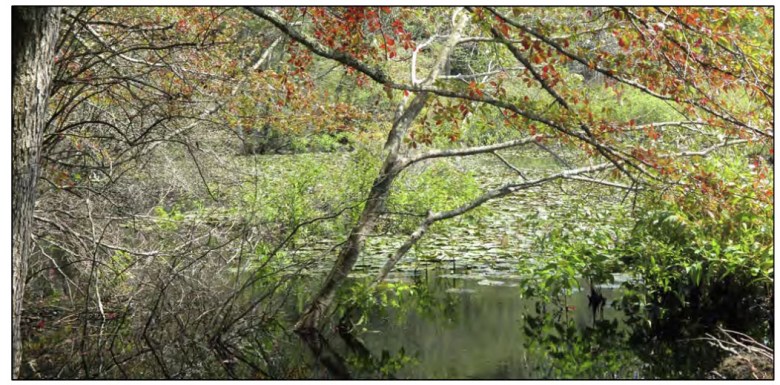
You come across a vernal pool. Easily overlooked, these biodiverse hotspots are small but mighty in ecological importance. These are nature’s little nursery for frogs, salamanders and essential insects which call these pools home. These are places where chemical intrusion can spell ecological disaster on a major scale, now and years to come.
Stop and listen. It’s so quiet, you can hear a nearby stream trickling toward the river. And there’s even more. Keep going deeper into the forest.
Underfoot, a thousand miles of mycorrhizae, aka wood-wide-web, transports nutrients, moves water, and feeds all life through an extensive, highly connected subterranean system. This all-important hidden and delicate infrastructure helps the forest adapt to climate change, nourishes tree saplings growing under a closed canopy and serves as a 24-hour banking system that barters for carbon, phosphorus, and nitrogen to feed plants in need. Mycorrhizal networks take decades to establish, yet are obliterated in mere seconds by heavy logging machinery. Their loss spells disaster for life all around.
Though our eyes can see so much wonder, there are species, seemingly invisible, not by magic, but by forest design — bats, owls, bobcats, coyotes down to the tiniest microbiota — that keep the forest ecosystem in balance, unbeknownst to the human recreator. Without them, no such balance can occur and no amount of forest management can replicate their habitat, custom made by nature. Road building and logging not only introduce invasive species but also sever contiguous migratory corridors, making urban-wild boundaries ripe for surprise encounters.
Your mind and body refreshed, the journey ends where it started. We climb into our cars, shaded by the elders towering above. Though absent of words, the forest is grateful to live on another day, sustaining innumerable species that depend on each other for survival. The Preserve also nourishes the human visitor, providing an outdoor classroom of enrichment for young, developing minds and bodies — a rare and invaluable counterbalance in a world where screens compete for every waking moment.
Logging the Preserve threatens one of a few remaining mature coastal forests — one that took shape long before our ancestors arrived. Left intact, the forest will continue to consume large amounts of carbon from our warming atmosphere. Logging causes extensive soil damage, leaving behind hot, arid conditions that many plant and microbial species cannot survive. Roads seed invasive species, often controlled with chemicals that cause unintended damage to native habitat close-by and downstream.
Our state flower, the Mountain Laurel, is targeted for thinning or removal as are large stands of oak, our state tree. Nature, left alone, has self-managed and adapted over eons, without intrusion of chainsaws and roads. With nature as her witness, the forest knows what we are only beginning to understand how to adapt and survive on a warming planet. If only we would stop and listen.
This is your moment to act. There is a hearing Wednesday, September 16, 2026 at 9 a.m. Old Saybrook Town Hall. Show up. Speak up. The trees, the wildlife, and the generations who come after us are counting on it.
Sierra Farris lives in Essex.