


Construction workers in hard hats and safety vests, hustling to transform a vacant office park in Avon to 176 units of housing, took little notice of the small ceremony celebrating their labors last summer on a project made possible by Connecticut’s controversial affordable housing law, 8-30g.
“This is an incredible town. It’s been so supportive, and we’ve had such a great experience,” said Dara Kovel, the chief executive officer of Beacon Communities, the developer. “We also landed in the district of one of the state’s most passionate and vocal advocates for housing for people in need.”
That would be Rep. Eleni Kavros DeGraw, D-Avon.
Opposition to 8-30g, as well as an omnibus housing bill Kavros DeGraw helped draft and pass last year, has been foundational to a Republican Party desperate for wedge issues that might resonate in suburbs where the GOP has lost its way, places like the Farmington Valley suburbs of Avon, Canton and Simsbury.
Kavros DeGraw is both a symptom of and contributor to the GOP’s slide in the valley.
With other moms alarmed by Hillary Clinton’s loss to President Donald Trump in 2016, Kavros DeGraw began reorganizing an ineffectual local Democratic Party that did not run full slates for municipal office and had failed to nominate a candidate for the 17th House District of Avon and Canton in 2014 and 2016.
What happened over the next decade in Avon is emblematic of the political shift that has drawn many upscale suburbs in Connecticut away from Republicans, helping Democrats win supermajorities in what was a closely divided General Assembly when Trump opened his first term in January 2017.
It is a story of how politics still are local, even when shaped by national trends, issues and personalities. Trump was a catalyst, but it was on-the-ground organizing that transformed Avon, a comfortable community of 19,000 with a median household income of $154,058, into a small-town Democratic powerhouse.
Kavros DeGraw, now 51, a stay-at-home mother of three with a background in writing, started a grassroots organization after the 2016 election with a friend, Carrie Firestone, called Forward Connecticut. It was organized around four pillars: connect, inform, serve and lead.
“We had, almost overnight, 2,000 members on Facebook,” she said. “They wanted to know what could they do because everybody was like, ‘This is going to be bad.’”
Grief and anger over a presidential election fueled action, first in the 2017 municipal races.
“We had women all over the Farmington Valley who suddenly stepped up to run,” Kavros DeGraw said, adding they were not universally welcomed at Democratic town committees unaccustomed to new volunteers with new ideas and ambitions. “It was like, ‘Why are you here?’”
Kavros DeGraw said she announced a plan to raise $15,000 for the municipal elections, instantly getting pushback from a Democratic town committee member.
“He goes, ‘Well, we need to raise like $1,800.’ And he goes, “What would you spend on $15,000?’ I said, ‘We’re going to run a full slate of candidates.’ And he goes, ‘Where are you going to get a full slate of candidates?’” she said.
Avon had 3,748 registered Democrats and 4,145 Republicans when they started in late 2016, and the GOP controlled the town council with a lopsided majority. Gains would come slowly. It was the start of a multiyear effort to recruit candidates, teach them how to run and expand the Democratic base.
“This is what these women did incredibly well,” said Eliza Massaro, a sales and management executive who joined the Democratic town committee in 2018, a move that would become life changing. Massaro now serves as its chair — and her volunteer political work became a career.
In 2021, Massaro abandoned her sales career to open 818 Political, a consulting firm whose name references the date when the constitutional amendment giving women the right to vote was ratified, Aug. 18, 1920. The majority of its clients are women, Kavros DeGraw among them.
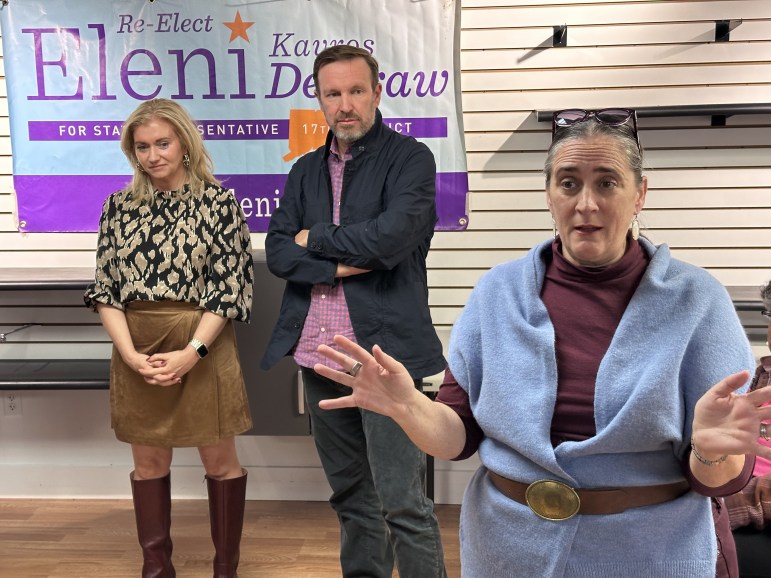
After working behind the scenes as an organizer, Kavros DeGraw ran for the General Assembly in 2018 in the two-town House district of Avon and Canton, challenging Rep. Leslee B. Hill, R-Canton. Kavros DeGraw carried Avon, but Hill narrowly won on the strength of the vote in Canton.
The same year, Democrat Ned Lamont won his first term as governor, but he lost to Republican Bob Stefanowski throughout the Farmington Valley. Other Democrats, notably U.S. Sen. Chris Murphy and congressional candidate Jahana Hayes, did better.
Kavros DeGraw ran again and won in 2020, the night Joe Biden was elected president, carrying Connecticut by 20 percentage points and Avon by 24. She won with 52% of the vote. It also was the year that Democratic voter registration passed Republicans in Avon.
The trend would continue. As of this month, Democrats outnumber Republicans, 4,447 to 3,194, an advantage of more than 1,200 voters. Running full slates of municipal candidates, Democrats have won 4-1 majorities on the council in the three most recent elections.
Seeking a second term in 2022, Kavros DeGraw faced a moderate Republican councilwoman from Avon, Heather Maguire, typically a strong vote getter in municipal elections. It was the Joe Biden midterm, but national conservative politics intruded — that June, the U.S. Supreme Court overturned Roe v. Wade.
“I went out the day it was decided, and every door … was a husband working from home,” Kavros Degraw said.
She was struck by how unsettled the men were. One told her a story about his wife’s ectopic pregnancy.
“I had one guy, former military, who said, ‘What if you’re 16 and you just make a mistake? And I thought, ‘Oh, he’s got a sibling or a girlfriend or somebody in his past who had confronted an unwanted pregnancy,’” Kavros DeGraw said.
Kavros DeGraw won with 57% of the vote.
As the Democrats have consolidated, the Republicans in the valley have struggled with internal differences over whether to stand with Trump or tack to the center. In 2024, Kavros DeGraw’s Republican opponent was Manju Gerber, a leader of the socially conservative Moms for Liberty. Gerber got less than 38% of the vote.
Two of the three Republicans who preceded her in the 17th House District seat, Kevin Witkos and Tim LeGeyt of Canton, have broken with their party to varying degrees. Both were elected to the Canton Board of Selectmen after leaving the General Assembly and still serve.
Witkos, the first selectman, resigned from the Republican town committee.
“It’s been taken over by the, I’ll say, the right wing of the party, and that just doesn’t go well in the valley anymore,” said Witkos, who also had been a state senator.
LeGeyt, who succeeded Witkos in the House after Witkos’ election to the Senate, went further. The day after Trump’s election in 2024, LeGeyt went to town hall and changed his voter registration from Republican to unaffiliated.
“I just could not continue with some of the crap that I was seeing Trump take part in, and it’s only gotten worse,” LeGeyt said. “And so Republicans, you know, they’ve got their heads down. They’re not proud of what’s going on, in my opinion.”
Witkos said the health of the local GOP is poor.
“I don’t even get a lot of Republicans requesting to serve on a board or commission. There’s apathy there,” Witkos said. “I think we need somebody closer to the local level, the state level, to kind of re-energize the base, give them something to want to fight for, because I think that’s missing in our party.”
Andrew Ziemba, the Republican running against Kavros DeGraw this year, said his party lacks the infrastructure that Kavros DeGraw and the other women built for the Democrats in 2017 and 2018.
“Republicans, they tend to not really have a robust door-knocking effort. They don’t really do the volunteer calls. They don’t really send out these postcards to people. They don’t really have events,” Ziemba said. “I mean, it’s the Democrats who are very well organized. They make the calls, they knock the doors, and they have volunteers who are very aggressive about making those efforts.”
