


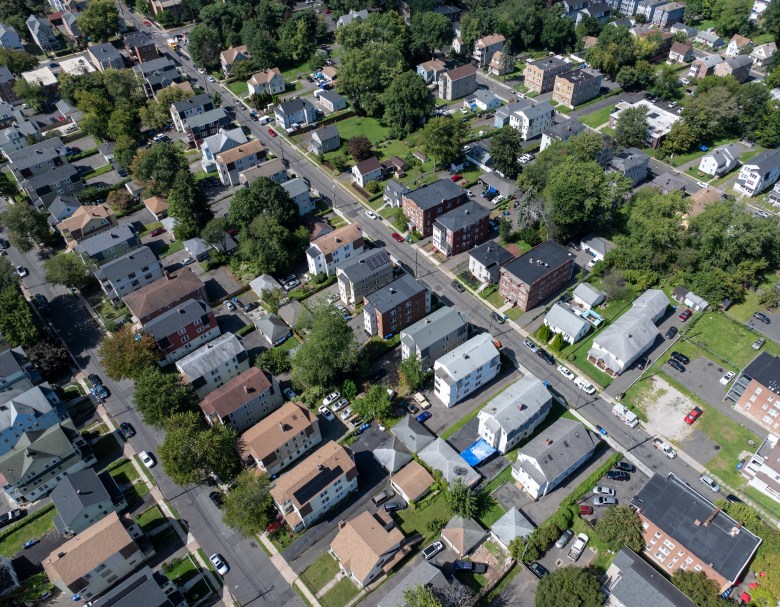
Until about a decade ago, people living in Bridgeport and Fairfield got the same amount of money for their housing vouchers, even though rent is much higher in Fairfield.
The amount of aid through the federally-funded housing choice voucher program — better known as Section 8 — is determined by averaging rent costs in a large, economically diverse metro area.
These housing vouchers, used at private apartments, are typically administered through towns and can be used anywhere in a set region. But using such a big geographic area to determine the voucher value made it hard for people to live in wealthier towns like Fairfield. Because of this, advocates say the widely used system led to significant housing segregation, with most voucher holders forced to live in lower-income areas with cheaper rents because it’s all they can afford.
“That means you’re actually kind of coming up with a number that is going to be too low to ever reach a lot of places that are higher-rent areas,” Erin Boggs, executive director of Open Communities Alliance.
To address this problem, federal rules were changed around 2017 to allow housing authorities to calculate voucher values based on ZIP code instead. But, since then, only two Connecticut authorities — Fairfield and Stratford — have opted to participate.
“It made a huge impact at least in Fairfield about the segregation that was really going on,” said Carol Martin, executive director of the Fairfield Housing Authority. “And when I say segregation, [it was] not intended by the rental assistance program. It was really driven by the markets.”
The areas with lower rents are often racially and economically segregated with lower-performing schools, more pollution and less access to outdoor space. A May 2026 report from the Open Communities Alliance found that around 50% of voucher holders in Connecticut lived in high poverty census tracts — and a Connecticut Mirror analysis of vouchers distributed in 2026 by ZIP code elicited similar outcomes.
The report attributed this segregation to voucher value and administrative barriers, among other issues.
While housing authorities can opt-in to small area fair market rents, only the Hartford metro area is required to utilize it. And Boggs believes state law can be used to make this method of calculation the standard and begin to address this segregation.
“The state housing authorities are a creature of state law, right? So the state gets to say a lot about, certainly their jurisdiction,” Boggs said. “When they’re based on a concern about segregation, they can make rules that correct for that, like adopting these other versions of the value vouchers.”
Housing Committee co-Chair Sen. Martha Marx, D-New London, said she’d be interested in looking at ways to require towns to use the small area method to calculate voucher values.
“I think you almost have to make mandates, right?” Marx said. “Everybody hates mandates, but there’s a reason for mandates.”
Housing Committee ranking member Rep. Tony Scott, R-Monroe, said he’d rather see mandates on the Department of Housing to use rental assistance in suburbs than mandates on towns. For its part, DOH officials say they do have housing mobility programs and other methods to reduce segregation.
“It alleviates the quote-unquote segregation,” Scott said. “It alleviates going to bad schools, alleviates that people all live together in bad crime areas. It alleviates all that. Let’s make it a priority for the DOH to say this is how we want to do these vouchers.”
The House and Senate Republican caucuses have historically opposed Democratic proposals to implement mandates on towns, particularly around housing. But with the midterm election resulting in a smaller GOP presence in the General Assembly, the question now turns to what housing priorities the state’s Democrats will set once the legislative session starts in January.
Neighborhood rent
While she can’t remember the exact year the Fairfield Housing Authority started calculating voucher values by ZIP code, Martin said they opted in as soon as they could. The 2017 federal rule change made it possible for authorities to volunteer to switch their valuation systems and required some larger authorities to do so.
“[This] honestly was a huge success for Fairfield, because I think we’re a community that was uniquely positioned for the HUD to implement small area fair market rents,” Martin said. “It really put us into a much more sustainable program, and we availed ourselves of it almost as quickly as it became law.”
The hyperlocal method of voucher calculation was optional for Fairfield, but Martin knew it would benefit the area.
Under the old regulations, we were going to the highest percentage above fair market rent that we could through a normal regulation process. And we were still [on average] $300 less than what typical landlords were renting apartments to.
Carol Martin, executive director of the Fairfield Housing Authority
Fairfield is grouped into the Bridgeport Regional Metro area, which includes towns like Trumbull, Bridgeport and Stratford. But Bridgeport has a median gross rent of $1,450 compared to $2,185 in Fairfield, and the median household income in Bridgeport is $113,747 less than it is in Fairfield. No one with a voucher has to pay more than a third of their income to rent; the amount each household receives changes based on income.
Because voucher value was calculated using the fair market rent for the region, Martin said, the Fairfield Housing Authority was “maxing out” their vouchers.
“Under the old regulations, we were going to the highest percentage above fair market rent that we could through a normal regulation process,” Martin said. “And we were still [on average] $300 less than what typical landlords were renting apartments to.”
Even with the flexibility to increase voucher value by 10%, Fairfield vouchers were not meeting rent costs in the area.
“Simply, the math didn’t work,” Martin said.
But this didn’t just mean that the vouchers were unusable — it meant that Fairfield was losing vouchers. After a certain point, they were given to a different housing authority.
“[Carol] was finding that her program was shrinking because this regional way of calculating the value of vouchers meant there was no way people could come up to the level of the rent in Fairfield,” Boggs said. “As soon as she adopted this, she was able to grow her program back.”
A CT Mirror analysis found that economic voucher segregation has not changed much over time. However, areas that have implemented the ZIP-code calculated rents have seen the percentage of voucher holders in high-poverty areas — those with poverty rates of 20% or higher — fall slightly since implementation.
In 2017, under former President Barack Obama’s administration, larger housing authorities across the country were required to switch to the small area method of calculating rent.
The Hartford Metropolitan Statistical Area was among those that had to switch. Data shows the area has seen an increase in the number of voucher holders living outside high poverty areas over the past 12 years.
Since 2013, the number of voucher holders living in West Hartford increased, while the number of voucher holders living in Hartford, a high-poverty area, fell by almost four percentage points.
“When you look at the Hartford region, I think the combination between the mobility counseling and the small area FMR is helpful because they go hand in glove,” Steve DiLella, the director of the individual and family support programs at the Connecticut Department of Housing, said.
Mobility counseling, which helps families in higher-poverty cities areas relocate to different areas using their vouchers, is used by the state in Hartford, Middletown, Meriden, Fairfield, New Haven and Bridgeport, DiLella said. These programs help them identify places to live, aid in negotiation with landlords and provide help with financial management and tenant rights education.
New Haven — a high-poverty city — and New Milford both saw drops in both total count and percentage of voucher holders living in the towns since 2013. DiLella thinks mobility counseling, small area fair market rents, and the waitlist lottery system, which does not use jurisdiction to determine who gets the next available state voucher, all impact where voucher holders live.
Despite the decrease of vouchers seen in some high-poverty towns, the overall distribution of vouchers across the state remained fairly stagnant. There were 6,226 state-distributed housing choice vouchers in 2013 compared to 8,177 in 2025 due to an increase in federally funded specialty voucher programs during the pandemic and for veterans. But even with more vouchers, there was little change in where most people lived across the state.
In 2013, 54.4% of state voucher holders lived in high poverty towns compared to 42.7% in 2025, CT Mirror’s analysis found. Around 3,390 vouchers were used in high poverty towns in 2013, compared to 3,494 in 2025. The OCA report also elicited similar results.
“The voucher programs, as originally envisioned, would have broken up that system so that people could live anywhere,” Hugh Bailey, policy director at Open Communities Alliance, said. “Part of what we’re trying to show is that, despite the promise and the potential of the voucher program, the outcome hasn’t really changed all that much.”
Hamden, Norwalk, New London, Stamford and Winchester saw the largest increases in percentage of total vouchers distributed year to year. DiLella said New London’s increase may be attributed to state vouchers given to folks who had previously been in public housing that closed. After public housing closed in the city, the state issued more project-based Section 8 housing, meaning that people got vouchers for specific apartment complexes. Towns like Hamden, meanwhile, may have seen an increase in voucher holders as a result of mobility counseling in nearby New Haven.
“Even when we do [mobility counseling], some households still choose to live in the community that may be in the cities,” DiLella said. “There is this piece of choice that I think sometimes in this conversation doesn’t always get recognized that, ultimately, even though we provide this level of service, households still can choose where they want, of their own free will.”
Historical segregation
Connecticut has a history of being one of the most economically and racially segregated states in the nation. A study released this year found that Connecticut schools are some of the most segregated in the nation, and a 2024 housing and segregation study found similar results.
A 2015 study from the Connecticut Fair Housing Center and the Connecticut Department of Housing detailed historic policies such as redlining and exclusionary zoning that fostered segregation and limited where families of color were permitted to live in the state.
Housing decisions by the family are influenced by many factors, including schools, employment, transportation, healthcare, childcare, and family support systems. Every family has different priorities, and housing assistance should support those choices.
Annette Sanderson, chief executive officer of Hartford housing authority
These policies, the study found, were still impacting housing segregation in the state.
“Connecticut’s fairly obviously racially and economically segregated, right, and whether it’s the worst, the third worst, the fifth worst [in the nation], I don’t really think is relevant to the conversation,” Sean Ghio, policy director for the Partnership for Strong Communities, said. “What are the outcomes for Connecticut because we continue to tolerate it?”
Annette Sanderson, chief executive officer of the Hartford housing authority, said in an emailed statement that when the agency made the switch to a small area rent calculation it was challenging to explain how vouchers used in different areas might be worth different amounts. Since implementation, there has been more flexibility for families who are looking for housing across the region.
“Housing decisions by the family are influenced by many factors, including schools, employment, transportation, healthcare, childcare, and family support systems,” Sanderson said. “Every family has different priorities, and housing assistance should support those choices.”
But not everyone wants to implement the calculation. In fact, some housing authorities are against making the switch.
“You hear two responses from housing authorities,” Boggs said. “One is, ‘These other areas cost more, so I’m going to have to give out more vouchers.'”
But Boggs said studies done by HUD found that housing authorities generally do not spend more money on vouchers under this calculation. Because fair market rent also inflates the cost of vouchers in areas with lower rents, the amount of money spent per voucher evens out.
However, Boggs also said local housing authorities cite administrative costs and the burden that switching over to a different calculation method would put on the housing authority.
Martin said the “upfront costs” to transition from fair market rents to small area fair market rents can be costly for a housing authority.
But once Fairfield made the switch, Martin said the program costs remained the same as before.
Connecticut law
While only the Hartford metro area is required to use the small area fair market rents and other housing authorities can currently opt-in, Boggs said she believes state law can be used to make this method of calculation the standard.
“The state housing authorities are a creature of state law, right? So the state gets to say a lot about, certainly their jurisdiction,” Boggs said. “When they’re based on a concern about segregation, they can make rules that correct for that, like adopting these other versions of the value vouchers.”
The issue is complicated by several political realities around housing policy in Connecticut. It’s hard to get significant housing legislation passed, particularly if it includes mandates for towns. Some Republicans also view vouchers as a way to help their smaller towns get closer to a 10% affordable housing threshold under a state law known as 8-30g, one of the state’s foremost affordable housing laws. Democrats want to push those towns to build more housing to meet the threshold instead.
Marx said she views the issue as one of public health. The Open Communities Alliance report notes that many low-income families have environmentally-driven health issues and want to move to a place with less pollutants.
“It’s almost not a voucher issue; it’s a public health issue. It is just so sad that life is already so hard for people, and we are just giving them no choice,” Marx said.
But, she added, there are several priorities for Democrats in the upcoming legislative session. Eviction reform has been an area of focus for committee leadership over the past few years, and Marx said she wants to look at changing minimum lot sizes statewide.
Housing Committee co-Chair Rep. Antonio Felipe, D-Bridgeport, said homelessness is his priority for the coming session. He said he’d be interested in talking about voucher segregation, but fears that increasing voucher values could mean fewer vouchers overall.
He wants to focus on getting rent costs down across the board, he said.
“I think it’s super important that we figure out a way to tackle segregation overall. That we figure out a way to make communities like Bridgeport and Fairfield — which are so different but neighbor each other — work together in terms of making sure that we are providing good and affordable housing for people,” Felipe said.
Connecticut Republicans have long sought a way to reform the 8-30g statute. The law offers court remedies to developers whose affordable housing proposals are denied, shifting the burden of proof to the town to show it had legitimate health or safety issues.
Towns are exempt from the law if at least 10% of their housing stock is designated affordable. One of the ways to increase that stock is by having housing choice vouchers in the community. In 2025, Scott, the Republican state representative from Monroe, backed a proposal that would have prioritized voucher use in towns that haven’t hit that 10% threshold.
He said he sees that as one of the ways to address segregation concerns and help towns make easier progress toward the 10% goal.
“It’s not going to be like building a 100-unit complex with 30 of them being affordable housing, but it will help,” Scott said. His bill didn’t get a public hearing in 2025.
Democrats and housing advocates have been reluctant to make changes to 8-30g, saying it’s one of few tools available to push towns that refuse to allow construction to do their part in alleviating the affordable housing crisis.
“They’re doing that just as a way to get out of building” new housing, Marx said.
But Housing Committee ranking member Sen. Rob Sampson, R-Wolcott, one of three state senators who won his reelection campaign this week, said he fundamentally disagrees with the idea of the government intervening to change the demographic makeup of any community. He said he wants to see people who really need vouchers get them but thinks too many people take advantage of the program.
“I think that they are being disadvantaged by these programs being available,” Sampson said. “They end up as a crutch instead of people becoming more self-starting and entrepreneurial.”