



What if Connecticut residential electric customers could have saved $1 billion over the past decade simply by changing how we purchase electricity?
That’s the question raised by new research I requested from Synapse Energy Economics. And at a time when families are struggling to pay their electric bills, it’s a question we cannot afford to ignore.

Eversource is seeking approximately $727 million in additional annual distribution revenue, a proposal that could increase a typical residential customer’s monthly bill by roughly $33 if approved. Families are already feeling nickel-and-dimed by rising costs, and another increase would only add to that burden.
As a member of the General Assembly’s Energy and Technology Committee, I believe we have a responsibility to examine every component of the electric bill, not just the charges that receive the most attention.
For years, Connecticut’s energy affordability debate has focused heavily on public benefits charges. Those costs deserve scrutiny, and we took steps to address them in 2025. But we also need to ask a fundamental question: Are we buying electricity in the most cost-effective way possible?
Earlier this year, Synapse published a study estimating that Connecticut residential Standard Service customers paid approximately $1.8 billion in wholesale supplier premiums between 2016 and 2025.
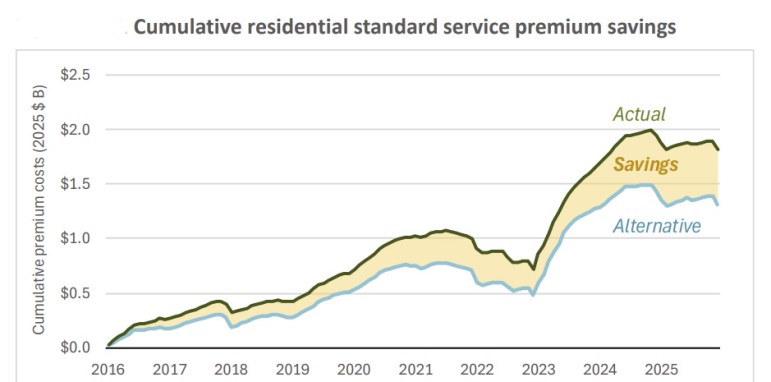
These aren’t profits collected by Eversource or United Illuminating. They’re costs associated with suppliers taking on the financial risk of selling electricity at predetermined prices.
Fixed-price contracts provide stability, but that protection comes at a price.
After reviewing the findings, I contacted Synapse’s researchers and invited Representative Tracy Marra, the Ranking Member of the Energy and Technology Committee, to join our discussion. Electricity affordability shouldn’t be a Democratic or Republican issue.
I subsequently requested a Connecticut-specific analysis to better understand whether alternative purchasing strategies could have reduced costs for ratepayers.
The results deserve attention.
Using historical data from 2016 through 2025, Synapse estimated that purchasing 25% of Standard Service electricity through a spot-market model, with subsequent cost reconciliation, could have saved residential customers approximately $500 million, averaging $42 per customer annually.
At 50%, the estimated savings increased to $1 billion, or approximately $86 per customer annually.
Let’s be clear: Saving $42 or $86 a year won’t solve Connecticut’s affordability challenges. But for families facing rising electricity costs, insurance premiums, property taxes, and grocery bills, every dollar matters.
And when those individual savings add up to hundreds of millions of dollars statewide, we have a responsibility to examine whether customers are paying more than necessary.
Perhaps most notably, both scenarios produced lower modeled electricity rates in 86 of the 120 months examined, with slightly less month-to-month bill volatility.
That challenges the assumption that greater participation in wholesale markets necessarily means less predictable bills.
These findings are based on a simplified historical model, not a guarantee of future savings. There were months when customers would have paid more, and wholesale markets carry risks that must be managed carefully.
But the research raises a serious question about whether our traditional purchasing strategy has placed too much emphasis on price certainty at the expense of potential savings.
Importantly, Connecticut has already begun addressing this issue.
In 2025, I supported bipartisan energy affordability legislation, Senate Bill 4, which became Public Act 25-173. Among other reforms, it required utilities to develop the capability to purchase at least 25% of Standard Service electricity through more flexible wholesale-market arrangements.
That legislation preceded the Connecticut-specific analysis I requested. The new findings provide additional evidence for examining how that flexibility should be used.
In October, the Public Utilities Regulatory Authority approved an updated procurement framework with a nonbinding 20% wholesale-market purchasing target and flexibility to go higher when conditions and safeguards justify it.
An updated procurement plan is due February 1, 2027.
We’ve created the opportunity to purchase electricity differently. Now we need to determine whether that opportunity is producing real savings.
As we approach the 2027 legislative session, I intend to work with colleagues on both sides of the aisle, regulators, and consumer advocates to examine how these reforms are implemented.
How much electricity is actually being purchased through wholesale markets? Are ratepayers saving money? Are adequate protections in place against price spikes? And do the results justify further changes?
Those questions should guide our next steps, rather than rushing to introduce another law before the existing reforms have been tested.
Eversource’s pending rate case concerns electricity delivery, while this research addresses electricity supply. They are separate costs, but both appear on the same bill families struggle to pay.
No single reform will make electricity affordable overnight. But that cannot become an excuse to overlook opportunities for savings.
Connecticut families deserve more than explanations for why their electric bills are high. They deserve evidence that we’re doing everything reasonably possible to bring them down.
That means looking beyond the usual arguments, following the data, and holding ourselves accountable for results.
Raghib Allie-Brennan represents District 2 (Bethel and parts of Danbury) in the Connecticut House of Representatives.