



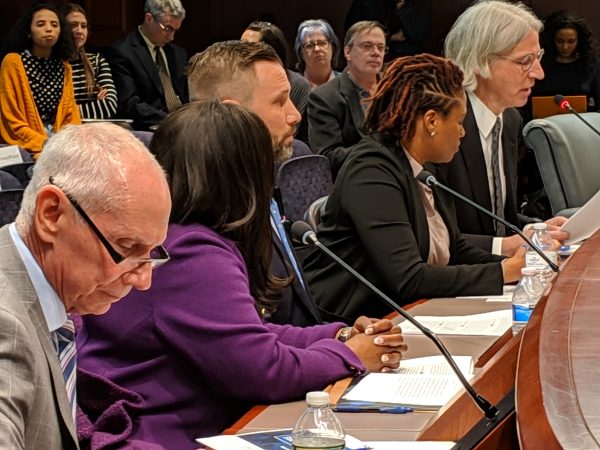
The recent string of scandals that has embarrassed the Connecticut State Colleges and Universities system and the Board of Regents (BOR) that oversees this system are simply the latest chapters in a long tale of failure and woe.
Since Gov. Dannel Malloy and the Connecticut General Assembly created the BOR and CSCU in 2011 by forcing the four Connecticut state universities, the 12 community colleges, and Charter Oak State College into a single administrative and oversight structure, problems have followed, one after another, about as regularly, and almost as predictably, as the rising and setting of the sun.
Given the resignation of CSCU Chancellor Terrence Cheng (July 2025), followed by that of his successor, Interim Chancellor John Maduko (April 2026), the suspension of Maduko’s successor, System General Counsel Karen Buffkin (May 2026), and the resignations of BOR Chair Marty Guay (May 2026) and Vice Chair Juanita James (September 2026), as well as that of Central Connecticut State University President Zulma Toro (also September 2026), each under a cloud of controversy, it is obvious that the system has a leadership problem.
This is nothing new. The first CSCU President, Robert A. Kennedy, lasted a year before several ethically dubious decisions cost him his political support and forced him to resign. Kennedy’s successor, Gregory Gray, alienated legislators as well as the faculty at most of the system colleges and universities, who voted no confidence in him. He lasted two years.
Mark Ojakian, a veteran state bureaucrat who headed CSCU from 2015 through 2020, survived as long as he did not because of his desire to collaborate with faculty (rumor has it he had a plaque on his desk engraved with the phrase “sometimes the squeaky wheel gets replaced.”) or his ability to win their support (he did not: faculty voted no-confidence in him as well) but because he maintained the backing of Malloy, who appointed him, incoming Gov. Ned Lamont, and other key powerbrokers in Hartford. Having set in motion a merger of the 12 community colleges into a single Connecticut State Community College (a shotgun consolidation, as it were, within the larger system merger), steadfastly opposed by the large majority of faculty, he retired.
In addition to turnover at the highest executive levels, CSCU has seen a musical chairs of college and university presidents, CEOs, regional presidents, system provosts, vice-provosts, vice-presidents, associate vice-presidents, directors, deans, acting this and interim that, coming and going, being hired or appointed, and either leaving or being forced out.
Ill-conceived, ineffective, and dysfunctional organizations (and CSCU has demonstrated, over and over again, that it is all of the above) rarely attract capable leaders, good managers, or the best possible employees in general. Skilled and talented people tend to steer clear of the wreckage of such organizations and go to where they are able to put their skills and talents to good use.
The primary problem facing CSCU, however, is not leadership but rather the premises the system is built upon and the manner in which it is constructed. These may be summarized as follows:
- Since education funding is not considered a fixed cost in Connecticut and fixed costs (e.g., Medicaid, debt service, retiree health care and pensions) account for over half the state budget, increase each year, and must be paid for, the Governor and General Assembly will regularly prioritize spending on other agencies, programs, and initiatives over spending on public higher education. Thus, savings and efficiencies must constantly be squeezed out of college and university budgets.
- The only way to achieve savings and efficiencies, as well as achieve stated secondary goals (reduce administrative costs, largely by consolidating “back-office” functions; plow savings into teaching and “student-facing” services; improve student “success rates,” especially for socio-economically disadvantaged students), is to organize 17 colleges and universities into a single system, assemble a central office of managers and bureaucrats in Hartford to run this system, then destroy 12 community colleges and combine them into a sub-system within the greater system and create a second central office of managers and bureaucrats in New Britain to run the sub-system.
- CSCU must be structured as a centralized, top-down hierarchy. Primary authority will reside at the central offices in Hartford and New Britain, not at the colleges and universities. Bureaucrats who do not teach, do not work at a campus, rarely if ever see a student, and do not know the citizens who live in the respective service areas of the colleges and universities will make (for the community colleges), or greatly influence (for the universities), the key decisions about every matter of significance (budgetary, personnel, academic, curricular, initiatives and priorities) for every campus.
- Decades of direct legislative oversight of the community colleges, Connecticut State Universities, and Charter Oak State College were a failure. Thus, CSCU will be overseen by a Board of Regents composed of 13 political appointees and two students, all volunteers, few possessing any higher education experience save as students, and most with full-time jobs or commitments elsewhere.
So, what could possibly go wrong with such a creative, innovative plan? Not surprisingly, everything — for 15 years and counting.
By Governor Lamont’s own admission, the CSCU merger has achieved not a penny of savings to date. Nothing. As the merger has saved no money, there has been no money to reinvest into teaching and student services. Is it conceivable that 17 autonomous colleges and universities, each with an administration in control of its own budget, would have done no worse than this, and perhaps done better?
And who could have possibly predicted that expanding the number of managers 22.8 percent (including a 35.9 percent increase for the community colleges), mostly to staff the two system offices, would save no money?
Conversely, since 2012 the number of full-time faculty has declined 11 percent (14.3 percent at the community colleges). Between FY 2013 and FY 2023, the number of full-time classified staff fell 22.3 percent (38.3 percent at the community colleges). Over the past three years, the number of part-time and contingent faculty and staff positions, those most vulnerable to the budgetary axe, has increased 21.5 percent.
Regarding secondary goals, centralizing administrative functions such as accounting, information technology, human resources, payroll, and purchasing has simply diminished the quality, reliability, and timeliness of these services on every campus. There seems to be little evidence that any system initiative —more importantly, any initiative that required combining seventeen institutions to implement—has significantly improved student success, however defined. In Spring 2026, enrollment, which plummeted during the COVID-19 pandemic, stood at 87.5 percent of what it was seven years earlier, lagging the enrollment rebound at the University of Connecticut and the state’s private colleges and universities. Since Fall 2020, the four Connecticut State Universities have had greater full-time equivalent (FTE) enrollment than the consolidated community college, which may reflect well on the former but does not reflect well on the latter. Between 2017 and 2025, the number of students enrolled in community college non-credit courses declined 64.6 percent. [4]
A 2024 report on the new Connecticut State Community College detailed a slew of “bureaucratic inefficiencies, communication gaps, budget constraints, and operational shortcomings” that hinder students and do nothing to help the socio-economically disadvantaged. An evaluation of the CSCU system, commissioned by the Office of Policy and Management, highlighted similar failings and concluded that the BOR is “. . . ill-equipped to provide . . . necessary guidance and . . . appropriate oversight and accountability . . . .” Assuming faculty and staff—the people on each campus who teach, advise, mentor, know, and work directly with students—had had use of even a portion of the over $600 million the system office withheld from the constituent institutions, the $100 million (perhaps more) that was squandered to replace twelve community colleges with one, and the nearly 8 percent of the state block grant that is spoken for by system bureaucrats, is it possible that students might have been helped in some way? [5]
To merely hire a new chancellor, appoint 15 new regents, or tinker with the existing structure of CSCU will be to do nothing but reinforce failure. The current structure is fundamentally disordered, unwieldy, and unworkable and was from the moment it was conceived. It needs to be razed to the ground and rebuilt, probably along the lines of what existed prior to 2011, which served students and the public tolerably well for decades.
If the incoming Governor and General Assembly actually give a damn about both students and taxpayers, they will take decisive action to fix this mess. And if they do not, rest assured that the fiasco, and the scandals and controversies, will continue.
Francis Coan is a Professor of History Emeritus at Tunxis Community College and Representative Emeritus on the Board of Regents Faculty Advisory Committee.