



The burden of bail: A three-part series
Over the next three weeks, the CT Mirror will explore the effects and challenges of Connecticut's cash bail system.
This week: One man's uphill struggle to stay out of prison illustrates the pitfalls of the system
Next week: Why New Jersey got rid of most cash bail
In two weeks: Financing freedom through GoFundMe
Jean Conquistador didn’t expect to have to post bail.
He’d been accused of violating his probation by showing up at his girlfriend’s house, so he drove himself to the New Britain Police Department on the morning of Jan. 13, 2022, after learning that there was a warrant out for his arrest. Figuring he’d be back home in a few hours, he didn’t ask anyone to watch his 11-month-old pit bull, Papo.
But at his virtual arraignment later that morning, Judge Laura F. Baldini set his bond at $45,000, partly because of the seriousness of the charge for which he’d been put on probation. If Conquistador posted bond, the judge said, he’d be put on intensive pretrial supervision to ensure he complied with the terms of his release.
But first, he’d have to come up with $45,000. He could post the full amount himself, which he’d get back once his case was resolved so long as he showed up for court. Or he could pay a bail bondsman thousands of dollars to assume the risk of paying Conquistador’s bond — a fee that would not be returned to him.
Conquistador told the judge that neither was an option.
“I’m not going to bond out, so I’ll be incarcerated,” Conquistador said, asking someone — anyone — to tell his family he was going to jail and ask them to take care of Papo and get his pickup truck, which he’d parked on Pearl Street, so it wouldn’t get towed.
“I do not have the money to bond out,” he said.
There were almost 450 people in Connecticut correctional facilities on Jan. 1 who, like Conquistador, were held on bonds between $20,000 and $50,000 while they awaited trial. If they posted bail, they’d be able to fight their case from outside the confines of a jail cell. If not, they’d stay locked up until the case was resolved — when charges are dropped, when they plead guilty or when a jury decides their fate.
Connecticut has made major strides in reducing the number of people in its prisons and jails, thanks to criminal justice reforms and falling crime rates.
For perspective: There were 19,894 people in prisons and jails on Feb. 1, 2008; On May 20, 2022, there were 9,880.
But a greater proportion of those in lock-up aren't there serving sentences. They're awaiting trial in prison, because they couldn't afford bail.
According to a CT Mirror analysis of monthly reports produced by the Department of Correction, the accused made up about a quarter of those behind bars in June 2013. In January 2022, they made up 42% of those locked up.
Staying in jail longer before trial
Those locked up pretrial are also spending more time in jail, according to another analysis by the CT Mirror, especially since the start of the pandemic.
Much of the change in the incarcerated population over the past few years is due to the pandemic, according to experts. The pretrial population actually decreased by 21% between 2010 and 2019, said Marc Pelka, the undersecretary for the Criminal Justice Policy and Planning Division of the Office of Policy and Management.
“There is a substantial number of people who never see their way to DOC [Department of Correction] following an arrest,” Pelka said, explaining that not everyone who gets arrested remains locked up pretrial on a bond. “At every kind of stage in the process, there's a review conducted to determine eligibility for diversion, discharge or some resolution.”
But recent national research shows the increase in pretrial detention began well before COVID-19.
Between 1970 and 2015, there was a 433% increase nationally in the number of individuals who have been detained while awaiting trial, according to a report released earlier this year by the U.S. Commission on Civil Rights. The report also notes that more than 60% of defendants are jailed pretrial because they couldn’t afford bail.
“Presumption of innocence is the bedrock of our criminal justice system, with liberty the rule and pre-trial detention intended to be a ‘carefully limited exception,’” said Norma V. Cantú, chair of the U.S. Commission on Civil Rights. “Under the current bail system, it has become the norm.”
Something that looks like a low bond on paper is not a low bond for somebody who does not have access to a lot of resources.
Joshua Perldeiner, deputy assistant public defender
Research suggests being jailed pretrial makes people more likely to be convicted and receive harsher sentences than those who remain free until their case is resolved in court.
Imagine being held in jail for six months on a bond you can’t afford, said Joshua Perldeiner, a deputy assistant public defender in New Britain and Conquistador’s attorney. As those months tick by, you lose your apartment, your housing vouchers, your job, maybe even your family.
Your life has been turned upside down, Perldeiner said. You’ve lost almost everything, but what you have gained is six months of jail credit, time that could be applied to your sentence. All you have to do is take a deal the prosecutors are offering you, collateral consequences of that conviction be damned.
“So when the state turns around and says, ‘Hey, you want to resolve this with a guilty plea, [you’ve] already done six months … You want to enter a plea for a year?’ That sounds very attractive,” Perldeiner said. “Cash bail uniformly punishes our clients.”

In Connecticut, bail serves two purposes: to make sure people show up for court and to ensure good behavior if they are released while their case is pending.
The actual amount of a bond can be misleading because defendants don’t need to post the full amount to get out of jail. They can post a surety bond through a bail bondsman, who, for a fee, will pay the bond if a defendant fails to show up for future court appearances.
“Our role hasn’t changed for 20 years that I’ve been in the business,” said Andrew Marocchini, the founder and general manager of BailCo Bail Bonds. “It is our job to make sure that that defendant shows up to court. And if they don't, then we either have to pay the state to make the state whole, or produce the defendant, go out and find him or her and bring him back.”
Connecticut enshrined the right to bail in the state constitution, even protecting criminal defendants from “excessive bail.” But a reasonable bond amount for someone with money could be unreasonable for someone who is poor.
“Something that looks like a low bond on paper is not a low bond for somebody who does not have access to a lot of resources,” Perldeiner said. “The smaller your network of resources, the fewer people you can draw on, the more disproportionately these bonds affect your entire life.”
Poor people are, of course, disadvantaged in the criminal justice system, and the way the bail system sometimes operates is an example of that.
Senate President Pro Tem Martin M. Looney
Some lawmakers are interested in reforming — or reimagining — the system. Senate President Pro Tem Martin M. Looney, D-New Haven, asked the Sentencing Commission in 2019 to explore alternatives to Connecticut’s cash bail system.
“For a long time, I have had grave concerns about our bail system and the fact that very many low-income people are in effect punished by the bail system as it is,” said Looney.
Looney said he would be willing to propose legislation to move Connecticut away from a money bail system.
Perhaps cash bail might be necessary when a defendant has a history of failing to appear for court hearings, Looney said, but most of the time, he believes a person’s ability to post bond should be based on something other than their access to financial resources.
“Poor people are, of course, disadvantaged in the criminal justice system, and the way the bail system sometimes operates is an example of that,” said Looney.
High bond amounts and long stays in pretrial detention disproportionately affect people of color. A U.S. Commission on Civil Rights report found that Black and Hispanic defendants were more likely to be detained on higher bond amounts and more likely to be incarcerated pretrial.
“The reality is the people that suffer from the bail system are the Black and brown communities, because they don't have this luxury of cash laying around where they can bond their loved ones out of jail,” said Jewu Richardson, one of the directors of the CT Bail Fund. “If you're giving people bonds they can't afford to post, I mean, what are you really doing? This system is not working, and people are suffering.”
Conquistador is Hispanic. In Perldeiner’s experience, clients who are racial or ethnic minorities typically get assigned higher bonds than those who are white. The reasoning is complicated and often obscured in court proceedings, but Perldeiner said minorities tend to have more contact than whites with the criminal legal system, which influences how they’re perceived in court and can impact their bond amount.
“His record is worse, because he's Hispanic, he was under more supervision than he would have been if he was white, because he'd been arrested more times,” Perldeiner said.
“So all of these things add up, these little, like, tiny kicks as a result of being Hispanic, add up to a thing where you can't even point to it at the time of arraignment to say, 'Oh, well, it was the judge who was racist,' because all of these things are kind of mystified by the system, so each of the little strikes against him that happened before he got into the courtroom, by the time he's in the courtroom, they're all kind of whitewashed.”
An unexpected jailing
Conquistador appeared in court on Jan. 13 via a video feed from lockup. He interrupted the judge to tell her he hadn’t gotten along with the bail commissioner in his interview that morning.
“He definitely called me a racist,” said the bail commissioner, who isn’t identified in the court transcripts.
The bail commissioner recounted Conquistador's criminal history. His rap sheet included multiple violations of probation. He had a pending case for breach of peace and violating a protective order. He’d posted a $15,000 bond through a bondsman to get out of police lockup for those charges, but he was tapped out; he couldn't afford to bond out of jail again. He also had previous convictions for threatening, falsely calling 911, and violating probation.
Despite his past, the bail commissioner recommended that the judge release Conquistador on a promise to appear.
Perldeiner sided with the bail commissioner. Conquistador’s girlfriend had obtained a protective order against him, Perldeiner said, but it had been amended in 2018. She’d told the public defender’s office she’d be willing to sign a sworn statement that Conquistador hadn’t bothered her the night he showed up at her house; it had been her mother who had called the cops.
Perldeiner ran through the details of Conquistador’s life, condensing all he had going for him into a few sentences: Self-employed. Enrolled to complete training for a commercial driver’s license. Doing well with his mental health treatment.
The state’s attorney, Danielle Koch, disagreed. She asked for a $50,000 bond at Conquistador's arraignment because Conquistador had violated his probation by getting rearrested for a domestic violence charge. And, Koch said, Conquistador was under investigation by the Berlin Police Department for a road rage complaint.
The judge sided with the prosecutor.
“Certainly, given this history, the fact that he’s been afforded the opportunity to avail himself of the rehabilitative aspects of probation before, has numerous violations of probation, he’s got a new criminal matter — the allegation in the VOP warrant also indicates that he allegedly failed to report to probation, leads this court to set a bond in the amount of $45,000 cash or professional surety,” Judge Baldini said.
"Your Honor, if I may?" Conquistador asked.
Baldini kept talking, outlining where Conquistador would be allowed to go without having to tell his probation officer, should he post bond. Baldini tried to set a date for the next court hearing when Conquistador interrupted her.
"Your — your — your Honor, if I may?" Conquistador said.
"What is it—" Baldini asked.
"Please," Conquistador interrupted.
"— That you would like to say, sir?" Baldini finished her sentence.
Conquistador mentioned his puppy and pickup truck. Perldeiner said he was going to call Conquistador's mother to take care of it.
Baldini asked Conquistador and Perldeiner to stop talking over one another.
"You've indicated that you have a pickup truck that's outside?" Baldini said. "Perhaps you can speak with your attorney about facilitating whatever needs to get done with regards to that."
Instead of going home later that day, like he expected, he was transported to Hartford Correctional Center.
Posting bond — or not
Marocchini said bonds were used more often in the late 1990s, when he first joined the bail bondsman industry, even for low-level criminal charges that are now considered innocuous.
“Over time what was realized for relatively low-level charges for offenders without a history, the bonds weren’t really necessary. It didn’t really change the outcome of whether they showed up to court,” Marocchini said. “From a businessman standpoint, I would rather have more bonds than not, but there's certain things that are good for society and certain things that aren't, and it's kind of hard to stand by those things that aren't proven necessary.”
Societal change isn’t the only reason there are fewer bonds these days.
Lawmakers passed reforms in 2017 that barred judges from setting money bail in most misdemeanor cases, the major exception being for crimes involving family violence. Two years later, Superior Court judges changed court rules to allow defendants to post 10% of the cash bail in misdemeanor cases where the bond is $20,000 or less, funds they would get back once their case is resolved. If they paid a bondsman, they wouldn't get the money back.
I think the end goal is so these people don't reoffend. We want to rehabilitate them and make sure that they get the services that they need.
Joan Newton, intake referral assessment specialist
As Pelka said, those charged with crimes in Connecticut have multiple chances to get out of jail without having to post bail, plead guilty or hope their case gets dropped.
When suspects are arrested, police can either give them a bond or a promise to appear in court. Those who stay locked up are visited by bail staff with the Court Support Services Division, who can modify the bond after interviewing defendants. Those still jailed and held on a bond are then arraigned in a court hearing, where prosecutors, public defenders and bond support staff make a recommendation to a judge about what they think the bond amount should be. The judge uses all that information, often in a hearing lasting only a few minutes, to decide how high or low to set a person’s bond.
At any stage in this process, individuals can bond themselves out of jail if they have the money or enlist the services of a bond agent.
“A lot of times, I will say, "Listen, I'm gonna put a bond on you. What can you make?’” said Joan Newton, an intake referral assessment specialist who works at the New Britain Courthouse. “If they have zero means to post anything, I'm going to try to get them out."
Newton talks to defendants in lockup, using a six-page assessment tool that assigns a defendant a score and an appropriate bond amount that corresponds with the severity of their charge.
Most of the people Newton sees have mental health or substance use issues.
“I am one of the first people that they see other than police,” Newton said, explaining the role she plays in connecting people in the justice system with support systems and programs to help them recover. “I think the end goal is so these people don't reoffend. We want to rehabilitate them and make sure that they get the services that they need."
IAR specialists, also known as bail commissioners, like Newton are only one voice in the courtroom during arraignments. Defense lawyers and state’s attorneys also make arguments in court, usually for higher or lower bond amounts.
Saving money by serving time
Money is a proxy for risk in Connecticut’s cash bail system. The higher a person’s bond amount, the greater the court considers them either a risk to public safety or likely to skip court appearances.
Conquistador’s past aligns with a point made by many in the bail bonds industry: that those with criminal cases who get locked up on a bond generally have spent time incarcerated before.
“The defendants by and large in Connecticut jails have lengthy records, the ones who stay in jail. So you know, the concept that you're just a first timer — sure, it happens,” said Jeff Clayton, executive director of the American Bail Coalition. “But generally, it doesn't happen very often. Most of the people that get stuck in there are there for reasons far beyond 'I can't afford it.’”
But not everyone who is incarcerated on a bond wants to post it. Edwin Ortiz, a New Britain resident, said he was in jail on a $150,000 bond from Nov. 2019 to Jan. 2021, for misdemeanor sexual assault and breach of peace charges.
“I couldn’t post that, no way,” said Ortiz.
When I know I have to do time, why bond out, get sentenced and have to come back?
Edwin Ortiz
Ortiz priced some bail bondsmen while he was in jail, trying to figure out how much it would cost to get himself out. But he didn’t want to dip into savings and knew his family was strapped for cash. So he sat behind bars as COVID-19 worked its way through the prison system.
After more than a year, he was released on a promise to appear and given an ankle monitor. Ortiz acknowledges that getting released on a promise to appear is evidence the system works, that he wasn’t held indefinitely on a bail he couldn’t afford and forced to plead out — even though he did sit in jail for more than a year on bond.
“In the whole midst of that, I could have caught COVID and passed away,” he said.
Ortiz said he has been through the court system before. He has posted bond for cases in the past, but sometimes, when he knows he’s going to have to do prison time anyway, it doesn’t seem worth it to spend the money to go home if he’s just going to have to come back.
“When I know I have to do time, why bond out, get sentenced and have to come back?” he asked.
When Ortiz was in jail for those 14 months, he’d see his peers borrow money to bond out, only to come back a few months later. He’d ask what happened, and they’d tell him they just got sentenced.
“Now you have to start from scratch when all that time would have counted,” said Ortiz.
Another chance
It took almost two months, but Conquistador got out of jail on March 3. His mother and two aunts pooled together money from their disability checks, along with help from a friend, to pay a bondsman to get him released.
He’d spent two months in jail on two bonds he couldn’t afford — one in New Britain, and another in Meriden. By the time he was released, he’d lost the home he’d been renting. His landlord kicked him out while Conquistador was in jail, throwing all his belongings outside by a dumpster. Someone took Conquistador’s chainsaw and pressure washer, expensive tools he needed for work.
He owed money for car insurance payments that had accrued while he was in prison, and he owed money to a bondsman, he said, for getting him out of jail in November 2021.
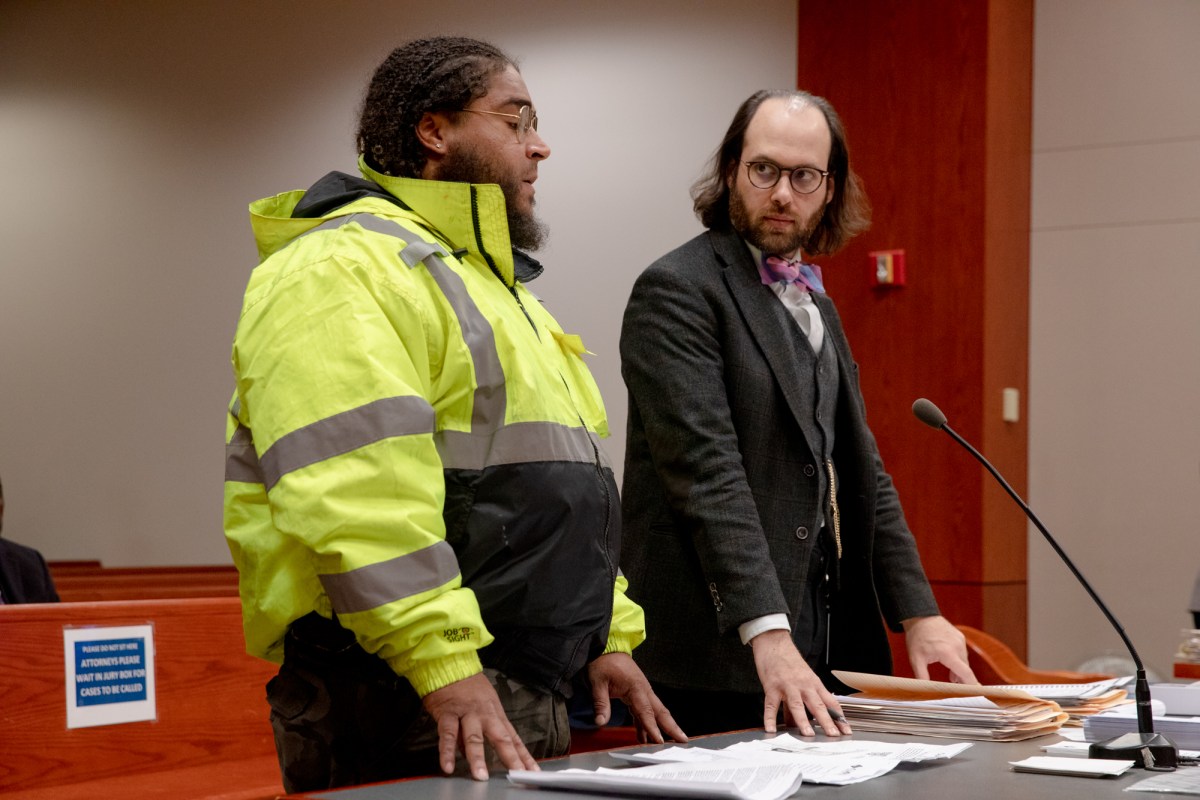
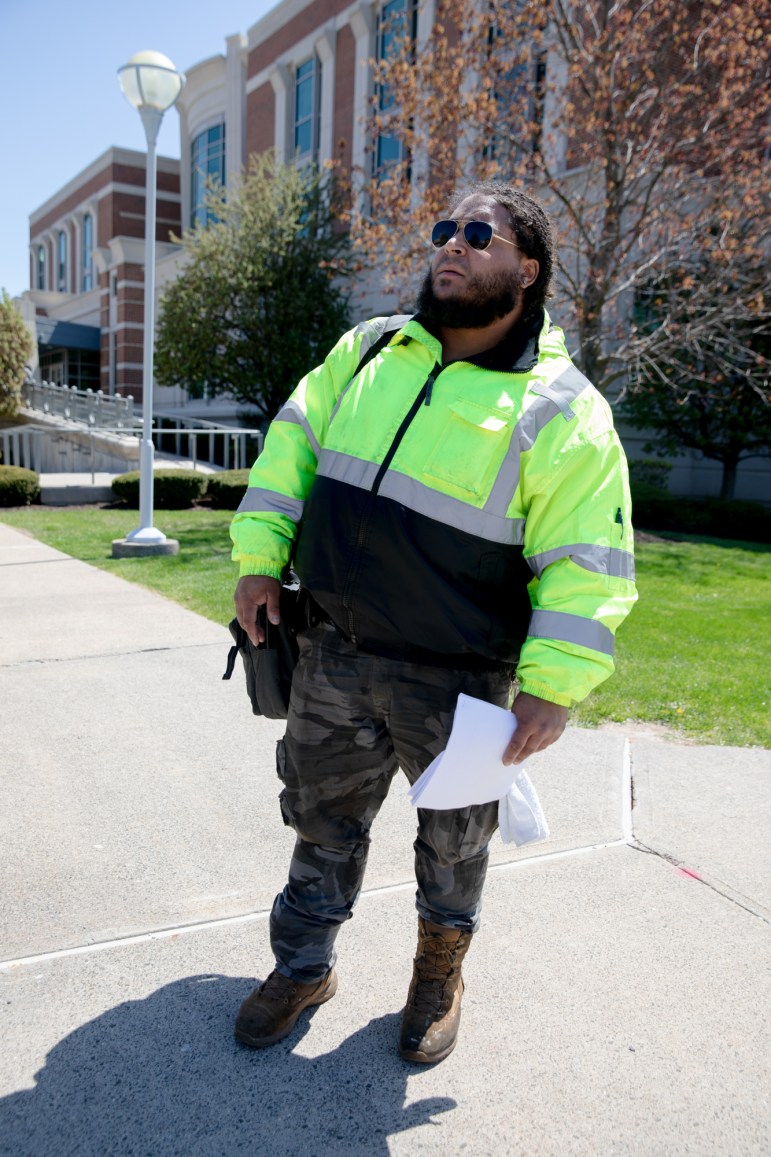
Conquistador arrived for a hearing at the New Britain courthouse on April 29. He was dressed in his work clothes — army pants and a reflective jacket — for his job as a residential contractor at his own business, Conquistador General Contracting, LLC. He’d told members of his church he might not make it to work later that day because he might be going back to jail.
I was basically pressured into pleading guilty because I couldn’t afford to bond out.
Jean Conquistador
To stay out of jail and comply with the terms of his supervision, Conquistador had been required to ask his probation officer for permission any time he wanted to go somewhere. That level of scrutiny proved difficult for Conquistador, Perldeiner said. Tthe probation officer told the court that Conquistador should be put back in jail and given a higher bond.
Conquistador had been trying to get his life back together since getting out of jail. He’d been passing drug tests, going to school and church and getting mental health treatment.
“I’m doing what I’m supposed to be doing,” he said before the hearing.
Conquistador lingered outside the courtroom before Judge Maureen M. Keegan called his name.
“I’m a little bit nervous,” he said, because if he were given a higher bond, he’d be stuck in jail again. “I wouldn’t be able to pay it this time.”
All told, Conquistador said, he’d done seven years in prison, mistakes stretching back to his teenage years. Now 34, Conquistador is trying to stay out of the system. He was first arrested at age 14, doing time in juvenile detention centers and prisons across Connecticut.
“My lifestyle was selling drugs, using drugs, stealing cars, stealing car parts,” he said. “I was careless in doing whatever I wanted to do.”
Then, during a two-year sentence around 2015, Conquistador decided he wanted to change. He wrote letters to community colleges from his prison cell, asking them for educational pamphlets. He has since earned 21 college credits, working toward his dream of becoming a lawyer.
Conquistador had asked Keegan for another chance. He apologized, explaining that he takes medications to treat bipolar condition and sometimes reacts impulsively. He told her he got his commercial learners’ permit that past week, that he’s been in and out of prison for a while, but he’s trying to change.
“I’m still the same person, but I’ve come a long way,” he said.
Keegan wound up giving Conquistador one more chance to show he could comply with the terms of his supervision.
“You’ve got family members who put up a lot of assets so you could be out,” Keegan said. “Why would you play with that?”
Conquistador thought about all the times he got arrested growing up when he was hanging out with the wrong crowd. His family had never bailed him out of jail before — until last March.
"They dug into their piggy banks to bond me out," he said later. "They knew I needed help."
State records show that, despite his change of heart in 2015, Conquistador still wound up in jail again after he decided to leave his prior life behind. He did a monthlong stint in jail at the end of 2017, then went back for eight days in March 2018. He was readmitted on a probation violation on June 1, 2018, staying in until he was sentenced to time served in August 2019. He was never released, though, because he picked up a new charge in prison for threatening a correction officer.
“I was basically pressured into pleading guilty because I couldn’t afford to bond out,” said Conquistador.
Conquistador was released on Feb. 10, 2020. He stayed out of jail for almost two years after that — his longest stretch since 2015 — until he was admitted on Jan. 13, 2022, when he turned himself in and didn’t expect to have to post bail.
Perldeiner sees situations like Conquistador’s all the time, people resolving to change but still winding up incarcerated, stuck in a cycle of arrest and release, imprisoned on low-level charges for violating the terms of their probation.
“They just cannot claw their way out of the system,” he said. “Once the court has its hooks in you, it has you for life.”
Conquistador put on his aviator sunglasses as he left the New Britain courthouse on April 29. It was a sunny day, the kind where there isn’t a cloud in the sky.
Conquistador talked about his plans for the future and his struggles for a few minutes before heading off to work.
The sun shimmered off his reflective jacket as he walked away.
This reporting was made possible, in part, through support from the Fund for Investigative Journalism.
