



Gov. Ned Lamont’s tightfistedness with bonding for the earmarks that lawmakers love to bring home — for everything from ballfields to historic preservation — was an immediate source of tension after taking office in 2019. The governor promised to put Connecticut on a “debt diet.”
But he did not hesitate to place a $74 million item on the agenda for Friday’s meeting of the state Bond Commission that will provide borrowed money for everything from a $250,000 recreation master plan in rural Plainfield to $8.7 million towards 64 units of affordable housing in Hamden.
The money is the fourth round of funding for the Community Investment Fund, a compromise reached by the governor and General Assembly in 2021 that creates a competitive process for nonprofits and municipalities to get funding and eases a legislative-executive turf battle over borrowing.
It doesn’t eliminate politics and the legislative art of bringing home the bacon, but the fund generally gets good marks from a once-skeptical governor and lawmakers of both parties for setting standards on a process that formerly was ad hoc, often reflecting the desires of a single lawmaker.
“This really requires community buy-in,” said House Speaker Matt Ritter, D-Hartford. His Republican counterpart, House Minority Leader Vincent J. Candelora of North Branford, said, “It does dig deeper than one official determining what’s important for their town.”
Lamont praised the program last month at a groundbreaking on a public park on a long-vacant parcel in Windsor, a project that was twice rejected for funding. It won approval in the third round as the town responded to critiques from the staff of the Department of Economic and Community Development.
“This application only got stronger every time that it came through,” said Matt Pugliese, deputy commissioner of DECD. “And I think it really shows what a great process we have here in place, when state government is working in a really coordinated way with our local government to make sure that we have a clearly shovel-ready project that we’re able to get moving on right away.”
Wilson Park has several of the hallmarks that Lamont said he likes to see: The final design was the product of deep community involvement, the town also is putting up money — and it is shovel-ready.
Earth-moving equipment already was on site when Lamont joined local officials — and state legislators who represent Windsor in the House and Senate — to don white hard hats and grab shovels for a ceremonial groundbreaking likely to find a mention in reelection campaigns.
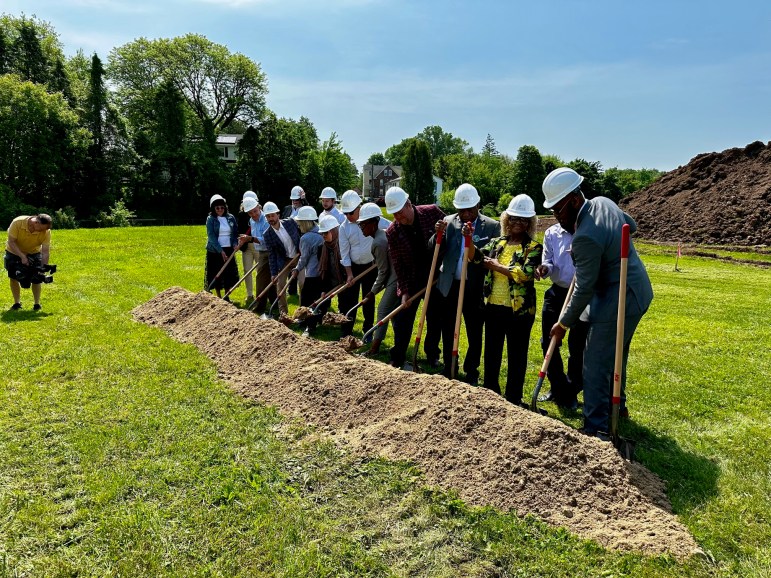
Lamont told the crowd the new program forced lawmakers to set priorities, curtailing the endless informal lobbying of past years.
“Generally, the legislative leaders would come into my office and say, ‘This is the most important bonding investment I have,’” Lamont said. “I said, ‘Here’s the deal. Here’s $175 million a year, but I want you to help establish your priorities, make sure you know this really is the most important.’”
The law creating the program committed to $875 million in borrowing over an initial five-year period, assuming about $175 million in grants in each of those five years. It assigned the vetting to DECD and the final decision to an oversight board co-chaired by Ritter and Senate President Pro Tem Martin M. Looney, D-New Haven.
“It remains a really highly competitive program,” Pugliese said. “We’ve had over 650 applications for over $3 billion worth of grants.”
Including the round certain to be funded Friday by the Bond Commission, there have been 98 approved grants totaling $349 million. The grants have gone to governments and nonprofits in 35 of the 55 communities that meet eligibility standards assessing economic need and poverty.
The Community Investment Fund, or CIF, arose from a debate begun by two other proposals that Lamont would have vetoed: One was a bill that would have transferred control of the Bond Commission from the governor to the legislature, and the other would have created an “equitable investment fund” financed by new taxes on high earners.
Both were proposed by Sen. John Fonfara, D-Hartford, the co-chair of the Finance, Revenue and Bonding Committee. Fonfara said his goal for the latter was grander — truly transformational projects in the state’s poorest communities. On that score, he said, CIF generally falls short.
“It hasn’t resulted in that, to a large extent. I’m not being critical of anyone about that,” Fonfara said. CIF is funding projects sought by municipalities, often with a regional impact that would be funded by counties in other states.
Fonfara also acknowledged that he misses the larger role lawmakers once had in setting local funding priorities.
Others see the process as a reform, albeit one that’s had problems.
“I think it’s certainly seen growing pains,” Candelora said. “They initially were slow in getting money out the door. Some of the projects had money that was not spent in a timely fashion.”
Rep. Maria Horn, D-Salisbury, co-chair of the Finance, Revenue and Bonding Committee, said early rejections came with insufficient feedback, but the standards are clear, even if some decisions will be second-guessed.
The ranking House Republican on the finance committee, Rep. Holly Cheeseman of East Lyme, said some of the CIF grants go to transformational projects, but others are small in scope.
Griswold, a rural town of about 11,000 people, got an $8.7 million grant in the previous round for municipal water infrastructure that could open 325 acres to commercial development and allow the construction of multi-family housing.
But Cheeseman questioned the $1.6 million in the current round for a park at the Lyman Allyn Museum in New London.
Candelora said DECD has improved its vetting, and he now pays what may be the ultimate compliment: “We should be using these types of a vetting process for all of our bonding.”
Looney, the Senate leader who co-chairs the Community Investment Fund board with Ritter, said the agency is “doing a fine job vetting the process.”
He represents a city that has done exceedingly well. New Haven has won 20 grants totaling $54 million, the largest being $12.1 million towards the revitalization of the Long Wharf neighborhood.
Senate Majority Leader Bob Duff, who is a member of the CIF board, is from Norwalk, a city that has won five grants totaling $21.4 million, including $8 million for infrastructure supporting a mixed-use project with 472 units of housing.
Ritter’s Hartford has gotten approval for 13 grants totaling $47.8 million, the largest being $9.1 million for the expansion of Real Art Ways, a gallery, cinema and educational institution. Other Hartford grants have gone to prepare sites for housing construction.
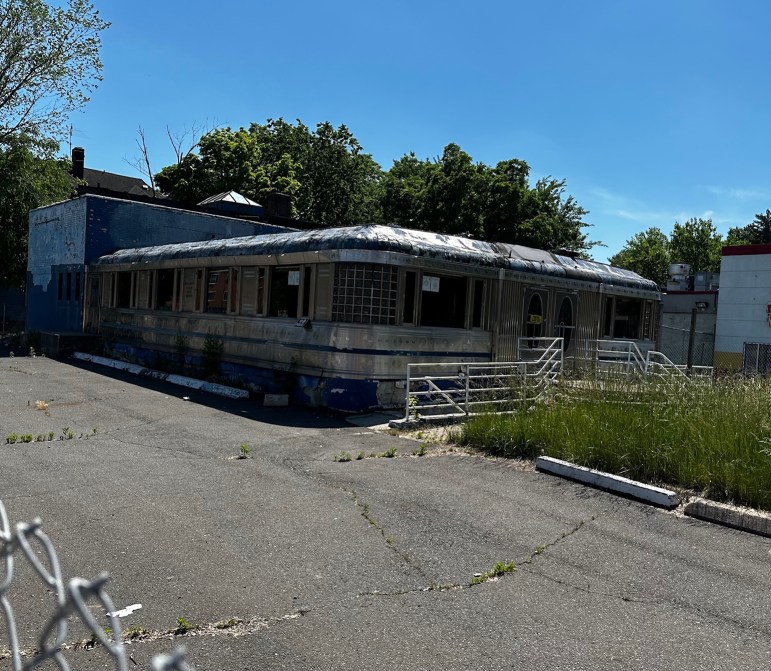
One of the 27 grants that will be funded by the $74 million on the Bond Commission agenda Friday will provide $3 million to the Asylum Hill Neighborhood Association to renovate the long-vacant Aetna Diner, a local landmark on Farmington Avenue. The group also got $1.2 million for the same project in the first round of funding.
The Charter Oak Cultural Center in Hartford, which is located in Connecticut’s first synagogue, is getting $6.5 million for renovations in the current round.
Overall, Bridgeport is right behind Hartford, with $46.2 million in approved funding winning fewer but bigger grants. One of its seven grants provided $22.5 million to demolish the defunct coal-fired electric plant that occupies prime real estate on the city’s waterfront.
In the latest round, Bridgeport is getting $8 million towards the remediation of 20 acres of brownfields, and the Connecticut Trust for Historic Preservation is getting $5.2 million to help preserve a half-dozen churches and other buildings in a five-block area of Bridgeport’s Washington Park.
The trust applied and was rejected twice before.
“Every round, we try to figure out what can get better in terms of communication with the towns and nonprofits, to communication with the legislative delegation, and even our own ways of analyzing,” Pugliese said.
None of the grants cover an entire project. They are intended to make them possible in a variety of ways — remediating brownfields, lowering the cost of financing for affordable housing, providing water or other infrastructure or renovating public facilities.
As summarized the by Office of Legislative Research, the goal of the grants is to further “consistent and systematic fair, just, and impartial treatment of all individuals.
“This includes individuals who belong to underserved and marginalized communities that have been denied such treatment, such as Black, Latino, and indigenous and Native American people; Asian Americans and Pacific Islanders and other people of color; religious minorities; lesbian, gay, bisexual, transgender, and queer persons and others comprising the LGBTQ+ community; people who live in rural areas; and people otherwise adversely affected by persistent poverty or inequality.”
Links to lists of the funded projects:
