


When it comes to a specialty license plate promoting pizza and a charity, you gotta read the fine print. Or at least understand the limits of a phrase on Connecticut’s newest specialty tag: “Supporting Connecticut Foodshare.”
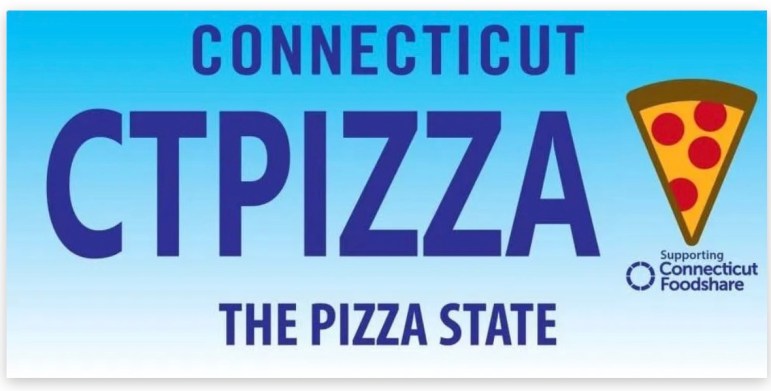
The plate costs $65 and bears the image of a pepperoni pizza slice and the Foodshare logo. In place of the standard “Constitution State” slogan is one bragging about Connecticut’s claim to be “The Pizza State.”
But, as the office of Gov. Ned Lamont now knows, when it comes to the fee for the pizza plate, there is no sharing with Foodshare. The money goes to the DMV, as is the case for most special plates.
“We are not getting a piece,” said Jason Jakubowski, the president and chief executive officer of the 43-year-old nonprofit that serves as a statewide food bank, supplying pantries, meal programs and mobile sites.
He was not complaining. The plate gives Connecticut Foodshare a branding boost and an opportunity to raise money. Buying the plate is done on Foodshare’s web site at www.ctfoodshare.org/pizzaplate, which offers a convenient button to make a donation.
And yes, Jakubowski said, “We are encouraging people to donate to us.”
But the episode calls attention to the quirky nature of all those specialty plates on Connecticut motor vehicles. A chosen few share the proceeds with a charity. (The choosing is done by an act of the General Assembly.)
The governor arrived at a promotional event Monday unaware of that twist.
A press advisory from his office had stated the plate would be added to the roster of “more than 50 types of specialty license plates that serve as fundraisers benefitting local nonprofit organizations.”
“I didn’t quite focus on that,” Lamont said Tuesday. “I knew there was a button you could click.”
Tony Guerrera, the commissioner of motor vehicles, has no authority to unilaterally direct DMV fees to charity. When he does, it is at the direction of the General Assembly.
The legislature’s Office of Legislative Research lists 16 instances where lawmakers have mandated that a charity get a cut. They include plates commemorating the Amistad slave uprising and promoting environmental, animal welfare and children’s health causes, as well as the U.S. Olympic team.
For every Cure Kids Cancer plate sold, for example, $10 goes to the pediatric oncology units at the Connecticut Children’s Medical Center and Yale-New Haven Children’s Hospital. The Ferrari Club of America gets a logo, but no cash. That’s also the case with the Benevolent & Protective Order of the Elks. But a Hartford Whalers plate gets a few bucks for Connecticut Children’s Medical.
The costs of the specialty plate are additional to the basic costs of registering a motor vehicle.
Jakubowski said his group is happy to partner with DMV on the pizza plate, and he noted that Lamont and the legislature provided additional funding in the new budget to partly offset losses in the federal funding.
“The unfortunate reality is that even in a wealthy state like Connecticut, hunger is on the rise, an 11% increase over the last year,” Jakubowski said. “There’s about 515,000 Connecticut residents who don’t know where the next meal is coming from.”
Jakubowski said Guerrera, who is a former lawmaker, predicted the pizza plate would be popular, possibly resulting in the General Assembly adding Foodshare to the groups that can get a share of the sales.
Any nonprofit can seek the visibility of getting their logo on a license plate by applying to the DMV. Three municipalities also have done so: the cities of Meriden and Norwich and town of Stafford.
Meriden claims to be the crossroads of Connecticut, Norwich the rose of New England, and Stafford the “nation’s 1st resort.”
The latter is a reference to the mineral springs in Stafford that Cleveland Amory once described in a book has having ”the honor of being the first recognized society resort in the country.”
