


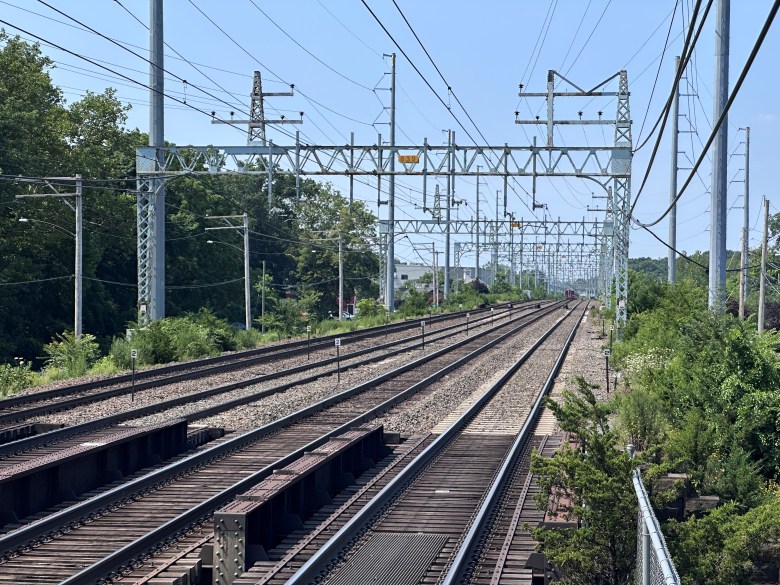
This might sound familiar: At a press conference outside the Stratford rail station, Gov. Ned Lamont, members of Congress and transportation officials outlined plans to provide faster service by 2035 on the New Haven line, one of the oldest, busiest and pokiest stretches of commuter rail in the U.S.
They did that Monday morning, just as they did on a Monday morning in June 2021. This time, Lamont and ConnDOT could point to concrete developments — most notably the long-awaited start on the first piece of a three-phase, $1.6 billion project to upgrade 3.1 miles of track between Stratford and Bridgeport.
And yes, that’s $1.6 billion for improvements to a relatively small stretch of the 45 miles of New Haven Line in Connecticut. Outside the project highlighted Monday are far bigger ticket items: Replacement of four major bridges that are more than a century old and come with price tags ranging from $1 billion to $3.6 billion.
Only one, the Walk Bridge in Norwalk, is under construction. Design work has begun on a second, the Devon Bridge that crosses the Housatonic River and is expected to be the most expensive of the four.
The Stratford project is a case study of how slowly major infrastructure projects move in the U.S., especially in a curvy and crowded rail corridor completed in 1849 to connect New Haven and Manhattan. Financing challenges, shifting political winds and requisite environmental and historical impact studies all are factors.
Phase one will be completed under a $340 million contract with the Yonkers Contracting Company, with $184 million from the Federal Rail Administration, $145.5 million from Connecticut and $11.2 million from Amtrak. Completion of the other two will require finding about another $1.3 billion.
“We need predictable, reliable funding,” said Garrett Eucalitto, the commissioner of ConnDOT.

Infrastructure builders struck a $1.2 trillion gusher five years with the passage of the bipartisan Infrastructure Investment and Jobs Act negotiated by the Biden administration. But the gusher has slowed to a trickle and will go dry on Sept. 30 unless Congress and the Trump administration act.
While the federal government has regularly authorized highway funding that provides a steady stream of money in five-year increments under formulas and competitive grants, there was no similar funding for rail until 2021, Eucalitto said.
Eucalitto and Lamont said they are optimistic that rail funding will be reauthorized, saying the Northeast Corridor employed by Amtrak, Metro-North and other passenger rail systems between Boston and Washington is having a moment with federal appropriators.
“They’re investing heavily in Amtrak, new fleets,” Eucalitto said. “They’re investing in Penn Station. Well, they don’t want to invest and then have the system failing further up the tracks because, you know, it is one entire system from Boston to D.C., and I think that’s why we’ve been successful sharing that message with Amtrak, with the Federal Railroad Administration.”
Officials from Amtrak, the Federal Rail Administration and Metro-North were in attendance Monday, as were U.S. Sen. Richard Blumenthal and U.S. Rep. Rosa L. DeLauro, who is expected to regain her Appropriations chair if Democrats regain the House majority.
Connecticut has a prominent place on the rail administration’s project list for the Northeast Corridor. It’s just a question of funding it.
Lamont also was upbeat about the prospects, even though his relationship with the Trump administration has been strained over immigration enforcement and Connecticut’s passage of revisions to the Trust Act that the administration views as hostile to its goals of ramping up deportations of migrants without legal status.
“Garrett and I met with Secretary of Transportation Sean Duffy, who’s a big believer in transportation, says the president is a builder,” Lamont said. “The president likes big projects, big projects that he can take credit for that make a difference. This is obviously a big project that will make a real difference in people’s lives. I think we’ll get it done.”
The work that began Monday with a ceremonial groundbreaking — the tossing of sand that had been deposited on the edge of a parking lot — is the smallest of three phases of a project to replace the catenary lines that power the electric trains of Metro-North and Amtrak, construct a new station, replace several small bridges and upgrade road beds to allow faster speeds.
Connecticut sped up service from New Haven to Grand Central in 2022 by offering “super express trains” with fewer stops, cutting about 10 minutes off the trip.
“Our Super Express trains between New Haven and Grand Central have reduced trip times to as little as 88 minutes,” said Joe Lagana, the vice president for operations at Metro-North.
“Since then, we shaved another 11 minutes off of that timetable due to infrastructure improvements,” Eucalitto said. Those improvements included addressing signal problems and bad drainage that forced slower speeds.
The goal of the current project is to raise the current Federal Rail Administration standards from class 4 to class 6, increasing the maximum authorized speed limit in some places from 70 mph to 90 mph — a speed the current equipment can reach.
“Trains have the higher operating speeds, but the tracks have always been the limitation for us in Connecticut, and so that’s where we’re doing our part to upgrade the infrastructure,” Eucalitto said.
The third phase would create more space between sets of tracks, allowing trains to use a function that tilts the trains on curves at higher speeds. Currently, the tracks are set too close for the trains to tilt safely.
But none of the planned improvements would allow true high-speed rail. Amtrak’s existing Acela trains can go 150 mph, and the next generation cars go even faster. Such speeds would require a new route that does not follow the curves of the coast line, as do the rails from Boston to New Haven and New Haven to New York.
“The only way to get to what a lot of people would say is true high-speed rail, you would have to build a completely new alignment,” Eucalitto said. “That’s not feasible. So we’re going to live within the geographic constraints we have and do the best possible infrastructure we can within that alignment.”
