This story has been updated.
Gov. Ned Lamont defeated liberal challenger Josh Elliott in a primary Tuesday that tested Democrats’ allegiance to a more moderate incumbent, who guided Connecticut through a pandemic and presided over an unprecedented string of budget surpluses and a major tax cut.
The Associated Press called the race for Lamont shortly after the polls closed at 8 p.m.
With nearly 90% of precincts reporting, Lamont led by more than a 2-1 margin. The victory brought down the curtain on an intra-party drama unanticipated when Lamont planned his campaign for a third term — one that could make him the state’s longest-serving governor in more than 200 years.
In winning the first primary challenge to a Connecticut governor in 48 years, Lamont prevailed in a volatile season marked by the losses of establishment candidates in high-profile Democratic primaries across the U.S., though most involved open races. No governor has lost a primary in 2026.
Elliott appeared before his supporters at a brew pub in his hometown of Hamden around 8:50 p.m. to concede and call for Democrats to unite behind Lamont in November.

“The worst thing that people can do is check out,” Elliott said. “We need more people to be engaged.”
Lamont praised Elliott.
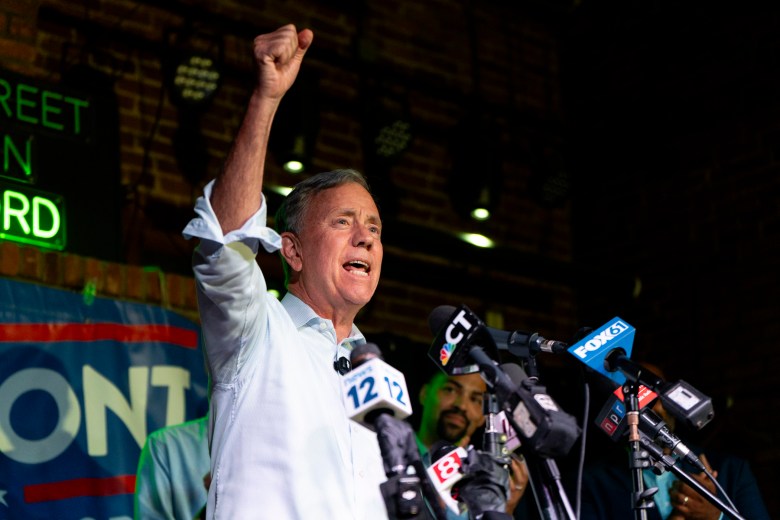
“I look forward to carrying this battle into the fall with each and every one of you, Democrats in Connecticut, what we stand for,” Lamont told Democrats at his victory party in Hartford. “I want to give a shout out to Josh Elliott. He ran a feisty campaign, raised very important issues.”
U.S. Sen. Richard Blumenthal, standing with Lamont on stage at a tavern closed for the victory party, said the summer primary was a prelude to an even better November.

“What we’re seeing tonight is the beginning of a blue wave across the country. We’re showing right here in Connecticut. We’re taking the country back from Donald Trump. We’re not going to let him get away with the illegality, the corruption, the chaos, the war,” Blumenthal said.
Throughout the campaign, both Elliott and Lamont made clear their opposition to Trump’s hostility to undocumented immigrants, his attack on Iran and his orders for tariffs that rose and fell with his mood. But Lamont said governors are chief executives who also are judged on performance.
“We’re fighting Trump where we’ve got to fight him,” Lamont said before the polls closed. “But more importantly, or just as importantly, we got to manage the state every day and make sure it’s a place affordable for people, so they can get by. That takes a certain pragmatism.”
Lamont, 72, who narrowly won an open race in 2018 and was convincingly reelected in 2022, begins his general election campaign on favorable terms against Republican Ryan Fazio, a 36-year-old state senator from Greenwich trying to lead a struggling GOP back into contention.

Trump is not helping. His approval rating has tanked, and midterm elections typically bring bad news to the party holding the White House. Republicans held nearly half the seats in Connecticut’s General Assembly when Trump began his first term. They now hold fewer than one-third.
While campaigning for the state Senate in a swing district, Fazio refused to say how he voted in the presidential elections the three times Trump was on the ballot. As a candidate for governor bracing for a Republican primary that never came, Fazio loudly assured the GOP he voted for Trump all three times.
Three dozen states are holding gubernatorial elections this year, but Lamont and J.B. Pritzker of Illinois are the only two governors seeking a third term.
Lamont had the backing of nearly every labor group, including the Connecticut AFL-CIO. While the labor-backed Working Families Party played a role in Elliott’s first election for the House a decade ago, it sat out a primary that raised many of the issues on its wish list.
One reason was that the labor movement has done well in Connecticut under Lamont, passing a law in 2019 that ensures its minimum wage will be among the highest in the United States.
Elliott was aggressive in his campaign, running irreverent ads taunting the independently wealthy Lamont as out of touch. One Elliott commercial aired late in the campaign featured a young mother comparing the governor to a soiled diaper — overdue for a change.

But even before both candidates praised each other, there was little sign that the primary would haunt the general election campaign in Connecticut, where Republicans have not won races for governor or congressional seats in 20 years.
Lamont and Elliott encountered each other Tuesday morning outside a polling place in Bridgeport, speaking amicably before shaking hands.
“Whatever happens, we’re going to be united going forward at the end of tonight. We’re a big tent,” Lamont said.
“We both wanted Democrats to win in November,” said Elliott, who still will be on the ballot in November but as a candidate for reelection to the state House of Representatives. Smiling, he added, “Different Democrat, but a Democrat.”
While the primary pitted a Millennial against a Baby Boomer, the 41-year-old Elliott cast his candidacy as an ideological challenge, not a generational one.
Elliott had promised to follow Massachusetts and seek a 4% surtax on incomes exceeding $1 million, as well as pursue a state public option on health care and legislation encouraging the creation of municipal power companies with state financing.
As for what’s next in his own political career, Elliott — who is simultaneously running for re-election to the House — said he may run for governor again in 2030.
“What is that, four years away? Yeah, it’s like tomorrow,” he said. “Of course.”
Several Democrats, Elliott included, said a primary is an imperfect measure of the appetite for moving the party leftward in Connecticut.
“Every race is its own beast, its own specific state, own specific district, own specific candidates. I don’t read too much into it,” Elliott said during a stop outside a polling place in Hartford on Tuesday. “I do think that there is a desire for change, but you can say that every four years. Is this moment really all that different? I don’t know.”
Comptroller Sean Scanlon, a Democrat who served with Elliott in the House and has worked closely with the governor, said state elections increasingly are nationalized, influenced by the polarization in Washington and on social media and cable television. That is most often the case in legislative contests, he said.
“People want different things from legislators. Someone will fight to draw attention” to an issue or cause, Scanlon said. “They tend to want their mayors and governors to be steady hands who are guiding the ship in the right direction, and that is exactly what Ned Lamont personifies.”
Still, plenty of Democratic insiders grew concerned as Elliott’s campaign progressed, his caustic ads went on the air, and Lamont failed to respond. Lamont didn’t hit back until a week ago, airing an ad featuring Rep. Toni Walker, D-Hartford, hitting Elliott for missing 240 votes and generally dismissing him as a minor player in Hartford.
The ad didn’t say that the missed votes were a tally accumulated over 10 years, and the majority were votes in committee, not on the floor of the House. Elliott called the ad “disingenuous.”
Elliott said that was the spot that made him comfortable with running the diaper ad, which he said he had been hesitant to use — even though it tested well.
“I felt like, OK, we’ll release this ad, no problem,” Elliott said. “So I felt comfortable with it by the time we put it out.”
The commercial features a mother changing a diaper.
“You know what they say: politicians are like diapers,” the young mother says in the spot. “Change them often, and for the same reason. Ned Lamont has been running for office for four decades. Same old mess. Nothing getting better except the size of his pile.”
Lamont was terse when asked what he thought of the ad.
“Not much,” he replied.
One voter, Allison Davis of Wallingford, told Elliott as he arrived for his post-election party at Haven Beer Company in Hamden, that he’d lost her vote in the closing days of the campaign.
“He lost my vote because of the diaper ad,” said Davis, who called the piece “immature.”
Davis and her sister, Cheryl Davis of Madison, conceded they were less then enthused about a third Lamont term, despite thinking he generally did a good job. But Fazio won’t be an option for them.
Elliott said he was proud of his race, which he said exceeded expectations by forcing the first primary since 1978 and qualifying for public financing, albeit late in the cycle.
“We’re up against an incumbent governor who’s generally well liked, so we had an incredible amount of headwind,” Elliott said. “At the same time, it’s like we were able to sort of prove everybody wrong every step of the way here.”
Except the last one.