



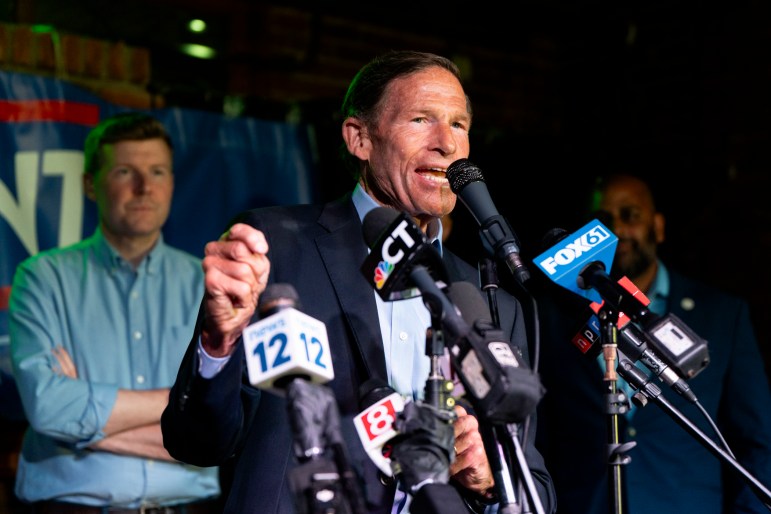
Hours after celebrating the decisive win of a popular incumbent governor, U.S. Sen. Richard Blumenthal was back at work.
Standing out in the sun in front of a Ukrainian Catholic church in Hartford, the three-term Connecticut senator told a small group of supporters about the Senate’s recent passage of a wide-ranging Russia sanctions bill he helped get across the finish line. Shortly after, he headed to New Britain’s farmers market to meet with farmers.
Blumenthal, who isn’t on the ballot this year, has an unrelenting work ethic, regardless of whether he’s up for reelection. He typically packs his days in Connecticut with multiple events. When the Senate is in session, he squeezes in whatever he can on Monday mornings before heading back to D.C.

Still, after a high-stakes primary in which his colleague U.S. Rep. John Larson, was soundly defeated by a younger challenger, it could be hard for Blumenthal — and other aging members of Connecticut’s congressional delegation — to dodge questions about age and the calls for generational change that are sure to play a role in future campaigns.
So far, the 80-year-old senator seems undeterred.
“Age is always a state of mind, not just a time of life,” said Blumenthal, a third-term senator who has been on Connecticut’s ballot for several decades. “The energy and excitement are impressive, and I hope to carry it forward myself.”
Blumenthal is up for reelection in 2028 when he will be 82. He hasn’t confirmed what he’ll do in two years, but he said he’s taking the steps to prepare for another campaign — in the event he runs again.
“I’m focused on this November, electing Democrats to the United States Senate so we take back a Democratic majority and that’s my focus,” he said. “I have a campaign committee. I haven’t announced anything. I’m raising money, but my focus is on November.”
Age and seniority have become pressing topics in Congress, hitting a fever pitch in 2024 after a groundswell of calls from Democrats for Joe Biden to drop out of the race. Biden initially declined to pass the torch, but then suspended his presidential reelection campaign months before the race after a disastrous debate. Since then, Democrats have been less inclined to wait for older lawmakers to retire.
Larson became the seventh Democratic incumbent in the House to lose a primary this year. The reasons challengers prevailed have varied — some were ideological and others generational. The four-way primary for Connecticut’s 1st Congressional District was about the latter.
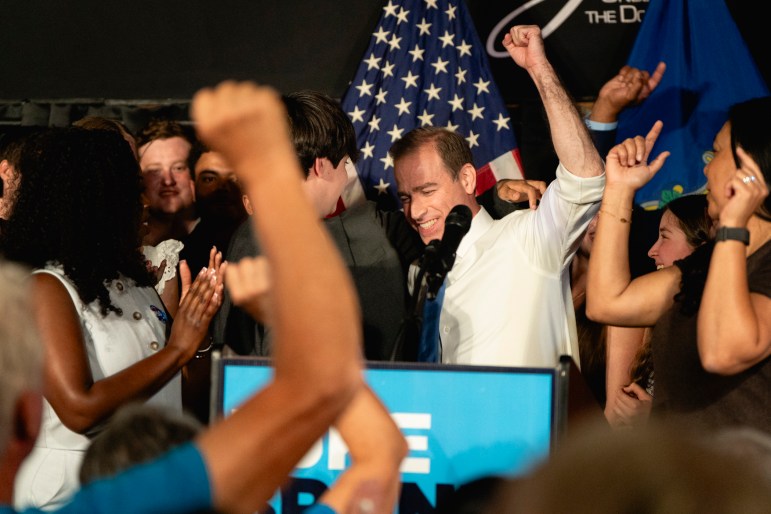
The 14-term congressman lost to former Hartford Mayor Luke Bronin, who mainly campaigned on the need for new voices and new energy in Congress, without needing to lean much on age at all. Bronin called his victory a “political earthquake in Connecticut.”
That raises questions and speculation about whether an appetite for change will carry into the 2028 election cycle, when all five U.S. House seats in Connecticut will be up again, along with the U.S. Senate seat held by Blumenthal.
Democrats have wondered, most privately out of a desire not to offend Blumenthal, if Bronin’s run against Larson offered a template for someone to similarly challenge the senator.
The former Hartford mayor hewed to a simple, unchanging message. He made no attacks, praised Larson’s record — and argued it was time for a change after 28 years.
At a church on the Sunday before the primary, Bronin said, “I respect the person I’m running against. I do. But to every thing, there is a season.”
Younger challengers didn’t prevail across the board in Connecticut Tuesday. Gov. Ned Lamont, the older of the two candidates, easily won the Democratic nomination, prevailing over 41-year-old state Rep. Josh Elliott of Hamden, who waged a primary challenge from the left.
“Ned Lamont was the older of the two, and he won by a 2-to-1 majority. So clearly age has always been a consideration. When I started, I was the youngest,” Blumenthal said. “But age I think is not going to be a determinant in the outcome of any election on its own.”
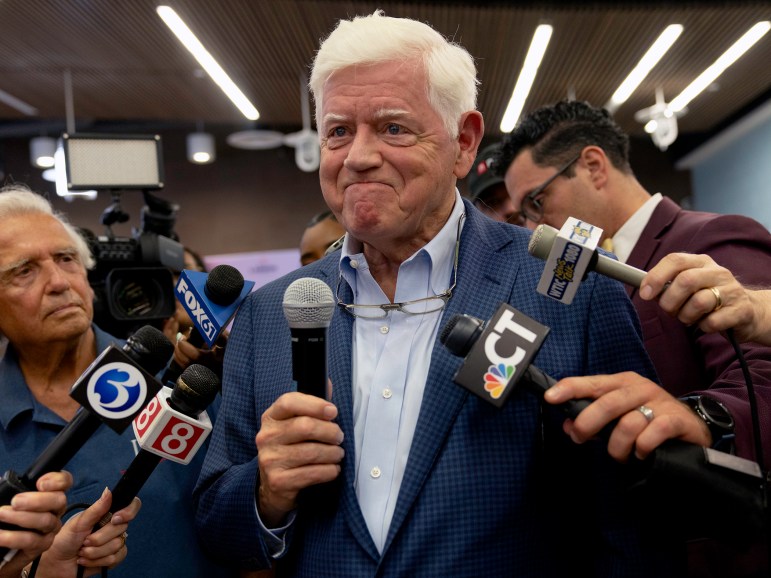
There has been little turnover in Connecticut’s all-Democratic congressional delegation in recent years. U.S. Rep. Rosa DeLauro, 83, has been there the longest and is on track to win another term in November. If she prevails, and if Democrats take back the House this fall, she’ll reclaim the gavel of the influential House Appropriations Committee.
Larson was the only member of the five-member delegation to face a primary this year.
But after Bronin and two other challengers took on a sitting lawmaker, a deep bench of Democrats in Connecticut who are waiting to ascend the political ladder both at the state and federal levels might not be willing to wait for retirements.
The question around Blumenthal’s political future came up at one of the congressional debates. In a lightning round, the four candidates in Connecticut’s 1st District were asked about it. Larson’s three challengers answered affirmatively that Blumenthal’s current term should be his last.
Much like Larson’s own defense for seeking another term to Congress, he replied: “It’s up to him.”
In the race for the 1st Congressional District, Bronin was not the first to announce against Larson. Ruth Fortune, a Haitian immigrant and mayoral appointee on the Hartford Board of Education, went first. Seemingly overnight, Larson was facing four opponents, one who would drop out.
Roy Occhiogrosso, who was the campaign strategist for Gov. Dannel P. Malloy’s two successful runs for governor, said the political class sometimes is too quick to draw lessons from the most recent election.
“I think people make the mistake of watching an election result and then immediately determining there is a trend or a model that can be applied another race. I’m not sure that’s true,” Occhiogrosso said.
He noted that a 78-year-old congressman had been denied the nomination to another two-year term, but a 72-year-old governor cruised to victory over a challenger 30 years his junior the same night.
“It’s usually each race is unique and decided by its own factors,” Occhiogrosso said. “That was a good reminder.”
Age aside, the unprecedented primary challenging Larson may offer a template for future candidates who are looking to navigate Connecticut’s strict ballot access laws. Fortune made the primary ballot through the unconventional and logistically challenging process of qualifying through petition signatures.
“I think we won’t wait until things are so broken again. When we overcome this current nightmare that we’re in, people will challenge their representatives more frequently. And I hope that becomes more of the norm,” Fortune said in the days leading up to Tuesday’s primary. “I’m hoping it’s the straw that breaks the camel’s back.”
“If nothing else, I think we’ll see more grassroots candidates willing to do the petitions because they see that it’s been done,” she added. Fortune has said she’s going to work with the Connecticut General Assembly on trying to take up ballot access reforms.

U.S. Rep. Joe Courtney agreed that it could open the door to more candidates. He pointed to Fortune’s unlikely but ultimately successful path to qualifying for the August primary ballot.
Courtney’s own primary challenger, Kyle Gauck, didn’t meet the threshold at nominating convention to make the ballot. And he didn’t qualify through the petition process either. Courtney was ultimately uncontested without a primary on Tuesday.
“I think Ruth Fortune’s success, in terms of getting on the ballot, is really one of the more underappreciated stories of this election. It was really defying all the conventional wisdom,” Courtney said at Larson’s election night party. “I’m sure people are really looking at this as an example. I think her race in some ways was going to be the one that actually has the most sort of enduring appeal and inspiration for people.”
Another nearby race centering around age and seniority is the Sept. 1 Democratic primary in Massachusetts between U.S. Sen. Ed Markey and U.S. Rep. Seth Moulton. Markey is 80 and if he wins again, he’d be 86 at the end of another six-year term.
Moulton, 47, has made age a centerpiece of his campaign even more than Larson’s challengers did. The Massachusetts congressman has a similar profile to Bronin. They’re the same age and both veterans who were endorsed by the Democratic group VoteVets, which is seeking to elect more military veterans to office. Moulton is a Marine Corps veteran who served in Iraq; Bronin is a Navy veteran who served in Afghanistan.
And in a similar vein to Connecticut’s own congressional primary, the incumbent is looking to make it more of an ideological race. As a progressive senator, Markey has focused on Moulton’s more moderate record since coming to Congress in 2015.
Blumenthal argued that it’s not all about age: Democrats need to give voters a reason to vote for them. He’s hopeful that’ll bode well for them in November’s midterms.
“There’s no magic about age. It’s about energy, new ideas, a commitment to fighting, and outreach and connection with people,” Blumenthal said. “It’s what we need to do as Democrats in this election. We need to convince people we’re on their side.”
The Connecticut Mirror/Connecticut Public Radio federal policy reporter position is made possible, in part, by funding from the Robert and Margaret Patricelli Family Foundation.

