


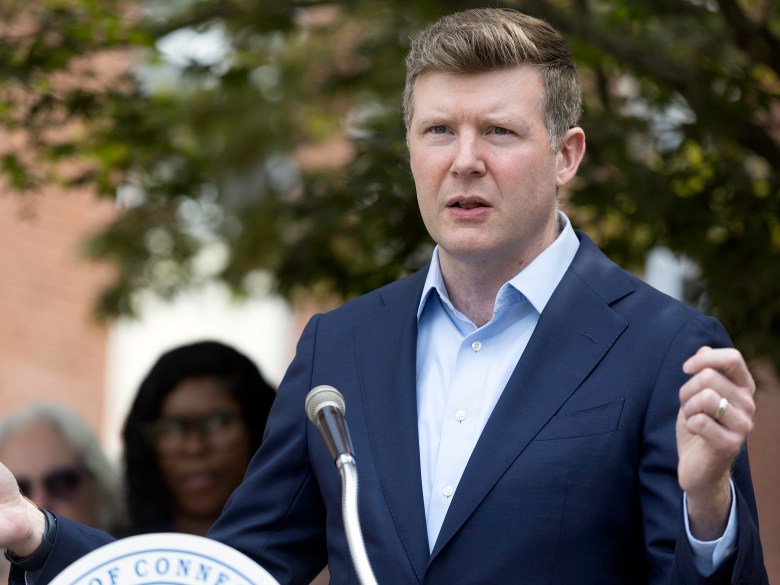
Special education programs face a funding crisis this year that cannot be solved unless Connecticut reforms controversial state budget caps that have diverted billions of dollars to pay down pension debt, Comptroller Sean Scanlon said Tuesday.
The state’s chief fiscal watchdog, who is involved with two analyses of how Connecticut funds local schools and other municipal services, estimated special education services will cost $96 million more than their available resources.
“The way that we fund education generally, and specifically special education, is very broken,” Scanlon, a Guilford Democrat, said during his monthly media briefing on state fiscal and economic issues. “I think you’ve seen report after report showing that year after year — and yet nothing changes.”
The special education funding crisis is happening even after Gov. Ned Lamont and the Democratic-controlled General Assembly used emergency procedures last spring to exceed the state’s chief budget cap to send an extra $183 million to local schools and another $100 million in general aid to cities and towns.
But Lamont, a fiscally moderate Democrat, wouldn’t consent to legislators’ requests to make that an ongoing exception.
In other words, lawmakers were allowed to exceed the cap once. But if they want to maintain those payments 12 months from now, they will have to cut spending elsewhere or seek gubernatorial permission for another exception.
But Scanlon and other education advocates say the special education crisis facing local schools won’t be solved in one year.
Nearly one in five Connecticut students, 19.1%, was identified as having a learning disability in the 2025-26 academic year, Scanlon reported, citing data from the state Department of Education. It was less than 15% just eight years ago.
Those numbers are rising, partly because some local educators have gotten better at identifying students in need, said Fran Rabinowitz, executive director of the Connecticut Association of Public School Superintendents.
But the biggest driver of those numbers, she added, is a dearth of intervention services that could identify and address students’ learning challenges early — averting the need for special instruction entirely.
“We don’t have a robust system of intervention in many of our districts,” Rabinowitz said.
Lisa Hammersley, executive director of the School and State Finance Project, said “districts are at a breaking point” trying to cover special education costs.
Federal law mandates districts provide special services that some children need. State government will send $221 million to districts through its chief special education grant this fiscal year, leaving cities and towns to grapple with billions of dollars in additional expenses.
Scanlon has spent the past year working with a bipartisan panel of 14 mayors and first selectmen to examine Connecticut’s heavy reliance on municipal property taxes to fund many public services, not just education. He also has been assisting a 100-member citizens’ assembly tasked this summer by the Connecticut Conference of Municipalities with undergoing a similar review.
The comptroller said Tuesday the state can do little to help communities solve a special education crisis until it reviews state budget caps, labeled “fiscal guardrails” by supporters, that have forced unprecedented surpluses since 2017.
Lawmakers created one “guardrail” that has removed huge chunks of income and business tax receipts from the budget — without first studying how much would likely be removed or the ramifications for programs.
In the two decades prior, the average state budget closed with a surplus equal to one-tenth of 1% of the General Fund. In the nine years under the “guardrails,” the average surplus is nearly 9%.
The bulk of those captured funds have been used to pay down Connecticut’s considerable pension debt, which still exceeds $30 billion, and to build a record-setting $4.5 billion rainy day fund.
After initially resisting most efforts to modify these caps, Lamont has compromised with Democratic legislators over the past two years to divert more dollars for education, healthcare, social services and municipal aid, though many lawmakers argue the system still is heavily skewed in favor of saving and paying down pension debt.
Lamont’s budget spokesman, Chris Collibee, noted the governor formed his own working group this year to study education issues, including special education costs. That panel, which includes many education advocates, is expected to issue recommendations when the 2027 General Assembly convenes in early January.
“As students’ needs evolve, the state’s approach to funding education must keep pace,” Collibee said. “This review is an opportunity to ensure that state investments reach students where they are needed most and that every child, in every community, has access to a high-quality public education.”
Lamont’s GOP opponent, Sen. Ryan Fazio of Greenwich, says the governor has compromised far too much and needs to adhere strictly to the existing caps.
But Scanlon says Connecticut’s perspective has changed greatly, and the state can invest more in special education and other vital programs and still shrink pension debt.
The 2010s were marked by two of the largest state tax hikes in Connecticut history, a string of budget deficits and a sluggish economy.
Connecticut has chopped more than $11 billion off its pension debt since then and cut state income taxes in 2023.
Meanwhile, the coronavirus pandemic in the early 2020s dramatically increased demands for social services while placing strains on hospitals and other healthcare providers, problems that still exist today. And unprecedented cutbacks in human service programs are threatening thousands of Connecticut residents.
Connecticut has run up significant deficits in its Medicaid program in each of the past three fiscal years as demand has grown, and the Lamont administration reported $25 million in Medicaid cost overruns in July alone — the first month of the new fiscal year.
“We are in a significantly different situation, and yet the ‘guardrails’ are the same, Scanlon said. “I believe that [budget caps] need to be adapted to meet moment that we’re in.”
