


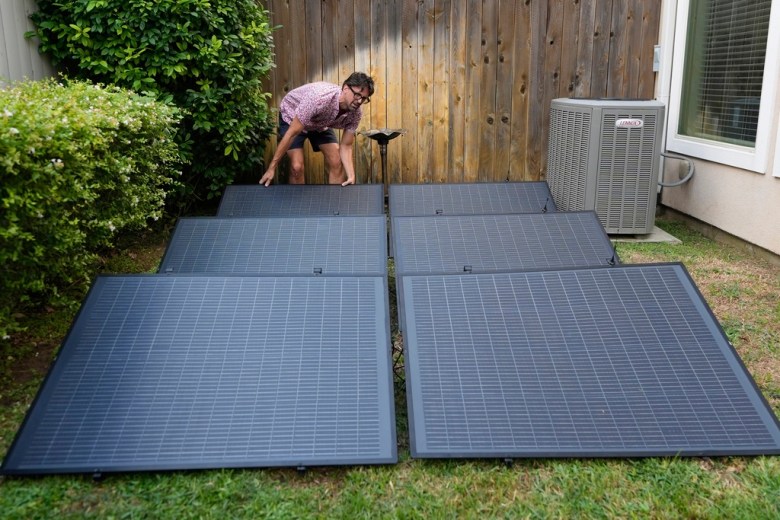
Earlier this year, Connecticut joined a growing list of states easing restrictions on small, portable solar panels that can be plugged into a wall outlet to offset some residential electrical usage — and shave dollars off monthly bills.
The new law, passed as part of H.B. 5340, allows residents to purchase and install plug-in solar systems under 1,200 watts without notifying their utility company. It went into effect Oct. 1. Previously, anyone seeking to install any kind of solar device had to seek permission from their utility first, through an interconnection agreement.
But while the law exempts smaller systems from the interconnection process, it still requires the devices to meet the safety standards set by the state’s building and fire codes, as well as certification from UL Solutions, a national product-safety group.
That has led to confusion over whether plug-in panels are safe to own — or even legal.
Some of the hangup has to do with the lack of building codes that specifically address plug-in solar panels, which are a relatively new technology in the U.S.
In April, months before the new solar law took effect, lawmakers voted down revisions to the state’s building and fire codes over disagreements on an unrelated issue, road access for fire trucks. The codes, which are typically updated every four years by the state’s Department of Administrative Services, are now in limbo as officials and lawmakers seek to resolve the dispute.
Leigh Appleby, a spokesman for DAS, said there is no timeline for when the building and fire codes will be updated to specifically address plug-in solar panels.
“DAS is reviewing how the existing codes apply when a device is plugged into an existing outlet,” Appleby said in an emailed response to questions. “Adding or changing an outlet or circuit requires a permit and inspection. We can’t give a blanket assurance that every device or installation is safe or code-compliant. Local building officials and fire marshals enforce the codes in their municipalities and can assess specific installations.”
Without new state codes, however, local officials have no way to ensure that solar devices meet safety standards, according to Roger Nelson of the Connecticut Fire Marshals Association. (Nelson, who also serves as the fire marshal in Bloomfield, said he has not heard from any residents in his town about installing plug-in panels.)
“Until a code is passed, it’s not legal in Connecticut,” Nelson said.
Even Connor Yakaitis, a deputy director at the Connecticut League of Conservation Voters who was among the state’s early proponents of plug-in solar panels, said he was urging residents to be cautious. As more and more states pass laws similar to Connecticut’s, Yakaitis said officials around the country have been taking notice and working to resolve lingering safety and regulatory hurdles.
“Lot’s of people have been asking, ‘When can I go get these panels?” Yakaitis said. “We’ve been telling people not to buy panels until this is all ironed out.”
Regardless of the uncertainty, plug-in solar panels are widely available for sale online at prices ranging from a few hundred to several thousand dollars.
One online retailer, the California-based nonprofit Bright Saver, sells a 180-watt kit for $285, plus $29 for an annual membership. (Without a membership, the kits sell at retail for $499.)
Cofounder Cora Stryker said Bright Saver’s model is based on wholesale clubs such as Costco, which are able to offer lower prices by buying products in bulk. In addition, she said the group’s membership model helps to form a voting block that can advocate for removing existing barriers on plug-in solar. Bright Saver has 57 members in Connecticut and has shipped 49 kits to the state.
“Our whole goal is to build a massive membership that takes action to support clean energy… and make it dirt cheap,” Stryker said.
Stryker said Bright Saver’s plug-in kits meet the requirements under Connecticut’s law by having each of the component parts, such as the solar panel, plug and inverter, certified by UL Solutions. That definition, she said, is enough to cover most of the systems currently available on the market.
“I think it gives coverage for anyone in Connecticut who wants to buy one, even at the component level certification, and plug it in and not worry about the utility,” Stryker said. “It could be more explicit, but I think it’s OK.”
Other states, such as California and Vermont, have more stringent rules requiring that the entire system receive certification together as one device. UL Solutions launched a new full-system certification standard in January, but it has yet to approve any products for the U.S. market.
“That distinction is important,” Ken Boyce, UL Solutions vice president of principal engineering, said in an emailed statement. “A system assembled from individually certified components is not automatically certified. Component-level certifications may not address hazards arising from component interactions, including electric shock, circuit overload, compatibility with ground-fault protection, accidental contact with energized parts, and unsafe current flow. In other words, certified parts do not necessarily add up to a safe, certified whole.”
Stryker said Bright Saver plans to obtain UL certification on a fully-integrated system “in the very, very near future.” However, she said the requirements for that certification will necessitate rewiring by a licensed electrician and a special outlet, meaning the systems will not be available to most renters.
One of the authors of H.B. 5340, state Sen. Norm Needleman, D-Essex, said he is open to “refining” the law to add more clarity around plug-in solar, but he has yet to hear any specific concerns from constituents.
Connecticut’s law also requires that plug-in solar systems come equipped with a device that prevents electricity from being fed back onto the power grid during an outage. This rule was added in order to address concerns raised by utility officials that the devices could pose a threat to line workers who are working to restore power.
Additionally, anti-tampering features on many older electrical meters may fail to recognize any excess power sent onto the grid by unregistered solar panels, resulting in customers being charged extra for the power they produce. While this issue can be addressed with new, more advanced two-way meters, the rollout of those meters has been slowed in Connecticut due to disputes between regulators and Eversource, the state’s largest utility.
Eversource Spokeswoman Jamie Ratliff said in an email Monday that any devices sold in Connecticut must come with a warning about the potential for excess generation.
“It is important for the safety of our line workers and customers, as well as the reliability of the electric system, that only approved devices with built-in safety features are connected to the electric grid,” Ratliff said. “We understand that testing is taking place with certification agencies towards meeting these goals, which we believe is a necessary first step.”