


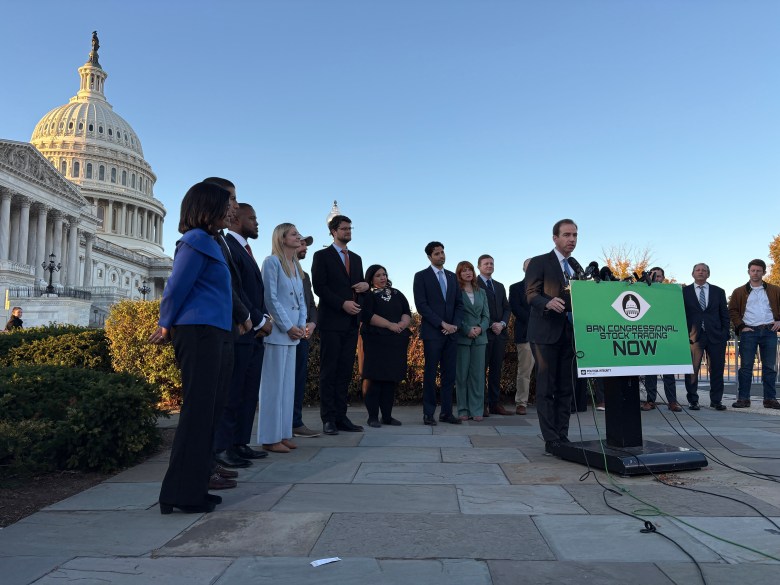
When Luke Bronin gets sworn into Congress next year, the Connecticut Democrat wants to immediately ban stock trading by members of Congress and place such a prohibition into the House rules.
In the longer term, Bronin hopes Congress can pass legislation that would enshrine such rules into law — and go even further on his party’s goals of campaign finance reform and anti-corruption measures.
Bronin has been in Washington since last week as part of the new member orientation to get acclimated with the responsibilities and quirks of Congress. Between trainings and the longstanding tradition of the House office lottery, the member-elect is staking out some early policy positions he believes Democrats can tackle as early as Day 1.
He’s part of a group of 50 incoming Democrats urging leadership to prohibit members and their spouses from “owning or trading stocks, commodities, futures, derivatives, and other related securities” with the exception of diversified mutual funds or investments in a qualified blind trust.
“We have to hold this president accountable for that corruption. But if we’re going to be serious about reform, then we have to make those changes that bind us too,” Bronin said at a Tuesday press conference outside of the U.S. Capitol. “And it is long overdue for Congress to say that anybody who has the honor of doing the people’s business in this capital should not be spending a minute focused on their own private gain.”
The members at Tuesday’s press conference reflected the ideological diversity behind the effort: sitting lawmakers and moderate and progressive candidates who flipped GOP-held seats or defeated incumbents in primaries. While the focus was largely on stock trading, each member named other priorities in that vein: limiting super PACs and corporate PAC money in elections, banning former members from becoming lobbyists, and seeking to overturn Citizens United.
They were also among the signers of the Political Integrity Project’s pledge. Along with Bronin, U.S. Sen. Chris Murphy is the other member from Connecticut to sign it, according to its website. The pledge names many of the priorities listed by the sitting and newly elected members, including “to not hold or trade any individual stocks” while advocating for a congressional stock trading ban.
While running as a candidate for office this year, Bronin filed a financial disclosure report over the summer, a requirement that shows any earned income, assets and liabilities. Between the filing period that covered January through mid-May, he reported owning a few individual stocks, but he confirmed he no longer holds those.
There have been previous legislative attempts to limit or outright ban stock trading in Congress. Polling from a few months earlier indicates a large majority of Americans believe it should be illegal for elected officials to buy or sell individual stocks.
Democrats have knocked a GOP-led bill, the “Stop Insider Trading Act,” which passed the House in July with support from only about a dozen Democrats, none from Connecticut. The bill failed to a clear a filibuster in the Senate, with no Democratic votes. They argue the bill didn’t go far enough — prohibiting members, spouses and dependent children from buying new stocks related to publicly traded companies but allowing them to still own and sell — and attached a voter ID measure.
Some of the incumbent members, like Jason Crow of Colorado and Pramila Jayapal of Washington, said they’ve been working on the issue for years. They feel like next year is their best shot to getting it done and making progress on money-in-politics issues. Jayapal has introduced the bipartisan “Restore Trust in Congress Act.”
Bronin said he wants to learn about the various legislative proposals that are already out there. “And if the proposals that are out there aren’t sufficient, then [I’m] eager to work with my colleagues to put one together that’s strong,” he added.
Bronin and the rest of the members of the 120th Congress will get sworn in on Jan. 3. He defeated longtime U.S. Rep. John Larson during the four-way Democratic primary in August and easily won a first term to the Hartford-based seat earlier this month.
Campaign finance became a major sticking point during the Democratic primary for Connecticut’s 1st Congressional District, with Larson and Bronin sparring over the sources of their fundraising.
Bronin, who led the Democratic field in fundraising, said he wouldn’t accept campaign donations from corporate political action committees then or in the future. He criticized Larson’s fundraising haul, half of which had come from PACs, including some that represent corporations and unions.
Larson hit back that Bronin’s financing depended heavily on a network of billionaires and executives associated with large firms. Bronin’s campaign also pointed to the wealthy donors who were making individual contributions to Larson.
Two other Democratic challengers, Ruth Fortune and Jillian Gilchrest, bemoaned the torrent of fundraising and spending coming from both Bronin and Larson’s campaigns. Gilchrest and Fortune, who lagged far behind in fundraising throughout the campaign, had described a “broken” political system where big money and special interests uplift candidates with the expectation they’ll benefit if they get into office.
Even with the vast fundraising and outside spending in Connecticut’s primary, all four Democrats campaigned on the need for campaign finance reform, including Bronin.
In the new Congress, Bronin said, he wants to see a constitutional amendment to overturn Citizens United, the U.S. Supreme Court ruling in 2010 that paved the way for unlimited political spending by special interests such as corporations and unions. He made similar comments regarding Citizens United throughout his campaign.
He also named other priorities around reducing money in politics and establishing ethics codes for the various branches of the federal government. That includes a binding code of conduct for U.S. Supreme Court justices. (Murphy and U.S. Sen. Richard Blumenthal, D-Conn., pushed for a similar code of ethics following scrutiny of Supreme Court Justice Clarence Thomas’ undisclosed gifts and deals in 2023.)
“I want us to be pushing an aggressive, comprehensive ethics reform and anti-corruption package and that includes everything from banning stock trading by members of Congress to ethics laws that actually constrain an out-of-control president and bind the Supreme Court too,” Bronin said in an interview. “And I want to see us make a serious push to overturn Citizens United with a constitutional amendment.”
There have been past policy pushes to ban stock trading in Congress that went nowhere. Lawmakers in support of such a ban argue congresspeople who are privy to certain information through their committees and overall jobs shouldn’t get to benefit financially from inside information.
“Members of Congress should not be allowed to enrich themselves by trading stocks,” U.S. Rep. Adelita Grijalva, D-Ariz., said Tuesday. “As part of our job, many of us have access to information the rest of the world does not. Using that information for profit is called insider trading, and for any other person, it would be illegal. Members of Congress should not get to play by different rules.”
Democrats’ legislative dreams in the House could run into a wall in the Senate. Even though the party will hold a majority that grew to 56 seats, Democrats will still be short of clearing the 60-vote threshold in the Senate needed to avoid a filibuster. Next year, advancing most legislation will take support from all Democratic members along with the votes of at least four Republican senators.
But Bronin remains hopeful that they’ll have the numbers and momentum to make progress on an elusive issue that’s had bipartisan support in the past.
“This was specifically about a stock trading ban, because that’s something we can do on Day 1 as a good-faith effort to the people who sent us here,” Bronin said. “I think there are a whole lot of Democrats who have been here already, who are eager to make change, but I also think there’s no question that this huge new freshman class is bringing a strong new energy to this work.”
The Connecticut Mirror/Connecticut Public Radio federal policy reporter position is made possible, in part, by funding from the Robert and Margaret Patricelli Family Foundation.
