


In the 1970’s flame-retardants were found to be carcinogenic and highly absorptive so they were voluntarily removed from children’s pajamas. Since then these chemicals have found their way back into our children’s products although the toxicity and danger to the health of children has remained the same. Flame retardant exposure is linked with cancers and immune suppression, learning disorders, lower IQ and hyperactivity, hormone disruption, reduced fertility and birth defects.
Schools/Child Welfare
Posted inCT Viewpoints
State Board of Education demands action on teacher evaluation
On April 6, I attended a public meeting by the Connecticut State Board of Education (SBE), in which members of the SBE vigorously debated the merit of further delays to implementation of real teacher evaluations in Connecticut. They were discussing the Performance Evaluation Advisory Council’s (PEAC) recommendation to permit school districts to go yet another year without incorporating the results of the state mastery test as one of multiple measures in a teacher’s evaluation. I applaud the SBE for pushing back on PEAC’s recommendation and drawing a real line in the sand.
Posted inCT Viewpoints
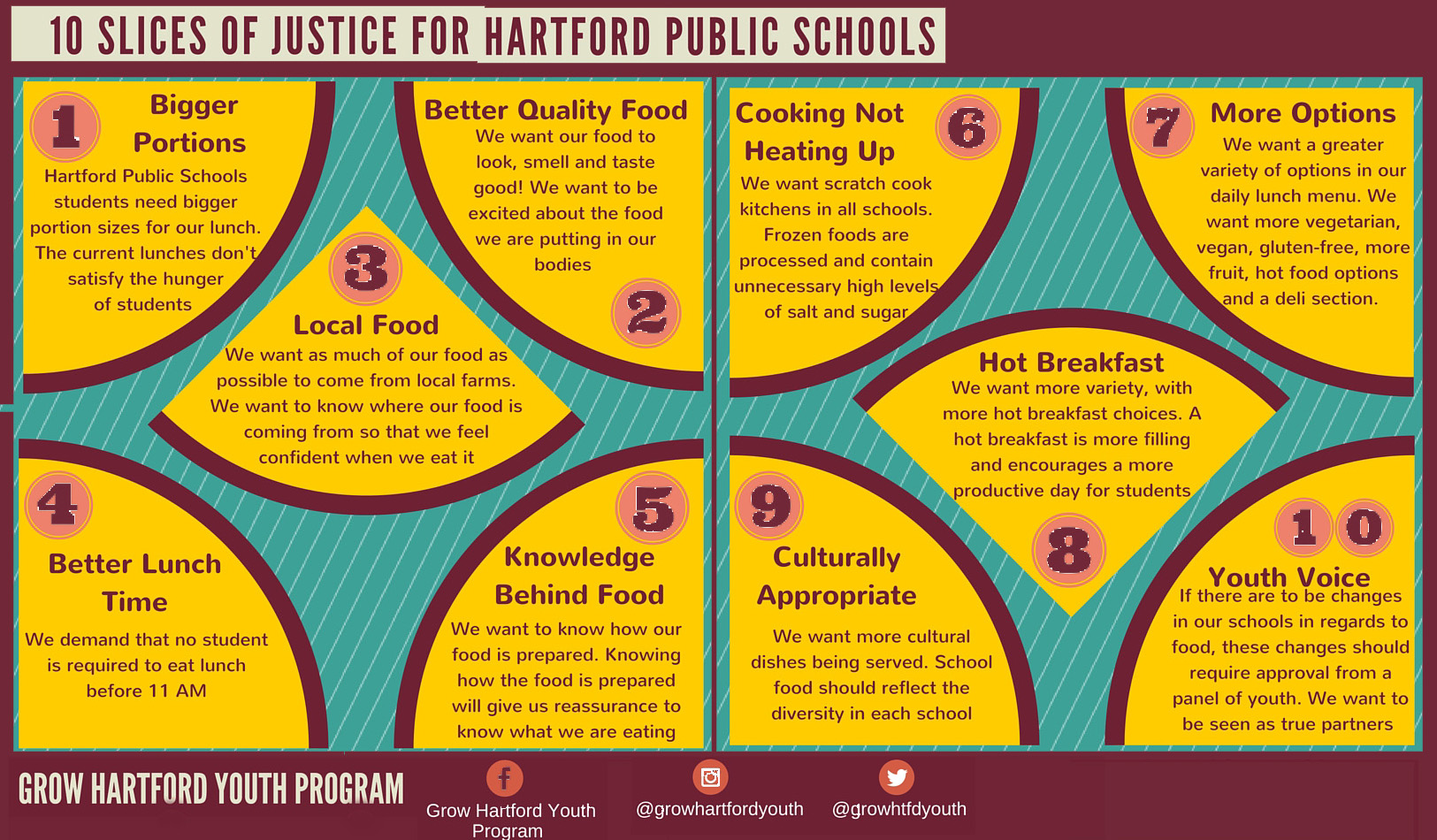
’10 Slices’ campaign aimed at improving food at Hartford public schools
2016 is a year for change and no greater truth exists than the saying, “It’s time for our students’ learning environment to stop being attacked.” If this is so, the budget cuts in the Hartford school system must not persist. If there is enough money to hire new police officers, then there must be money to keep our teachers in schools and feed our students the food they deserve. Both are necessary to teach our students the things they need to succeed.
Posted inCT Viewpoints
Connecticut must correct funding inequity in public schools
It is critical and past due that Gov. Dannel Malloy and especially Connecticut Commissioner of Education Dianna Wentzell look at the inequity in funding of the students who attend the Bridgeport Public Schools as compared to the more affluent suburban school districts in Connecticut.

Posted inCT Viewpoints
Invest in after-school programs to ensure Connecticut’s future
After-school programs are needed to provide Connecticut students a safe and supervised space, to keep them involved in academic enrichment activities that create lifelong learners, and to support working the families who drive this state. If fortunate programs like ours are forced to make difficult decisions, how are other programs going to continue providing this valuable resource? Investment in quality after-school programs is needed now more than ever to support a stable and equitable future for all in Connecticut.
Posted inCT Viewpoints
CT Mastery Exam Task Force has unique opportunity to fix assessment system
The Connecticut legislature’s Mastery Examination Task Force has a unique opportunity to design and determine a Connecticut Assessment System that can meet the needs of our students, satisfy their parents, and inform student learning for teachers while – at the same time – fulfilling the state’s obligations under the Every Student Succeeds Act.

Posted inCT Viewpoints
Examining Clinton and Sanders on K-12 education
There has been no substantive conversation about K-12 education in the Democratic debates, town hall meetings, or candidate rallies. Perhaps that’s because Democrats want to walk away from the contentious education policies and practices of the Obama administration and focus, instead, on the many other noteworthy accomplishments of Barack Obama’s presidency. Whatever the back story, we voters deserve to know what the candidates will do as President about the education of our children. What follows are key topics about K-12 education and what the candidates have said about them so far.

Posted inCT Viewpoints
Examining the Republican candidates on education
There has been no substantive conversation about K-12 education in the Republican debates, town hall meetings, or candidate rallies. Attention has been on other issues, but education is crucial both for the individual future of each of our children and for the future of our nation. We voters deserve to know what the candidates would do as President about K-12 education. What follows are key topics about K-12 education and what the candidates have said about them so far.

Posted inCT Viewpoints
Connecticut is struggling to implement anti-concussion measures
Though the Centers for Disease Control maintain that concussions are a significant public health problem, Connecticut —once a pioneer in concussion legislation— struggles to implement basic safety measures. While other states laws mandate athletic trainers for contact sport events, limit contact practices, and penalize officials who fail to follow concussion protocols, it is difficult in Connecticut to implement basic policies to educate coaches, parents and athletes on concussion safety.

Posted inCT Viewpoints
We need to limit the consumption of juice by Connecticut children
Over 15 percent of Connecticut’s low income 2- to 5-year old children are obese, ranking us fifth in the nation in early childhood obesity. While it is tempting to think that chubby toddlers will grow out of their baby fat, this is all too often not the case. An overweight child aged 3 to 5 is three times more likely to become an obese adult. And overweight children who become overweight adults have more severe adult weight problems and higher morbidity and mortality than people that first become overweight as adults.

Posted inCT Viewpoints
Use of Connecticut student data brings both potential rewards and risks
There is great potential for the appropriate use of student data to bring positive outcomes for our children and students. However, the use of student data also brings with it immense responsibility and great risk to the safety and civil liberties of children and their families.
Posted inCT Viewpoints
Parents’ rights group: Education officials’ behavior rude and appalling
As part of Education Commissioner Dianna Wentzell’s “leadership strategies,” designed to urge superintendents to “encourage” parents to have their children take the SBAC test rather than to opt out, the commissioner called in superintendents from public school districts across the state to the department’s Hartford headquarters for a “training session” on how effectively to communicate with parents.
Posted inCT Viewpoints
Why isn’t media asking presidential candidates about education?
It is difficult to believe as a life-long educator that the media has yet to ask any of the presidential candidates about their views on K-12 public education. It is a well known fact the public education in Connecticut and across the nation has suffered immensely as an outgrowth of the policies of the George W. Bush administration with its No Child Left Behind (NCLB) program. Likewise, public education continued its downward spiral as a result of President Barack Obama’s appointment of Secretary of Education Arne Duncan, who ushered in the disastrous Race to the Top along with the Common Core State Standards.
Posted inCT Viewpoints
Expediting childcare for homeless kids is right for all of us
Over 1,000 families and more than 2,000 children were homeless in Connecticut over the course of 2015. It is best for the health of these families — particularly for their children — and less costly for our communities to resolve family homelessness quickly by helping these families stabilize their lives. To do so requires streamlining access to quality childcare for these children to help them through a difficult period, while freeing their parents to find work or sign up for needed employment training, and secure permanent housing as quickly as possible.

Posted inCT Viewpoints
Providing exceptional education to all students requires more accountability, not less
The release of Connecticut’s teacher evaluation results in a school-funding trial has revealed that only 1 percent of teachers were evaluated as either “below standard” or “developing.” Recently, a CT Mirror story covered a discussion among members of the Connecticut Performance Evaluation Advisory Council (PEAC) about whether and how to amend the teacher evaluation process. In that story, Connecticut unions represented that the inclusion of a state assessment in the evaluation process is unfair to teachers. But, as a former teacher, principal, and superintendent, and a father of six Connecticut children—it strikes me as somewhat obvious that, quite to the contrary, these results indicate a strong, existing bias in favor of protecting teachers from data.