



As legislators and Gov. Ned Lamont scrambled last week to craft a new budget before Wednesday’s deadline, they groped for the latest in a string of maneuvers around a spending cap already strained to its limit.
A plan that already would underfund guaranteed worker benefits and shifts hundreds of millions off-budget to support child care and municipal aid would also abruptly boost, and then shrink, payments into the teachers’ pension fund — all to circumvent a fiscal guardrail Lamont assured business leaders was “sacrosanct” just four months ago.
But options to adhere strictly to the cap are severely limited by dysfunctions that have plagued this budget mechanism throughout its 34-year history. Without the extra spending those gimmicks permit, officials say, the legislature wouldn’t be poised to adopt a new budget before the 2025 session ends on Wednesday.
Put simply, a handful of big programs usually gobble much of the allowable spending growth and leave scraps for everything else. Over time, that creates big problems.
Lamont and legislators have avoided this since 2021, thanks mainly to $2.8 billion in emergency federal pandemic grants they’ve been able to spend outside of the formal budget. In other words, when the cap won’t allow more spending on any item, it could be bolstered with federal aid without breaking the rules.
But those pandemic funds largely have been exhausted, and dealing with the spending cap has never been more challenging.
Lamont: ‘A lot of people are gnashing their teeth’
“Let’s face it, I think a lot of people are gnashing their teeth under the [fiscal] guardrails,” Lamont said at a press conference Wednesday afternoon, explaining why he and Democratic lawmakers were grappling with yet another cap-centered impasse in budget negotiations.
At first glance, the limit is relatively simple. Legislators may budget what they did the prior year, plus some growth that reflects average household income or inflation, whichever is greater.
About one-quarter of the budget — payments on bonded debt and some pension contributions — aren’t subject to cap limits. Prior to 2017, neither was aid to poor cities and towns.
Legislative leaders told the governor last week they wanted to spend roughly $200 million beyond what the cap would allow in the 2026-27 fiscal year, the second of the new biennial budget.
The solution they convinced Lamont to accept was unconventional but not illegal.
They agreed to make a one-time, $200 million payment — on top of the required $1.7 billion — into the teachers’ pension fund in 2025-26, which will be the last year of a temporary cap exemption for these contributions.

Rules call for the spending cap limit to grow two years from now to accommodate the teachers’ pension line item when it comes back under this system. But Democrats say the cap limit should grow by an extra $200 million in 2026-27, even though the bonus payment won’t be repeated that year.
That then would leave $200 million legislators could spend on something else without exceeding the cap.
Lamont’s budget director, Jeffrey Beckham, has been urging lawmakers throughout the 2025 legislative session to remember the system is about affordability and sustainable budgeting.
“We are responsible to taxpayers; therefore, spending must be sustainable and not grow faster than our residents’ ability to pay,” Beckham said in late April after the Appropriations Committee proposed to exceed the cap next fiscal year by $215 million.
Spending cap has plagued governors, legislatures for decades
But the budget is complex, and a few programs can hijack much of the spending growth allowed each year.
While the capped portion of the budget grew just 7% between 2015 and 2019, required contributions to pensions for state employees and teachers combined increased 36%. And that included a deal with unions to defer portions of contributions owed this decade into the 2030s and 2040s.
The state faces a similar problem now with Medicaid.
Since 2021, the capped portion of the budget has grown 30%, sparked by a 40-year high in inflation in the summer of 2022.
But after Lamont agreed two weeks ago to allow a $284 million cap exception in the current fiscal year — chiefly to cover cost overruns in the Department of Social Services’ Medicaid account — spending growth in that program was up 46% since 2021.
Legislators foresaw these potential problems 34 years ago when they created the cap and included an emergency process to overrule the spending growth formula. The governor first must declare a fiscal emergency in writing, and 60% of both the House and Senate must approve.
But from the late 1990s through 2007, Republican Govs. John G. Rowland and M. Jodi Rell teamed up with Democratic-controlled legislatures to legally exceed the cap seven times.
Future governors and legislators would criticize this as fiscally irresponsible. Any exception became politically taboo after Democratic Gov. Dannel P. Malloy, who succeeded Rell in 2011, inherited a budget deficit topping 18% and approved a tax hike estimated at more than $1.8 billion a year.
Has CT over-corrected for past fiscal mistakes?
Still, many of Lamont’s fellow Democrats in the legislature say Connecticut has over-corrected for its past mistakes and now is allowing the cap to starve vital services.
Medicaid payments to doctors and others who treat the poor haven’t been adjusted broadly since 2007, leaving many low-income families unable to find treatment.
Nonprofit agencies that serve clients with developmental disabilities miss out on hundreds of millions of dollars annually because state payments haven’t matched inflation for decades. Cities and towns say the same is true of state aid for K-12 schools.
Meanwhile, the spending cap — coupled with other aggressive budget controls enacted by both parties in 2017 — has generated unprecedented annual surpluses averaging $1.8 billion, which equals about 8% of the General Fund.
That’s deceptively large, considering about three-quarters of the budget involves wages, benefits, Medicaid, debt service and other fixed costs.
This year’s projected surplus approaches $2.4 billion, or 10% of the General Fund. Analysts estimate the state will continue to save more than $1 billion annually through at least 2028.
These surpluses, used mainly to shrink Connecticut’s hefty pension debt, have become a source of frustration for many Democratic legislators and other advocates who insist core programs are slipping badly.
“I think members are looking to make a significant investment in our state this year, and we’re tired of hearing the governor say there’s not enough money when we know there is,” said Rep. Jillian Gilchrest, a progressive Democrat from West Hartford.
Co-chairwoman of the Human Services Committee, Gilchrest spearheaded a push to invest $250 million across four years in Medicaid rates. Nonetheless, the budget to be adopted this week is expected to order a much smaller investment. Advocates seeking big funds for nonprofit social service agencies also are bracing for little new money.
House Speaker Matt Ritter, D-Hartford, called the lack of investments in health care and social services two of his biggest disappointments.
“We do agree with the governor, the state’s in a better position financially” because of the spending cap, he said. “But we probably have gone a little too far.”

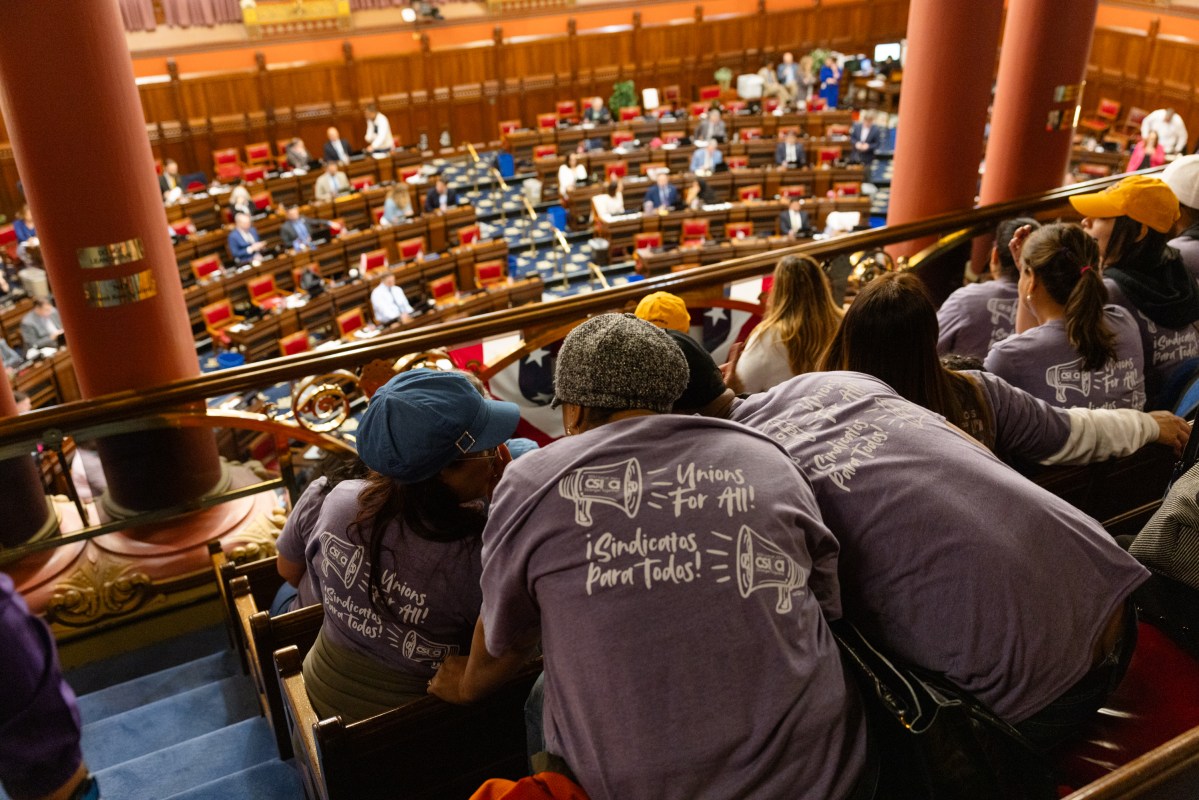
Labor groups descended on the Capitol en masse Saturday to protest insufficient spending on core programs and demand immediate reform of spending caps.
“If Gov. Lamont truly wanted transparency, he would declare a fiscal emergency and suspend the roadblocks,” said Norma Martinez HoSang, director of CT For All, a coalition of more than 60 labor, faith and civic organizations.
Connecticut has pledged in legal covenants with bond holders not to alter any of its budget caps dramatically before July 1, 2028, when many expect a landmark reform debate.
Lamont struggled to keep his own budget proposal under the cap
In the meantime, legislative leaders are trying to bend the limits without breaking them.
They’re not the only ones.
To keep the $55.2 billion two-year budget he proposed in February under the cap, the governor employed several workarounds.
First, he would underfund contractually required health care benefits for retired state workers by about $114 million per year. Comptroller Sean Scanlon says he hopes to mitigate that gap by negotiating savings with insurance providers, but any remaining deficit would be taken from the retiree health care trust — meaning the cost, plus interest, would be covered by future taxpayers.
Lamont also proposed borrowing rather than paying cash for a $60 million grant program that helps towns cover road paving and winter snow plowing. Borrowing occurs outside of the formal budget and spending cap.
Finally, he would shift $300 million from surplus into an off-budget account to fund future increases in early childhood development programs.
Given these maneuvers and the latest cap workaround involving the teachers’ pension, House Minority Leader Vincent J. Candelora, R-North Branford, said Lamont and Democratic legislators clearly are bending the rules.
“It’s a gimmick to pay something off budget in the first year, bring it on budget in the second year, to escalate the spending cap,” he said.

Candelora added he suspects the entire budget “is going to be cobbled together with gimmicks that do [an] end-around the spending cap.”
Senate Minority Leader Stephen Harding, R-Brookfield, predicted fiscal chaos when Lamont first agreed to legally exceed the spending cap two weeks ago. “Get your pocketbooks, your wallets ready,” he said. “You’re going to give over more of your money [to] the state of Connecticut.”
Lamont spokesman: ‘The spending cap remains sacrosanct.’
Chris DiPentima, president and CEO of the Connecticut Business and Industry Association, heard Lamont’s declaration that the spending cap is “sacrosanct” back on Jan. 15.
The business leader said from the moment the governor proposed his biennial budget on Feb. 5, complete with some cap gimmicks, he feared legislators would embrace them and offer more.
“That’s got us very alarmed, that we’re just ignoring the spending cap when all is said and done and not making hard decisions” to cut spending, DiPentima said.
But Lamont’s political options are limited.
Democrats threatened last week to suspend the 34-year-old requirement that Connecticut adopt a two-year budget — designed to encourage long-range fiscal planning — unless they could find more options to work around the spending cap in 2026-27.
The alternative, Ritter said, was to adopt a plan covering just 12 months through June 2026.
That would be problematic, to say the least, for Lamont, should he seek reelection next year.
Under that scenario, Lamont would have no approved spending plan in place should he fail to strike a budget deal with legislators next spring. And he would be faced with the chaotic prospect of managing underfunded departments by executive order, even as his reelection campaign entered the home stretch.
But despite some of the compromises the governor made this year to secure another two-year budget, spokesman Chris Collibee said “the spending cap remains ‘sacrosanct,’” and while legislators won’t see all the funding they wanted, there are new investments and fiscal stability.
“Our ‘kitchen table’ approach to budgeting over the past six years is the reason why Gov. Lamont was able to provide some flexibility in spending to cover essential services,” he said. “While other states are reducing services and/or increasing taxes, here in Connecticut have not only gotten our fiscal house in order but are doing the opposite.”
