



After a GOP wipeout in elections across the country, Democrats in Connecticut outlined a vision of how they’d like to use their new majorities in Congress and specifically their newfound authority across several congressional committees.
Democrats stormed back into power, regaining control of both the U.S. House and the U.S. Senate after making major gains in some of the reddest parts of the country. That will give them a large but also ideologically diverse coalition of Democrats who want to play a role in setting the party’s agenda.
Members of Connecticut’s delegation all drove home the same point: Democrats will need to take a two-pronged approach when they return to the majority. The party will have the delicate balance of pushing back on President Donald Trump through oversight efforts and tackling policies in the hopes of directly addressing voter concerns that led to their electoral success.
The 2026 midterm was a change election — some longtime incumbents lost in the primaries, including in the Connecticut General Assembly, and then voters sent a rebuke to Trump and Republicans, who have controlled all levers of power in Washington for two years.
Connecticut Democrats argue they can’t squander the opportunity afforded by Tuesday night’s wins.
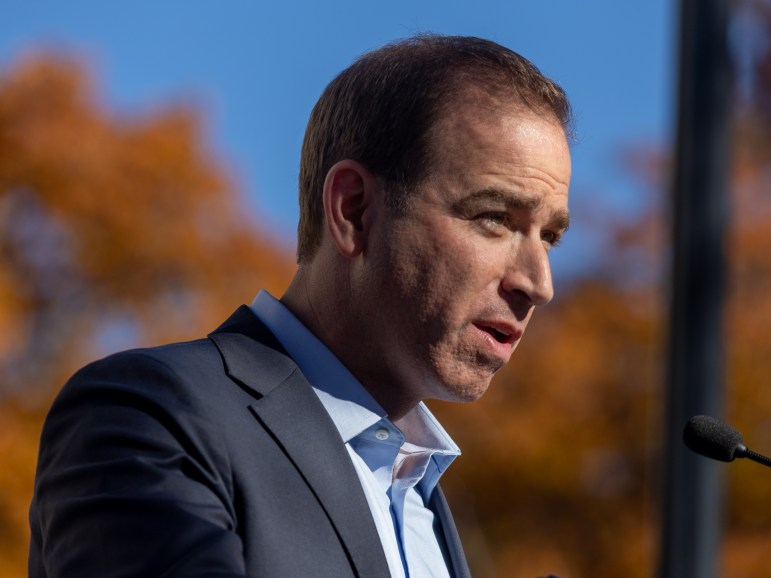
“If we want last night’s election to be remembered as more than a historic backlash to a corrupt president, then we need to get to work, solving problems that the American people desperately want us to see us solve,” said U.S. Rep.-elect Luke Bronin, the newest member of the congressional delegation, who unseated a longtime lawmaker in the August primary for the 1st District.
For Bronin, that means accountability as it relates to corruption and self-enrichment related to the administration while pursuing legislation to ban members of Congress from trading stocks and “serious” efforts on campaign finance reform.
Bronin was joined by a couple of his new colleagues in the congressional delegation at a Wednesday press conference outside of the state Capitol, who echoed sentiments about how Democrats in Washington need to navigate.
“We need to get to work not only saying no to Trump,” U.S. Sen. Richard Blumenthal said, “but positively yes to programs that cut costs to everyday Americans on healthcare, on everyday needs of people’s livelihood and lives and, of course, hold Trump accountable and fighting corruption.”
Democrats view their newfound power as much-needed oversight of the Trump administration, which some argue the party didn’t do enough of the last time they held majorities in Congress.
“Congress has the responsibility to conduct oversight. And I think part of the problem with the moment that we are in right now is that when we had the opportunity to enforce some of these regulations, to close some of the loops and gaps that we had seen, we didn’t do as much as we could,” U.S. Rep. Jahana Hayes, D-5th District, said Wednesday.
“We will also be legislating, but we have a responsibility to subpoena people and bring them in and peel back some of the layers of what has been happening because, again, people showed up because they were upset.”
In the lead-up to Tuesday’s elections, members of Connecticut’s delegation started to sketch out what Democrats’ return to power could look like from some of the highest echelons in Congress.
Nearly all of the Democrats will vie for the top spot on their committees, likely giving Connecticut’s delegation significant influence in the new session next year.
Their committees have different jurisdictions and roles, but Connecticut’s lawmakers see a throughline in the work for next year: a focus on oversight of the White House.
U.S. Rep. Rosa DeLauro, D-3rd District, hopes to reclaim the gavel of the House Appropriations Committee. She led the influential panel in 2021, but when Democrats lost the House majority two years later, she became the ranking member and has served in that role since.
The Appropriations Committee crafts spending bills, allocates money and funds the federal government. DeLauro’s leadership role on the committee comes at a time when there has been a major strain between the executive and legislative branch regarding federal funding.
DeLauro, 83, currently doesn’t face any challengers for the leadership position. She has said she hopes to restore education and job opportunities that could help address the higher cost of living and restore her committee’s authority on grants and other funding.
DeLauro has also said she envisions handling some oversight “in my lane” by taking a look at where federal dollars are flowing and whether some money “has been transferred illegally.”
U.S. Rep. Jim Himes, D-4th District, is angling for the top spot on the House Intelligence Committee.
Himes’ job as ranking member places him in the “Gang of Eight,” a group of the Republican and Democratic leaders in the House and Senate plus the chairs and ranking members of both intelligence committees.
The House Permanent Select Committee on Intelligence has oversight over U.S. intelligence agencies as well as some issues concerning the Pentagon and other government agencies. As a likely chairman, Himes, 60, has previewed congressional oversight as a main objective.
The congressman has already issued warnings to defense companies about cooperating with congressional oversight, specifically on a potential investigation into corporate donations for the construction of the White House ballroom. But if he gets the chance to become chair, he said, he’s cognizant he’ll need some amount of buy-in from Republicans during such a polarized time.
U.S. Rep. Joe Courtney’s work on the Seapower Subcommittee has a lot of crossover with the defense industries that power much of Connecticut’s workforce and economy, especially in his 2nd District.
Some of Courtney’s focuses will be on the Department of the Navy, submarine programs and the AUKUS agreement between the U.S., U.K. and Australia that will have to meet deadlines on the delivery of Virginia-class submarines.
Courtney, 73, also sees opportunities for oversight, whether that’s on the Air Force One plane gifted by Qatar as well as the White House’s battleship proposal. He also believes oversight over the war in Iran and U.S. Secretary of Defense Pete Hegseth’s tenure will be “front and center” for the full House Armed Services Committee.
Hayes would be a newcomer to leadership on the House Education and the Workforce Committee. So far, Hayes and Oregon Rep. Suzanne Bonamici are challenging the current top Democrat on the panel, U.S. Rep. Bobby Scott of Virginia.
Education is one of her top priorities, especially as a former teacher in Waterbury, and she’s cited concerns about the administration’s efforts to dismantle the U.S. Department of Education. She currently serves as the ranking member of the House Agriculture’s Subcommittee on Nutrition and Foreign Agriculture.
“I start tomorrow running for chair of Education and Workforce, because that to me is a big priority, but we have a budget that expires on Dec. 12,” Hayes said at Tuesday’s election night party in Waterbury. “I’m hoping we can do some negotiating on these big cuts in the ‘One Big Beautiful Bill.'” When asked about Trump’s veto powers, she said, “I don’t concern myself too much with what Trump says. We have the votes.”
Hayes has she’d prioritize trying to rescind cuts to Medicaid and the federal nutrition program known as SNAP that the law will enact through changes like new work requirements. Nearly 63,000 residents in Connecticut have so far lost SNAP benefits since eligibility changed as a result of H.R. 1. Medicaid changes are coming in January.

Blumenthal said he plans to serve as chairman of the Homeland Security’s Permanent Subcommittee on Investigations — a role he previously held when Democrats were in the majority — as well as the top spot on the Senate Veterans’ Affairs Committee.
Blumenthal, who signaled he’ll run for a fourth term in 2028, said he spoke Wednesday morning with Senate Democratic Leader Chuck Schumer, who is likely to return as majority leader next year. Blumenthal said he’ll support the New York Democrat for that role.
“I don’t think people understand the kind of weight that our delegation brings. We’re going to have at least two major chairman in the House and hopefully a third,” Blumenthal said, referring to Hayes’ run for committee chair. “Person per person, we’re going to be in a position to get results for the people of Connecticut.”
U.S. Sen. Chris Murphy currently serves as the top Democrat on the Senate Appropriations subcommittee that deals with funding for the U.S. Department of Homeland Security. When asked a couple of months ago if he would stay in that role or look to become chair, Murphy was uncertain and said, “there will be a lot of movement.” He is currently recovering after his hospitalization due to a stroke.
Tuesday’s elections cemented Democrats’ ironclad grip on federal races after they swept all five U.S. House races. Republicans in Connecticut have been locked out of Congress since 2009 after Chris Shays lost reelection to Himes.
Connecticut GOP Chairman Ben Proto is looking to the national party to help fund and sustain long-term party building. Republican congressional candidates in Connecticut had all bemoaned the lack of resources and financial support from the GOP at all levels.
“There was a time, not all that long ago, where the New England Republicans were dominant, and there’s been a shift. I understand that,” Proto said Tuesday night. “I think in order to make New England again a player at the federal level, those entities are going to have to invest — again with time, resources, human resources, dollar resources, professional work, ground-building work, grassroots work.”
When asked about whether Republicans’ messaging needs to change, Proto gave some indications of what they might need to do.
“I don’t know that the messaging has to change. I think that the messaging has to improve. I think the messaging has to be more personal. I think we have gotten caught up way too much in the consultant class in the Republican Party,” Proto said. “And we’ve lost the ability to just have conversations.”
Even with big majorities next year, Democrats will still need to contend with a president who can wield a veto pen. And they’ll need to negotiate with Republicans who will still have some leverage on must-pass legislation like government funding.
But Bronin argues that will show where Republicans are as Democrats look to build momentum into 2028.
“If the man in the White House vetoes those things,” Bronin said, “then it will be more evidence that he doesn’t give a damn about what the American people want.”
CT Mirror reporter John Moritz contributed to this story.
The Connecticut Mirror/Connecticut Public Radio federal policy reporter position is made possible, in part, by funding from the Robert and Margaret Patricelli Family Foundation.
