Gov. Ned Lamont informed legislative leaders Monday he will extend from Feb. 9 until April 20 the public health and civil preparedness emergency that gives him sweeping powers to manage the COVID-19 pandemic.
Leaders of the legislature’s Republican minority said the Democratic governor’s latest extension was premature and undercuts a GOP effort to outline a greater legislative role in managing the pandemic and future emergencies.
“We had a conference call at 1:30. This is the first discussion we had, and we’re being quick-pitched,” said House Minority Leader Vincent J. Candelora, R-North Branford.
In a letter quickly sent to Democratic legislative leaders and copied to the governor, Candelora and Senate Minority Leader Kevin Kelly, R-Stratford, proposed legislation limiting public emergencies to 30 days, subject to approval by a majority vote of the General Assembly.
House Speaker Matt Ritter, D-Hartford, and Lamont’s spokesman, Max Reiss, each took issue in separate interviews with the idea that the governor’s action was unexpected, since the fast-approaching expiration date of the current emergency was set five months ago.
“I think we all were on notice, respectfully,” Ritter said.
Ritter said a review of the 10-year-old emergency powers law used for the first time in response to the pandemic was likely, but probably not before the end of the session — and certainly not by Feb. 9.
“I don’t see how it’s feasible,” Ritter said.
Neither chamber is expected to meet for floor votes by then, he said.
Current law allows a governor to declare a public health or civil preparedness emergency for up to six months. The declaration can be blocked by a majority vote of a special committee of 10 key legislators within 72 hours.
Democrats hold a 6-4 majority on that committee. It is composed of the majority and minority leaders of the House and Senate, the Democratic co-chairs and ranking Republican members of the Public Health Committee, the Senate president pro tem and the House speaker.
Lamont declared a six-month state of emergency on March 10 and a five-month extension on Sept. 9 that has allowed him to restrict commerce, limit the size of social, entertainment and religious gatherings, and require the wearing of masks in stores and other public places.
At a press briefing held before the release of the GOP letter, Lamont said another extension of two-plus months would give Connecticut time to assess the impact of the continuing vaccination program and the relatively new threat of a more contagious variant of the virus that causes COVID-19.
“We think by April 20th we’re gonna have a really good handle on where we stand in terms of vaccinations, where we stand on the supply of vaccinations, where we stand on bending the curve, where we stand compared to that super contagious variant of the germ that’s out there,” Lamont said.

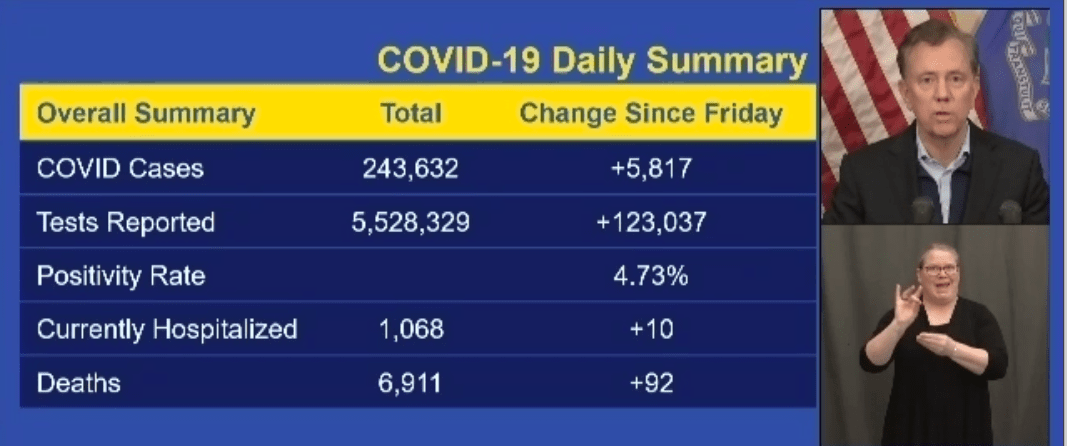
At the first of his twice-a-week COVID-19 briefings, Lamont said the testing and hospitalization data since Friday was encouraging, other than another 92 deaths. Only 4.73% of the 123,037 tests were positive, and hospitalizations are stable at around 1,100 patients.
“There is a black cloud. And that is the fact that we have four more folks who have been deemed infected by the super infectious UK variant,” Lamont said. “We knew it was here in this state. We knew it is here in this country. But now we are slapped in the face by this fact.”
Now, a total of eight people in Connecticut have been found to have the new variant.
Reiss, the governor’s communications director, took exception to lines in the Republican letter that he took as questioning the existence of a continuing emergency. The Centers for Disease Control and Prevention and every one of Connecticut’s neighboring states acknowledge a continuing emergency, Reiss said.
“Unfortunately, in our view, the continued exercise of emergency powers has become a matter of convenience, rather than a matter of emergency,” Candelora and Kelly wrote. “We hope you’ll join us in seeking a path toward replacing the overly-broad control held by the executive branch with a more collaborative decision-making process that gives equal footing to legislators and the citizens we were elected to serve.”
Ritter and Senate President Pro Tem Martin M. Looney, D-New Haven, later issued a sharply worded joint response:
“We very much consider the COVID-19 pandemic to be a continuing emergency, not a mere inconvenience. Connecticut Republicans are underplaying the seriousness of the crisis and the administrative challenges of distributing the vaccines while we are dealing with ongoing consequences of the ineptitude and inadequate planning of the previous Republican national administration.”
In an interview, Candelora did not dispute the need for emergency authority.
“I think there is authority that the governor — no question — needs for public health purposes,” Candelora said. “But at what point is the legislature going to begin to look at this long term issue, to try to address it legislatively? Because the way the vaccine rollout is going, this could certainly extend another year or two.”
Candelora, who owns a sports complex, said he was uncomfortable with the limits on religious gatherings, and he also thinks the legislature should limit how quickly the governor can impose restrictions.
“I’m sensitive to this, because I was running a sports complex that was told to shut down within 72 hours, which caused a lot more economic hardship than if we had 10 days to react to that,” Candelora said.
Candelora said he was not objecting to the original closure order in March, when the virus was new and rapidly spreading, but later orders revising the rules for reopening.