
UniteCT, the state’s administrator of federal emergency rental assistance, paid $6.4 million last week, the third consecutive week of increases in applications approved and dollars paid — a sign that a maligned federal COVID-19 relief program may be finding its footing in Connecticut.
The $22.6 million disbursed in July nearly equaled the combined tally for April, May and June, bringing to $45.8 million the total paid as UniteCT races to resolve as many cases of unpaid rent as possible before evictions resume in full. A little more than one-fifth of the 26,773 applicants to UniteCT now have received aid.
A federal moratorium on evictions ended over the weekend. Connecticut’s moratorium expired a month ago, but further restrictions imposed by Gov. Ned Lamont will slow evictions for non-payment at least through Sept. 30.
Quickly organized to distribute Connecticut’s $235.8 million share of the rental relief appropriated by Congress in January, UniteCT started with five payments totaling $42,509 in the week ending April 2 and progressed slowly.
The emergency rental assistance has been slow to launch nationally. In Connecticut, the program did not reach $1 million in weekly payments for the first time until May 7, uniting advocates for landlords and tenants in complaints of cumbersome rules and slow processing.
“Really, the program got working in May, June, July,” said Dawn Parker, the director of UniteCT, which is based at the state Department of Housing. “We were staffing up, training, getting all that kind of stuff in March and April.”
Connecticut’s performance largely has mirrored that of many state and county governments, which were left the task of standing up a bureaucracy to distribute the federal aid, following guidance set by the U.S. Treasury.
It has outperformed others, most notably New York — a state that didn’t make its first payments until last week, disbursing $1.2 million. Others have done far better. Working with two community organizations, Harris County in Texas has distributed $137 million to more than 36,000 eligible renters in the Houston metro area.
The program is open to tenants whose income is no more than 80% of the annual median for their community. In most of Connecticut, that means $54,950 for a household of one, with a sliding scale that tops at $107,600 for a household of eight.
Connecticut landlords complain that the pace of approvals remains slow, even if improved.
Nearly half the 26,773 applications made to UniteCT have yet to be reviewed for completeness, leaving applicants unsure if they are sufficient to be reviewed. Landlords and tenants must each apply.
“I still have some that are three or four months old,” said John Souza, who owns and manages 200 apartments in the Hartford area with his brother. “And if the tenant needs to do more or whatever, that’s fine. But they need to let me know so that I can get on their case and help them if they need it.”
Of the 13,899 applications deemed complete as of the end of the day on Friday, 5,800 were approved for payments, 5,208 were undergoing audit review, 2,481 were in prescreening, 335 had been withdrawn and 75 had been denied.
Acting on revised Treasury guidance, UniteCT has simplified income verification, reducing the necessary documentation and automatically qualifying tenants from census tracts where the income is only 60% of the average median.
“We still have to intercept the fraud and abuse, but where’s our tolerance to kind of give a little bit and say that’s a reasonable risk?” Parker said. “And that’s where we decided it’s reasonable.”
Erin Kemple, the executive director of the Connecticut Fair Housing Center, said the change has sped up processing, but advocates were unsure if Connecticut has matched other states in using eligibility for other programs, such as Temporary Aid for Needy Families, to qualify for rental assistance.
One consistent complaint shared by advocates for tenants and landlords is Connecticut’s reliance on online applications, while other states are more flexible.
“You can walk into a social service agency and have them do it for you,” Kemple said. “In Connecticut, you really have to either go online yourself, or you have to make an appointment. There’s not really any walk-in times with a social service provider, and there’s only a few social service providers.”
With an additional congressional appropriation of $8.6 billion in May, Connecticut was allocated another $186.6 million, bringing the total available resources to $421 million. Less clear is the extent of the need or how many people are facing eviction.
A Census Household Pulse Survey from June found 1.2 million American households expecting to face evictions in coming months, but Parker said she was uncertain how much rent was owed in Connecticut or how many tenants face eviction.
“There isn’t anything that we refer to that gives us the same number twice,” Parker said. “There’s not a good answer for that.”
Souza said he was seeking aid for tenants in 19 apartments, nearly 10% of his 200 apartments.
“Some were definitely behind, and it’s a godsend to them, I would say most of my tenants absolutely deserve it … they’re hardworking people, and they’ve had a tough time,” said Souza, who also leads an association of small-to-midsized landlords.
But he said the eviction moratorium has been abused by some tenants who ceased paying anything toward rent, even if they still were employed or received the enhanced unemployment benefits available during the pandemic. Landlords, he said, are likely to pursue evictions of those tenants.
Of the 5,800 cases resolved with payment by UniteCT, the average arrearage was just over four months’ rent, indications that most applicants continued to pay some rent during the moratorium. The average approved award was $7,485 in rent and $406 in utility bills. Awards are capped at $15,000.
“You know, tens of thousands of people did not just say, ‘Whatever, I’m just not going to pay you.’ It is the exception. I do feel bad for landlords who are dealing with that tenant who is the exception,” Parker said. “There are landlords who saw their tenants doing OK with money and not paying them.”
The average arrearage number could be skewed, however, by landlords declining to file with UniteCT in instances where they decided against working with a tenant who had refused to pay anything during the moratorium. A month ago, landlords refusing to file outnumbered tenants, 4,611 to 1,969.
Kemple, the tenant advocate, said the number of eviction filings actually have dropped since the state’s moratorium expired, from 167 in the last week of June to 64 in the last week of July.
Her assessment is that the executive order issued by Lamont when the state evictions moratorium expired has been effective. It requires landlords to complete a UniteCT application before sending a notice to quit the premises to a tenant for non-payment.
“And if they haven’t served the tenant with information about how to apply for UniteCT, then the case is going to be dismissed by the court,” Kemple said. “So, we think that’s a very good step in the right direction.”
Lamont’s order also extended an appeal period for tenants from three to 30 days.
In a typical year, about 20,000 eviction cases are filed, a step towards removal or, in many cases, the start of a mediation process that can keep a tenant in place with a repayment plan.
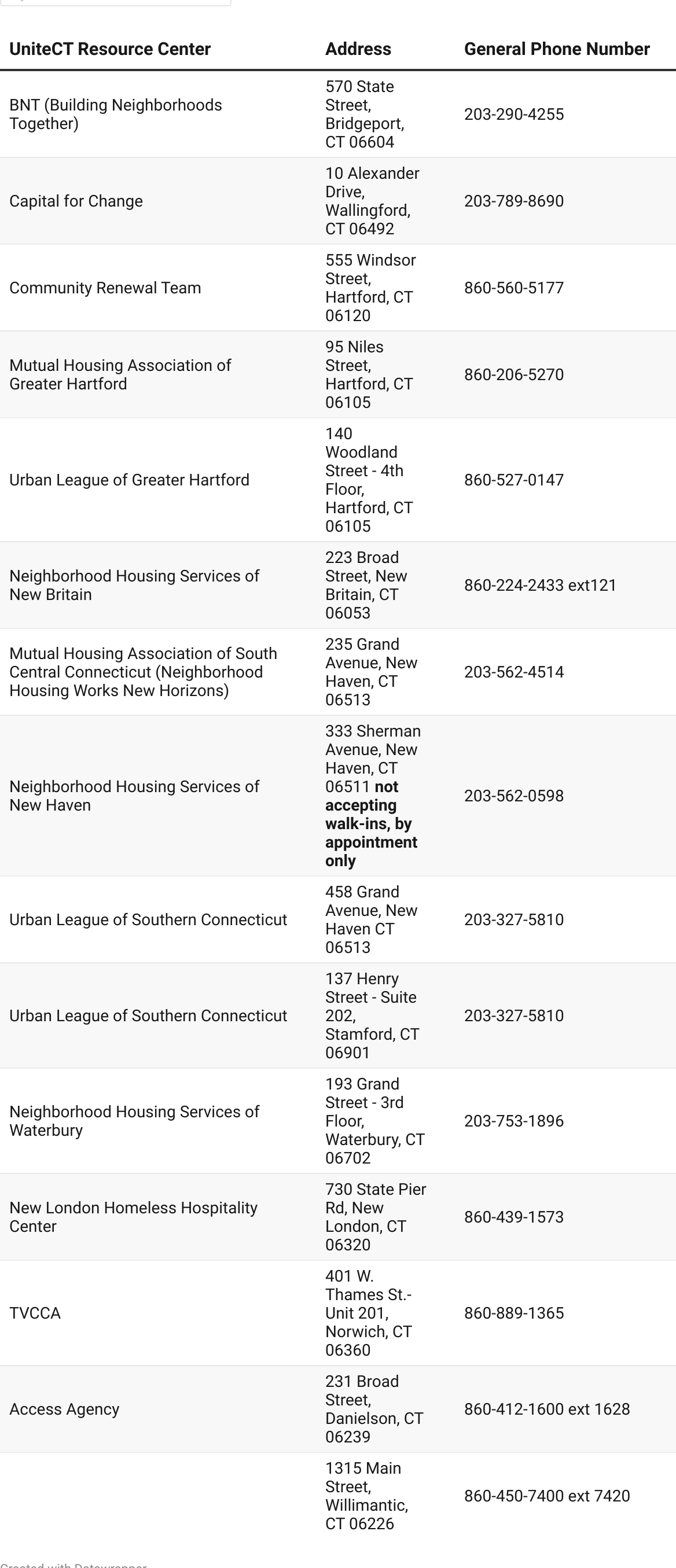
Information about UniteCT is available online at https://portal.ct.gov/DOH/DOH/Programs/UniteCT or by visiting one of these agencies.