



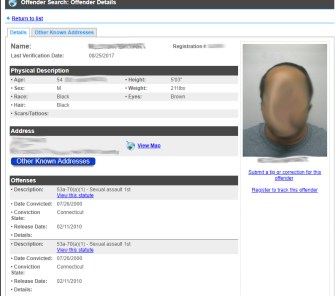
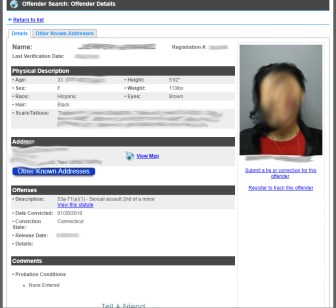
In the 1990s, in response to a number of horrific and highly publicized crimes against children, states and the federal government created stringent penalties for sex offenders, notably registries where offenders’ names and addresses are available to the public.
But now critics across the country are demanding review and revision of these policies, saying they are based on false assumptions, are a waste of money and do more harm than good.
The registries and related policies “are absolutely and fundamentally flawed. They do nothing to support prevention, are not a deterrent and do nothing for people who have survived sexual violence,” said Prof. Alissa Ackerman of California State University Fullerton, a criminologist and national expert on the treatment of sex offenders.
In 2015 the Connecticut Sentencing Commission, at the behest of the General Assembly, began a lengthy examination of Connecticut’s “system of assessment, management, treatment, and sentencing of sex offenders.”
After a two-year study, the commission recommended changing the state’s public registry from one based on the offense — commit most sex-related crimes and you go on the registry — to one based on the risk an offender poses to the community, as determined by a new, eight-member Sex Offender Registration Board. Individuals found to be low-risk — and some adjudged moderate-risk — would be on a registry only available to law enforcement personnel.
The proposal was crystalized into a bill introduced during the immediate past session of the General Assembly, though it failed to make it out of the Judiciary Committee.
State Sen. Paul Doyle, co-chair of the committee, said the complexity and emotional nature of the issue made it more appropriate for the longer session next year.
“We never got to the merits. Leadership was not prepared to deal with it in a short session.” He said he personally would have had to do more research before deciding how to vote.
Lawsuit
In a related matter, the nonprofit Connecticut for One Standard of Justice, which advocates for the civil rights of sex offenders, filed a federal lawsuit on April 4 seeking to overturn a Windsor Locks ordinance which bars persons on the sex offender registry from most public places in town.
The town’s “child safety zones” include a “park, school, library, playground, recreation center, bathing beach, swimming pool or wading pool, gymnasium, sports field, or sports facility” either owned or leased by the town. The suit claims banning a group of people from these facilities is unconstitutional.
The town has hired outside counsel to defend the ordinance, said town attorney Carl Landolina. He said it is very early in the case, and he expects a discussion about strategy soon. First Selectman J. Christopher Kervick said he expects the town to be flexible and open to modifying the ordinance if that will satisfy the plaintiffs.
Both the bill and the lawsuit may shed light on an area of the law that advocates believe is driven by misinformation and bad data.
“We have to stop ignoring the evidence,” said Cindy Prizio, executive director of Connecticut for One Standard of Justice.
Getting Tough
The movement to make sex offenders the only class of criminals with a public registry began nationally in 1994 when Congress passed the Jacob Wetterling Crimes Against Children Act (these laws are named after child victims in heinous crimes), which established the federal sex offender registry and provided guidelines for states to follow suit. It also required states to track sex offenders by confirming their addresses annually for 10 years after their release from prison or quarterly for the rest of their lives if convicted of a violent sex crime.
That was followed by Megan’s Law in 1996, which required all states to develop and implement a community notification procedure. Another law, the Adam Walsh Act passed in 2006, further toughened the registry law, making failure to register a federal criminal offense and adding some juveniles as young as 14 to the registry.
Connecticut has more or less tracked the federal pattern. The state created its first registry in 1994, which only required those who committed serious sexual assaults to go on the registry for one year, and their information was only available to law enforcement agencies.
The modern registry was created in 1998 and toughened up in subsequent years. The time on the registry was increased to 10 or 25 years, depending on the offense, and life for reoffenders. Those who commit nonviolent sex offenses were added. Most importantly, the names and addresses of nearly everyone on the list have been made available to the public. Judges can put persons who commit certain crimes, such as sex between an older and younger teen, on a law-enforcement-only list, but this applies to relatively few people.
At present the public registry has about 5,400 registrants, and the police registry, as it is known, has about 80.
‘Myths’
The registry and laws such as child protection zones are based on a set of assumptions that research indicates are highly questionable or outright false. The Sentencing Commission’s 204-page report calls them “myths.” They include:
- Nearly all sex offenders reoffend.
- Treatment does not work.
- The concept of “stranger danger” — that most sexual assaults are the work of people unknown to the victims.
“Research does not support these myths, but there is research to suggest that such policies may ultimately be counterproductive,” the commission’s report says.
The idea that all sex offenders reoffend has been propagated by politicians, judges and the media, but it isn’t close to being true. It apparently emanated from a single 1986 Psychology Today article by a therapist who said — citing no research or other evidence — that the recidivism rate for sex offenders reached 80 percent. The number was picked up by a Department of Justice field manual two years later and has been the basis of the claim, repeated over and over, even by a Supreme Court justice, that sex offender recidivism is “frightening and high.”
Indeed, the preamble to the decade-old Windsor Locks child safety zone ordinance being challenged in court says: “The Town Meeting finds from the evidence that the recidivism rate for released sex offenders is alarmingly high, especially for those who commit their crimes on children.”
The Town Meeting was misinformed.
Low Rate
Sex crimes are often horrific, causing physical, emotional and psychological damage to the victim and victim’s family, damage that can last a lifetime, said Laura Cordes, executive director of the Connecticut Alliance to End Sexual Violence and a member of the subcommittee that prepared the report and bill. She said these crimes also cost society millions in medical and law enforcement costs as well as lost wages.
But studies for more than a decade show sex offenders, once caught, have one of the lowest rates of recidivism of any class of criminals.
For example, the state’s Office of Policy and Management did two studies, released in 2012 and 2017, of the recidivism rate of sex offenders released five years earlier. The studies found that 3.6 percent of sex offenders were arrested for another sex crime by 2011, 4.1 percent by 2016. These numbers are consistent with similar studies done in Alaska, New York, Nebraska, Maine and California. An exhaustive study by the federal government followed nearly 10,000 offenders — about two-thirds of the total — released from prison in 1993 across the country and found that 5.3 percent had been arrested for another sex crime in the three years after release.
“The sexual recidivism rates for the 746 sex offenders released in 2005 are much lower than what many in the public have been led to expect or believe. These low re-offense rates appear to contradict a conventional wisdom that sex offenders have very high sexual re-offense rates,” says the 2012 Connecticut OPM report.
If convicted sex offenders aren’t committing the new sex crimes, who is? The answer: relatives, teachers, coaches, physicians, clergymen, dates, babysitters or other children — people known to the victim and, overwhelmingly, first-time offenders. Many studies (see this study) have found that the vast majority of sexual assaults on women and children are perpetrated by relatives or acquaintances. “Stranger danger” crimes against children — such as those perpetrated against the children for whom the laws are named — are “rare,” according to the U.S. Justice Department’s Office of Juvenile Justice and Delinquency Prevention. In 2011, the last year for which data is available, there were 105 kidnappings by strangers or slight acquaintances, some of which involved sexual assault, in a country of nearly 74 million children.
And, well-structured treatment programs do lower recidivism among those who have committed sexual offenses, several studies indicate (see here and here). Connecticut uses a “collaborative model of specialized supervision and treatment,” which, includes specialized units in some penal institutions and in the parole and probation programs (probation is part of a court sentence and administered by the Judicial Branch; parole is supervised early release and is under the state Department of Correction).
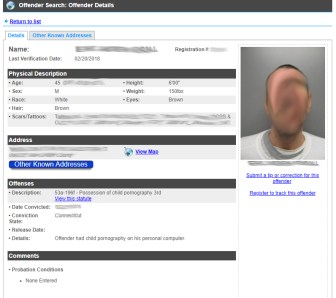
Sex offenders are a varied group, crossing all lines of age, race, class and residence. Their crimes go from serious sexual assault to child porn possession, voyeurism to indecent exposure. Most are on the registry.
‘Modern Lepers’
To have your name on the public registry is to wear the scarlet letter, be an outcast, a “modern leper,” in the words of one court decision. Eileen Redden, who worked with sex offenders in the prison system for 25 years and now heads the Connecticut Association for the Treatment of Sexual Offenders, said the very label “sex offender” is destructive “because it creates bias and discrimination.”
She said, “Most people convicted of crimes with a sexual component, which we call a sex offender, are people who want to rebuild their lives and become productive citizens.” The only way that happens is when they are allowed to live in safe housing, participate in family life and get meaningful employment,” she said.
The Department of Correction finds housing, typically in urban areas, and jobs for the approximately 500 parolees on the registry. The Judicial Branch attempts to connect the 2,100 probationers under its supervision with housing and jobs, but doesn’t reach them all, officials concede. So, about half of those on the registry are on probation or parole. Some of them, and many of those who’ve completed their sentences but are still on the registry, face an array of challenges:
- They have difficulty finding jobs. “In and of itself, a sex crime conviction can be an exclusionary factor used by employers…,” the Sentencing Commission report says. “They are eligible for minimum wage jobs. They can’t go back to their old professions. Some age out and never go back to work. It is totaling debilitating,” said Prizio.
- They have difficulty finding stable housing. “…it is exceedingly difficult in Connecticut to identify appropriate permanent housing options for people whose are on the publicly available registry. Private landlords often do not accept sex offenders as tenants,” the Sentencing Commission found.
This creates a host of problems. Offenders forced to live on the fringes of metro areas can incur high transportation costs to get to a job, and be separated from treatment options as well as support networks. Isolation can push a person toward recidivism, defeating the purpose of the public registry.
“If you want to protect the public, help these people find jobs and housing,” said Robert Farr, lawyer, former legislator and former member of the state’s Board of Pardons and Paroles, who served as co-chair of the sentencing commission’s subcommittee that drew up the proposed new law.
He noted that while very few sex offenders commit another sex crime, many commit other crimes, often to try to support themselves.
Although Windsor Locks and some other towns have passed ordinances to keep offenders away from public places, Connecticut has not adopted residency restrictions, as many states have. These laws prevent offenders from living within certain distances of schools, parks, bus stops, etc. This greatly reduces housing options; In the Miami area a colony of offenders ended up living under a causeway a decade ago, so few were the housing options.
Residency requirements have been proposed here numerous times, but vociferously opposed by victims’ advocates and the Department of Correction because it would make it more difficult to monitor the released offenders under its supervision, said Eric Ellison, the DOC’s deputy director of parole and community services.
Finally, offenders who have to move a lot run the risk of technical violations. Failure to report a change of address is a violation; failure to report your address every 90 days is a felony. This can be particularly challenging for offenders with mental disorders, said Redden. Every year a couple hundred offenders are rearrested on technical offenses such as failing to report a change of address or missing a parole appointment; there are more than 700 out of compliance, Farr said, many in urban areas where police have bigger fish to fry.
- Offenders — and their families — are often subject to threats and other harassment. In some states, vigilantes have killed sex offenders they identified from public registries (see here). All the sick people aren’t on the registries.
- Neighbors also incur penalties from the public registry. Slate reported that homes within a tenth of a mile of a known sex offender drop in value by an average of 4 percent.
All this for a policy that some studies indicate doesn’t work. For example, an extensive study of the Megan’s Law registry policy in New Jersey, using 21 years of data, found, “Megan’s Law showed no demonstrable effect in reducing sexual re-offenses.”
The registry does have backing from victims. “I have never heard a victim who didn’t support the registry,” said State Victim Advocate Natasha M. Pierre. That would be the public registry. She said in instances where the assailant was a family member, victims will sometimes push to have the individual placed on the police registry to protect the family’s reputation or privacy.
Pierre said from the victim’s perspective, the public registry creates an awareness that is good for public safety. But opinions vary among victims. She said some support the registry as it is, some are okay with only high-risk offenders on the public registry, and some want more information on the registry, such as whether the offender pled down from a more serious charge, so they can judge risk for themselves.
What Next
Advocates such as Prizio would like to do away with registries for all but the most dangerous offenders. As a first step, she and others want to reduce the number of people on the public registry. Former New Haven chief public defender Thomas Ullmann, a member of the sentencing commission, has opined that 150 to 300 offenders should be considered high-risk and eligible for the public registry. (Ullmann died in a hiking accident on April 13.)
Also, advocates want to move some resources upstream. If 90-plus percent of sex offenders aren’t reoffending, as the numbers indicate, then sex crimes are being committed by new people. The trick is to get to them before they commit a crime.
To prevent crimes by new offenders, Alissa Ackerman, herself a survivor of sexual assault, proposes:
- Comprehensive sex education in schools.
- Free or affordable mental health services, aimed at helping those who are confused about their sexuality, having fantasies about children, etc.
- Safe and affordable housing.
- A public education program that explains the nuances of sex offenses.
She concedes there are a very small percentage of very dangerous people who “probably should not have contact with the public.” If 95 percent of sex offenders don’t commit another sex crime, there is still the 5 percent who do. Some states use civil commitment to keep them away from the public; Connecticut does not.
The state has a couple of strategies to deal with the most challenging offenders. Courts can impose a special parole in which released offenders are closely monitored and can undergo four to six months of intensive treatment at the Sex Offender Rehabilitation Center on the grounds of the Corrigan-Radgowski Correctional Center in Montville, a secure residential facility for sex offenders created in 2012.
Other strategies are being developed around the country. One is a re-entry program called Circles of Support and Accountability, being used in Vermont and some other states. Each Circle group contains an ex-offender, a coordinator and a handful of volunteers who work with parole officers, landlords, employers and therapists to prevent high-risk sex offenders and violent felons from committing new crimes. Preliminary research finds that it is working (see here).
The bill
A standard defense of registries over the years has been something like: If you had a sex offender living next door, wouldn’t you want to know? One possible answer: Yes, if the person poses a risk to me or my family.
Farr thinks the Sentencing Commission’s bill addresses that concern. “There’s a broad spectrum of offenders. The problem with the current registry is that it doesn’t delineate between serial rapists and an 18-year-old who had sex with a 15-year-old girlfriend.”
By putting low-risk offenders on the police registry (the victim would have access to the offender’s file), more focus and attention can be paid to those who need it most, he said. Neither he nor Cordes could recall anyone appearing before their subcommittee who wanted to keep the sex offender registry as it is.
Nonetheless, the political challenge of getting the bill passed is daunting. What legislator wants to be seen as a champion of sex offenders? Farr must make the case that his bill is being smart on sex offenders, not soft on them.
Farr said his group will refine the bill and reintroduce it next year. He said there is a saying in the legislature that good bills take three years to pass, while bad ones fly right through. If so, he has two more years to convince lawmakers that the bill merits passage.
